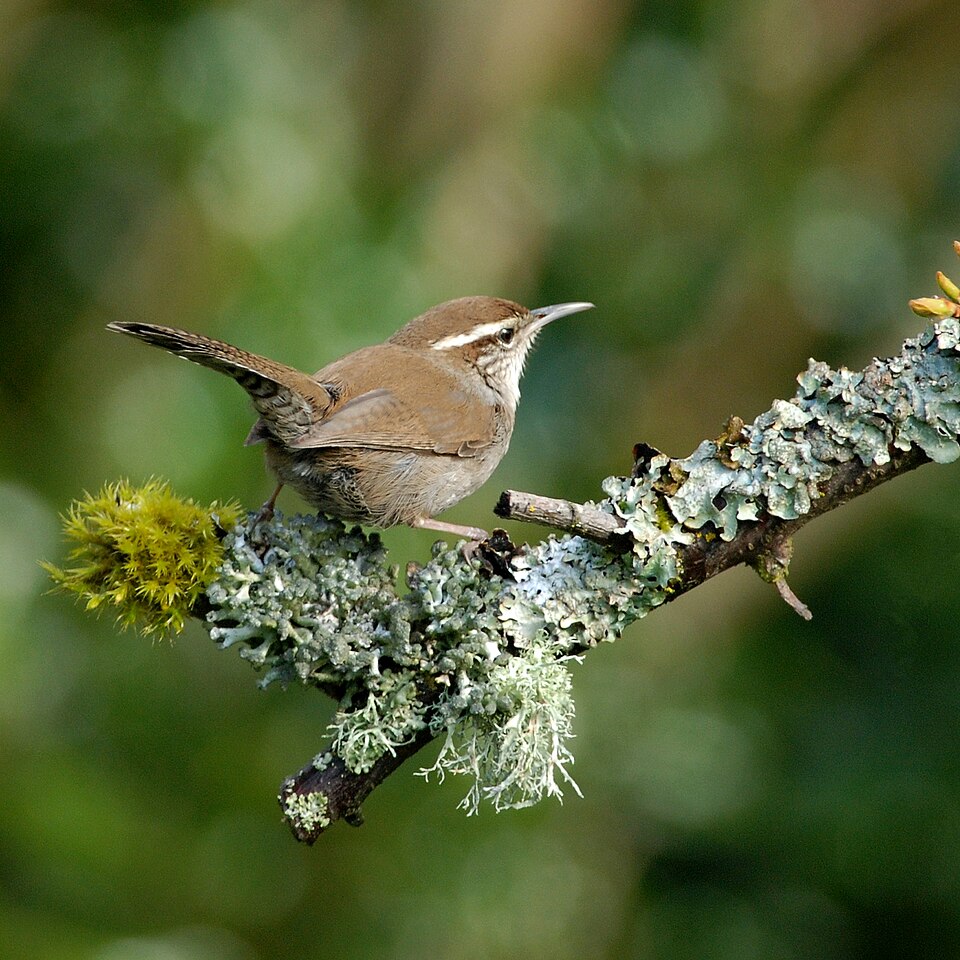
The Bewick's Wren (pronounced "Buick," like the car) is a slim, energetic little bird of brushy country across the western United States and Mexico. What sets it apart from most wrens is its long, expressive tail, which it cocks high over its back and swings from side to side like a slow metronome as it forages. Paired with a bold white stripe over each eye, that constantly flicking tail makes a Bewick's Wren one of the more recognizable small brown birds once you learn the shape.
It is also one of North America's most accomplished songsters. A male can carry a repertoire of a dozen or more distinct songs, learned from neighbors during his first months of life rather than inherited, and he will belt them out from an exposed perch far more readily than the skulking House Wren. Sadly, this is a tale of two populations. West of the Rockies the bird is common and even expanding, but the once-widespread eastern population has collapsed almost to the point of disappearance, largely blamed on competition with House Wrens. For most birders today, Bewick's Wren is a bright, talkative companion of western backyards, chaparral, and desert washes.
Look for a compact, long-tailed wren about the size of a chickadee but slimmer, usually with its tail held upright and in motion. The combination of a striking white eyebrow and a long, white-cornered tail that it flicks sideways is the quickest way to clinch the identification.
| Eyebrow | Bold, clean white stripe over the eye (supercilium) standing out against a plain brownish face, the single best field mark |
| Tail | Long for a wren, often cocked over the back, barred with black and tipped with white spots on the outer corners; frequently swished side to side |
| Upperparts | Plain grayish-brown to rufous-brown, varying by region, with little patterning on the back |
| Underparts | Pale gray to whitish below, clean and unmarked across the breast and belly |
| Bill | Long, thin, and slightly downcurved, typical wren probing bill |
| Size & shape | About 5 inches long, slender, with a noticeably longer tail than the stubbier House Wren |
Male vs. female
Male and female Bewick's Wrens look alike, same white eyebrow, same long barred tail, same plain plumage. There is no reliable way to sex them by sight in the field. Behavior offers the best clue during breeding season: it is the male who sings the loud, full territorial songs from open perches, while the female gives shorter calls and does most of the incubating.
Juveniles
Juvenile Bewick's Wrens resemble adults but look a little duller and softer overall, with slightly fainter face and tail markings and a faintly mottled or freckled breast in the youngest birds. The white eyebrow is present from early on, so even fresh fledglings show that key field mark. They quickly molt into adult-like plumage and become hard to distinguish from their parents by late summer.
The song is loud, musical, and surprisingly varied, often described as recalling a Song Sparrow, beginning with a few clear introductory notes and finishing in a buzzy or musical trill. A typical pattern runs something like "tsee-tsee-tsee-tideeleeeee," two or three sharp opening notes leading into a sweet rolling flourish. Each male knows several different song types and cycles through them, so a single bird can sound like a small chorus.
The everyday call is a sharp, scolding, slightly buzzy "bzzzz" or a dry "jip-jip," often run together into an irritated rattle when the bird is alarmed or scolding a cat, snake, or birder. These scolding notes are frequently the first sign that a Bewick's Wren is working through a brush pile nearby.
Bewick's Wren is largely a bird of the western half of the continent, common from the Pacific Coast and the desert Southwest through Texas and up into parts of the interior West, and south through much of Mexico. In these strongholds it is mostly a year-round resident, with only short-distance or elevational movements; northern and high-elevation birds may drift to lower or milder areas in winter.
The story east of the Mississippi is very different. A century ago Bewick's Wren bred across the Appalachians and the central states, but that eastern population has dwindled dramatically and is now nearly gone from much of its former range. The leading suspect is the expanding House Wren, which destroys the eggs and nests of competitors. Today an eastern sighting is a genuine rarity worth reporting.
Bewick's Wrens are almost entirely insect eaters. They glean beetles, bugs, caterpillars, ants, grasshoppers, spiders, and insect eggs from bark, twigs, foliage, and the ground, methodically probing crevices with that thin bill. You'll often see one creeping along a fence rail, hopping through a tangle of vines, or working over a brush pile with its tail flicking the whole time, much like a tiny feathered detective searching every nook.
In the colder months, when insects are scarce, they will add some seeds, fruit pulp, and other plant matter to the diet. This is also when they are most likely to visit feeders, though they remain primarily insectivores year-round.
Bewick's Wrens are cavity nesters and are wonderfully flexible about real estate. They will use natural tree hollows, old woodpecker holes, crevices in rocks or buildings, and readily accept nest boxes, but they are also famous for picking oddball sites like mailboxes, flowerpots, tin cans, coat pockets on a porch, and the cab of an idle tractor. The male often starts several rough nests, and the female selects and finishes one, lining a bulky cup of twigs, grass, and bark with feathers, moss, and soft material.
A clutch is typically 5 to 7 eggs, white speckled with brown and purple, incubated mostly by the female for roughly two weeks. Both parents feed the nestlings, which leave the nest about two weeks after hatching. In the warmer parts of the range, pairs commonly raise two broods in a season.
Yes, within its western range Bewick's Wren is a delightful and attainable backyard bird, especially if your yard offers cover and nesting spots. It is not primarily a seed-feeder bird, so the path to attracting one is more about habitat than handouts.
- Put up a nest box with a 1- to 1.25-inch entrance hole, mounted 5-10 feet up in or near brushy cover, they take to boxes readily.
- Leave a brush pile, log pile, or untrimmed tangle of shrubs; this is prime foraging and shelter habitat and a wren magnet.
- Plant native shrubs and let some leaf litter accumulate to support the insects and spiders they actually eat.
- Offer suet, mealworms, or peanut bits rather than relying on seed, these match their insect-based diet, especially in winter.
- Avoid pesticides, which wipe out the insect prey their chicks depend on.
- Provide a shallow water source or dripper for drinking and bathing in dry western climates.
- House Wren: Smaller, plainer, with a shorter tail and no bold white eyebrow; faint or absent face stripe and a more uniform brown look.
- Carolina Wren: Chunkier and warmer rufous, with a buffy (not white) underside and a thicker white eyebrow; the dominant brushy wren of the East where Bewick's has vanished.
- Marsh Wren: Has a white eyebrow too, but shows bold black-and-white streaking on the back and is tied to cattail marshes rather than yards and chaparral.
- Rock Wren: Paler and grayer with fine breast streaking and a buff-tipped tail; a bird of rocky slopes that bobs rather than swings its tail sideways.
How do you pronounce Bewick's Wren?
It's pronounced "BYOO-ick," exactly like the Buick automobile. The bird is named after the English engraver Thomas Bewick, a friend of John James Audubon.
What's the difference between a Bewick's Wren and a House Wren?
The easiest tell is the face and tail. A Bewick's Wren has a bold white eyebrow stripe and a long tail it swings side to side with white spots on the corners. A House Wren is plainer, lacks the strong eyebrow, and has a shorter, less conspicuous tail. Bewick's also sings a more musical, Song Sparrow-like song.
Why is the Bewick's Wren disappearing in the eastern U.S.?
The eastern population has crashed over the past century, and the main suspect is the expanding House Wren, which is known to puncture the eggs and destroy the nests of competing cavity nesters. Habitat change has likely added to the decline. West of the Rockies the species remains common and is doing fine.
Will a Bewick's Wren use a nest box or birdhouse?
Yes. They are enthusiastic cavity nesters and readily accept nest boxes with a roughly 1 to 1.25 inch entrance hole, along with all sorts of odd nooks like mailboxes, flowerpots, and sheds. Place a box near brushy cover for the best odds.
What do Bewick's Wrens eat at feeders?
They are mainly insect eaters and aren't big seed-feeder visitors, but they will come to suet, mealworms, and peanut bits, especially in winter. The best way to support them is to provide insect-rich habitat: brush piles, native shrubs, and a pesticide-free yard.