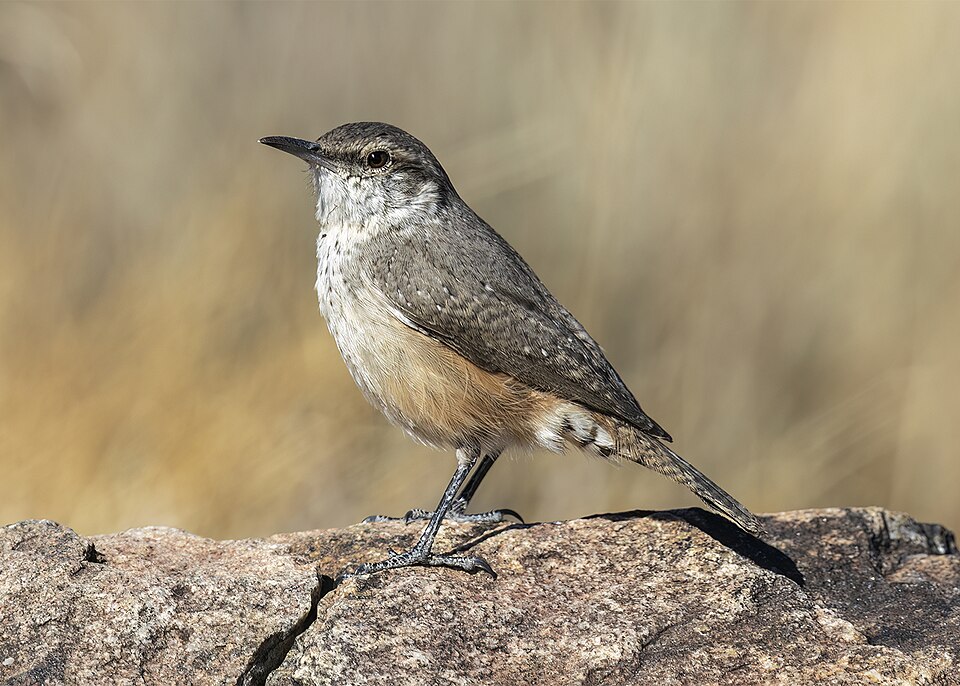
The Rock Wren is a creature of dry, broken ground - a small, pale, ceaselessly busy bird that makes its living scrambling over boulders, talus slopes, road cuts, canyon walls, and rubble-strewn hillsides across the western half of North America. Where other wrens favor brush and tangles, this one chose stone. If you are hiking a sun-baked slope in the Great Basin or the Rockies and a sandy-gray bird pops up onto a rock, dips up and down on its legs as if doing little knee-bends, and then unspools a loud, ringing, repetitive song from an exposed perch, you have almost certainly met Salpinctes obsoletus.
Rock Wrens are easy to overlook because their coloring matches the rock and dust so perfectly, but they have a personality that gives them away. They are curious, vocal, and constantly in motion, probing crevices with a long, slightly decurved bill. The species is also famous for one of the strangest nest-building habits of any North American songbird: it paves a walkway of small flat stones leading to its nest entrance. Birders who have never even seen the bird sometimes recognize the species by these little stone doorsteps tucked into a rock cavity.
This is a medium-small, slender wren with a fairly long, thin, gently downcurved bill and a relatively long tail it often holds level or cocked. Overall it reads as plain and pale - grayish-brown above, dingy white below - which is exactly why a good look at the fine details and the diagnostic behavior matters more than color alone.
| Overall color | Pale, dusty gray-brown above and grayish-white below - a washed-out, sandy bird that blends into rock and bare ground. |
| Fine speckling | Upperparts and breast finely flecked with tiny pale and dark spots; gives a delicately peppered, frosted look up close. |
| Belly and flanks | Lower belly and flanks wash to a soft cinnamon-buff, often the warmest color on the bird. |
| Tail | Buffy to cinnamon outer corners with a dark subterminal band, best seen as it flicks the tail open or in flight. |
| Bill | Long, slim, and slightly downcurved - longer and finer than a House Wren's, built for probing crevices. |
| Behavior | Constant bobbing or 'bouncing' on the legs while perched on a rock - a giveaway even at distance. |
Male vs. female
Males and females look alike. There is no reliable plumage difference you can pick out in the field - both sexes share the same pale, finely speckled gray-brown body, buffy flanks, and banded tail. Behavior offers a hint during breeding season, since the male is the one that sings persistently from prominent perches to defend territory, but the birds themselves are not separable by eye.
Juveniles
Juvenile Rock Wrens resemble adults but are even plainer, with the fine speckling on the breast and back muted or nearly absent, giving them a smoother, more uniform gray-brown appearance. The buffy tones on the belly and tail corners tend to be a bit more washed out, and freshly fledged young may show a slightly shorter tail and looser, fluffier body feathering before their first molt sharpens them up to adult-like plumage.
The song is loud, ringing, and remarkably persistent - a series of repeated phrases, each one usually given several times before the bird switches to a new one, in the classic mimid-like 'repeat-then-change' pattern. People often render it as a buzzy, trilled tu-wee tu-wee tu-wee, chair chair chair, keree keree keree, carrying a metallic or grating quality that bounces off rock faces. A single male may run through a large repertoire of distinct phrases, and the volume is striking for such a small bird in such open country.
The most useful call to learn is the contact note: a sharp, dry, two-syllabled tick-EAR or ji-keep, often described as a bouncing or springy sound, given as the bird hops among rocks. This call is frequently the first clue that a Rock Wren is nearby before you ever spot it.
Rock Wrens breed across much of western North America, from southern British Columbia and the interior Pacific Northwest east to the western Great Plains and south through the Great Basin, Rockies, Southwest deserts, and into Mexico. Wherever there is dry, rocky, sparsely vegetated terrain - lava flows, scree slopes, eroded badlands, canyon rims, quarries, and road cuts - the habitat suits them.
Northern and high-elevation populations are migratory, withdrawing south and downslope for winter into the southwestern U.S. and Mexico, while birds in milder southern parts of the range are largely resident year-round. The species is a famous vagrant as well: individuals turn up far east of the normal range, sometimes reaching the Midwest, the East Coast, and even southern Canada in fall and winter, making it a prized find for birders well outside its core territory.
Rock Wrens are almost entirely insectivorous, gleaning a wide variety of arthropods from rock crevices, bare soil, and low vegetation. The menu includes beetles, ants, grasshoppers, true bugs, flies, caterpillars, and spiders, along with other small invertebrates they can extract from tight cracks. That long, fine bill is the key tool - it lets the bird reach prey deep in fissures that a stubbier-billed bird could never access.
Foraging is an active, ground-and-rock affair. The wren creeps and hops over boulders and through talus, peering into shadows, probing crannies, and occasionally making short sallies after flushed insects. Rock Wrens are notably independent of standing water, apparently getting most or all of the moisture they need from their prey - an adaptation that lets them thrive in arid country where surface water is scarce.
Rock Wrens nest in cavities and crevices among rocks - a natural hole in a cliff or boulder pile, a gap under a slab, an opening in a rock wall, or sometimes a hollow in a bank or man-made structure. Inside, the female builds a cup of grasses, plant fibers, rootlets, and wool or fur, lined with finer material.
The species' signature behavior is the stone pavement: the birds carry and arrange small flat pebbles, and sometimes other debris, to create a 'porch' or paved walkway leading into the nest cavity. A single nest entrance may be fronted by hundreds of carefully placed stones, and the function is still debated - it may help with drainage, signal the nest site, or serve some other purpose. The female lays a clutch of white eggs lightly spotted with reddish-brown and does most or all of the incubation, with both parents feeding the young. In favorable seasons pairs frequently raise two broods.
The Rock Wren is not a backyard or feeder bird in any conventional sense - it will not come to seed, suet, or nectar, and it needs the open, rocky, arid habitat it specializes in. You generally find it by going to it rather than the other way around. That said, if you live in or near its range with the right terrain, you can make a property more appealing to it.
- Provide the habitat, not the handout: rock piles, dry-stacked stone walls, talus, and unmowed rocky slopes are what draw this species - it forages on bare ground and stone, never at feeders.
- Leave a sunny, gravelly, sparsely vegetated area rather than tidy lawn; Rock Wrens favor open ground with exposed rock and minimal dense cover.
- Skip pesticides - the bird depends entirely on insects and spiders, so a healthy bug population is the real attractant.
- If your land borders natural rocky terrain, simply protecting that habitat from clearing or development does more than any feeder ever could.
- Listen and look on hot, exposed slopes during breeding season - learning the bouncing tick-EAR call is the most reliable way to find them.
- Water is rarely needed since they get moisture from prey, so don't count on a birdbath to lure them in.
- Canyon Wren: Shares rocky habitat but has a bright rusty body, contrasting clean white throat and breast, and a longer bill; its cascading, descending whistled song is unmistakable and very different from the Rock Wren's repetitive phrases.
- House Wren: Warmer brown, plainer-faced, shorter and straighter bill, and prefers brushy, wooded, or garden habitat rather than open rock; lacks the buffy tail corners and the persistent bobbing on rocks.
- Bewick's Wren: Has a bold white eyebrow stripe and a long tail edged with white spots that it waves side to side; favors brush and scrub rather than bare talus, and is browner overall without the dusty, speckled paleness.
- Cactus Wren: Much larger and boldly marked with heavy spotting and a strong white eyebrow; lives in desert scrub and cactus rather than open rock, and gives a low, chugging churr unlike the Rock Wren's ringing song.
Why does the Rock Wren bob up and down?
It frequently does little 'knee-bend' bobs while perched on rocks, a habitual movement common in the species. Ornithologists aren't certain of the exact purpose - it may help judge distances, signal alertness to predators or rivals, or simply be a fixed display - but it's one of the most reliable behavioral clues for identifying the bird at a distance.
What is the stone walkway in front of a Rock Wren nest?
Rock Wrens famously pave the entrance to their nest cavity with hundreds of small flat stones and bits of debris, forming a little porch or path. The reason is still debated - possibilities include drainage, marking the entrance, or deterring something - but the stone doorstep is so distinctive that birders sometimes recognize an active nest by it even without seeing the bird.
Do Rock Wrens need to drink water?
Remarkably, they appear to need little or no standing water. They get most of their moisture from the insects and spiders they eat, which is part of how they thrive in hot, arid, rocky country where surface water is often absent. Putting out a birdbath is unlikely to attract them.
Will a Rock Wren come to my bird feeder?
No. Rock Wrens are insectivores that forage over rock and bare ground, and they don't visit seed, suet, or nectar feeders. The way to enjoy them is to seek out their habitat - dry, rocky slopes, canyons, road cuts, and talus - rather than waiting for them at a feeder.
How do I tell a Rock Wren from a Canyon Wren?
Both live among rocks, but the Canyon Wren is rusty-bodied with a striking clean white throat and breast and sings a famous cascading series of descending whistles. The Rock Wren is pale, dusty gray-brown with fine speckling and buffy tail corners, bobs on its legs, and sings loud, repeated phrases. Color and song separate them quickly.