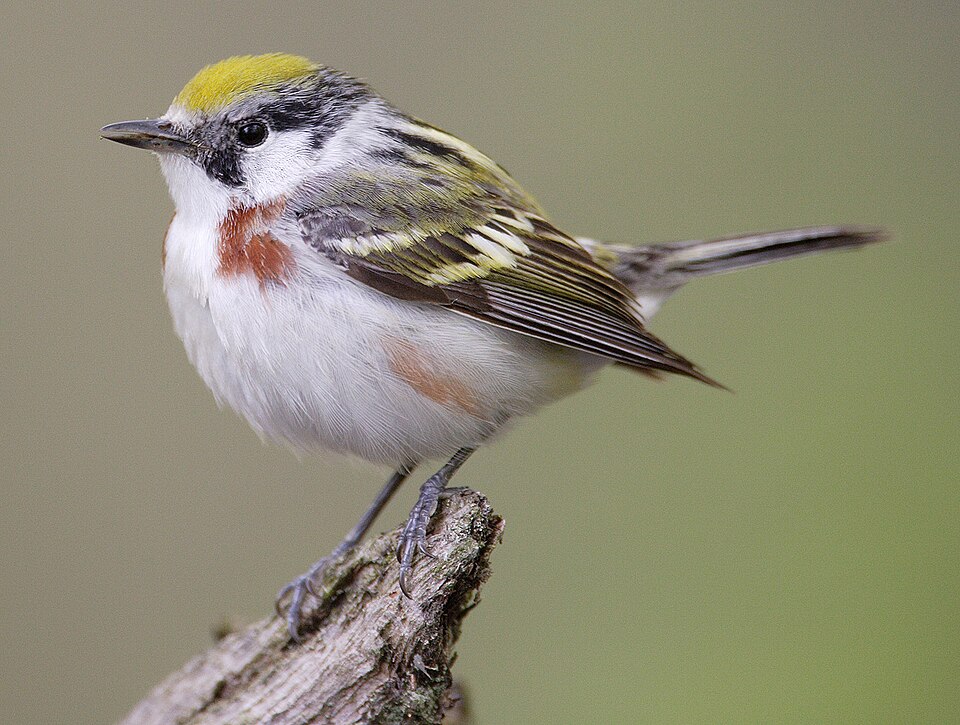
The Chestnut-sided Warbler is one of the most rewarding small songbirds of eastern North America's second-growth woodlands. In breeding plumage the male is unmistakable: a lemon-yellow cap, bold black "spectacles" and whisker marks on a clean white face, and a stripe of rich chestnut running down each flank. Add to that an eager, whistled song that birders famously translate as "pleased, pleased, pleased to MEETcha," and you have a warbler that practically introduces itself.
This is a bird that has actually benefited from human disturbance. It thrives in young, shrubby habitat, abandoned farm fields growing back into woods, recent clearcuts, powerline cuts, and brushy forest edges. When the eastern forests were largely cleared and then began regrowing, Chestnut-sided Warblers became far more common than they likely were in pre-colonial times. Today they are a familiar and welcome sight to anyone willing to scan the thickets at the edge of a regenerating woodland in late spring.
A small, slender, active warbler that often forages with its tail cocked slightly upward and its wings drooped, giving it a distinctive jaunty posture. Breeding adults are among the easiest warblers to name on sight; fall birds are far more subtle and require a closer look.
| Crown | Bright yellow-green cap in breeding plumage; lime-green and unmarked in fall |
| Flanks | Distinctive chestnut stripe down the sides of breeding adults (boldest on males) |
| Face | Clean white cheeks with a black eyeline and black moustachial mark in spring |
| Underparts | Bright white below in spring; clean grayish-white in fall, never streaked |
| Wings | Two yellowish wingbars in all plumages |
| Posture | Tail often cocked up, wings drooped; busy, energetic forager at eye to mid level |
Male vs. female
In breeding plumage the sexes look similar but differ in intensity. The male shows a brighter yellow crown, a bolder and more complete black mask and moustache, and a wider, more saturated chestnut flank stripe that can extend well down the side. Females are a touch duller overall, with a thinner, often shorter chestnut stripe and a less crisply defined black face pattern. The difference is real but can be subtle, and a dull male and a bright female can overlap, context and song usually settle it in the field.
Juveniles
Fall immatures and adults are strikingly different from the spring bird and account for the species' nickname potential for confusion. They are clean lime-green above with an unmarked greenish cap, a bold white eye-ring, plain gray-white underparts, and two yellow wingbars. Many lack chestnut entirely, though some retain a hint of it on the flanks. The combination of green upperparts, white eye-ring, and an absence of streaking below, plus that habitual cocked-tail posture, is the key to naming these otherwise plain "confusing fall warblers."
The classic song is a cheerful, accented whistle that rises and then snaps off at the end, most often remembered as "pleased, pleased, pleased to MEETcha." It is sweet, emphatic, and ends on a sharp, down-slurred flourish. This "accented-ending" song is given by males advertising and defending territory.
Chestnut-sided Warblers also sing a second, "unaccented" song, a similar series of notes but without the strong terminal accent, often used in interactions with other males near territory boundaries or later in the season. The common call note is a sweet, slightly musical chip or tsip, and migrants give a high, thin flight note. Learning the accented song is the fastest way to find this bird, which is far more often heard than seen in dense cover.
Chestnut-sided Warblers breed across southern Canada and the northeastern and north-central United States, from the Maritimes and New England west through the Great Lakes states and southern Ontario, and southward down the Appalachian Mountains into Georgia at higher elevations. They favor early-successional habitat throughout this range.
They are long-distance migrants, wintering in Central America from southern Mexico to Panama, where they often join mixed-species foraging flocks in the canopy and forest edge. Spring migration brings them north mainly in late April and through May, and they head south again from August into October. During migration they turn up well outside the breeding range, including across the eastern and central states, making spring a prime time to catch the brilliant breeding male before he disappears into the thickets.
This is an insect specialist. Chestnut-sided Warblers feed heavily on caterpillars, beetles, moths, leafhoppers, flies, and other small arthropods, along with spiders. They are active, restless foragers, gleaning prey from the undersides of leaves and the tips of branches in shrubs and small trees, frequently flicking out to hover-glean or sally after a flushed insect.
On their tropical wintering grounds they continue to eat insects but also take small fruits and berries, and they readily join the roving mixed flocks that move through Central American forests. In all seasons they tend to work the outer foliage at low to middle heights rather than the high canopy.
Chestnut-sided Warblers nest low in shrubs, briar tangles, or saplings, typically just a few feet off the ground in dense, brushy cover. The female builds a fairly loose, cup-shaped nest of bark strips, plant fibers, grasses, and weed stems, often bound with plant down and spider silk and lined with finer material and animal hair.
A typical clutch is 3 to 4 creamy or greenish-white eggs spotted with brown, and the female does most of the incubating for roughly 11 to 12 days. Both parents feed the nestlings, which leave the nest after about 10 to 12 days. Most pairs raise a single brood per season. Like many open-cup nesters in edge habitat, they are frequent hosts to Brown-headed Cowbird parasitism.
The Chestnut-sided Warbler is not a feeder bird, it eats insects, not seed or suet, so you won't lure it with a typical backyard setup. But you can attract it during migration and, if you live near suitable habitat, even in the breeding season, by offering the kind of brushy, insect-rich cover it depends on.
- Leave a brushy edge. A messy, shrubby border of native saplings, blackberry, and dense thickets mimics the early-successional habitat this species loves.
- Plant native shrubs and trees. Natives host far more caterpillars and insects than ornamentals, providing the foraging buffet warblers need.
- Skip the pesticides. Insecticides wipe out the caterpillars and small bugs that are this bird's entire diet.
- Add a moving water feature. A dripper, mister, or shallow bubbling bath is one of the few things that reliably draws migrating warblers into a yard.
- Watch in May. Spring migration is your best window, check shrubby edges and the outer leaves of small trees for that cocked-tail, yellow-capped flash.
- Yellow Warbler: Overall bright yellow with reddish breast streaks (males); lacks the chestnut flanks and white face. Fall birds are uniformly yellowish, unlike the green-above, white-below fall Chestnut-sided.
- Bay-breasted Warbler: Breeding males show chestnut on the crown, throat, and flanks with a dark face, not the clean white cheeks and yellow cap of the Chestnut-sided. Confusing fall birds differ in their buffy undertail and dingier flanks.
- American Redstart: Shares the active, tail-fanning energy of brushy edges, but adult males are black with orange patches and females gray-and-yellow, no chestnut sides or yellow cap.
- Magnolia Warbler: Also a yellow-and-black edge warbler, but shows a yellow throat and breast with heavy black streaking and a broad white tail band, very different from the white-bellied, chestnut-flanked Chestnut-sided.
What does a Chestnut-sided Warbler's song sound like?
The classic song is a bright, whistled phrase often remembered as "pleased, pleased, pleased to MEETcha," rising through several notes and ending on a sharp, accented, down-slurred flourish. Males also sing a similar but unaccented version near territory boundaries.
Where do Chestnut-sided Warblers live?
They breed in young, brushy second-growth woods, regenerating clearcuts, powerline cuts, and shrubby forest edges across southern Canada, the northeastern and north-central U.S., and the southern Appalachians. In winter they move to Central America from southern Mexico to Panama.
Will Chestnut-sided Warblers come to a bird feeder?
No. They are insect eaters and don't take seed or suet, so a standard feeder won't attract them. Your best bet is brushy native habitat, no pesticides, and a moving water feature, especially during spring migration.
How do you identify a Chestnut-sided Warbler in fall?
Fall birds look completely different from the spring male: lime-green above, clean gray-white below with no streaking, a bold white eye-ring, two yellow wingbars, and often no chestnut at all. Their habit of cocking the tail and drooping the wings is a helpful clue.
How do you tell a male from a female Chestnut-sided Warbler?
In breeding plumage both sexes look similar, but the male has a brighter yellow cap, a bolder black face mask and moustache, and a wider, deeper chestnut flank stripe. Females are slightly duller with a thinner chestnut stripe and softer face markings.
Are Chestnut-sided Warblers rare or declining?
They are common and listed as Least Concern. In fact, they expanded historically as eastern forests were cleared and regrew into the brushy habitat they prefer. Local numbers can dip where young second-growth matures into closed forest and that early-successional habitat disappears.