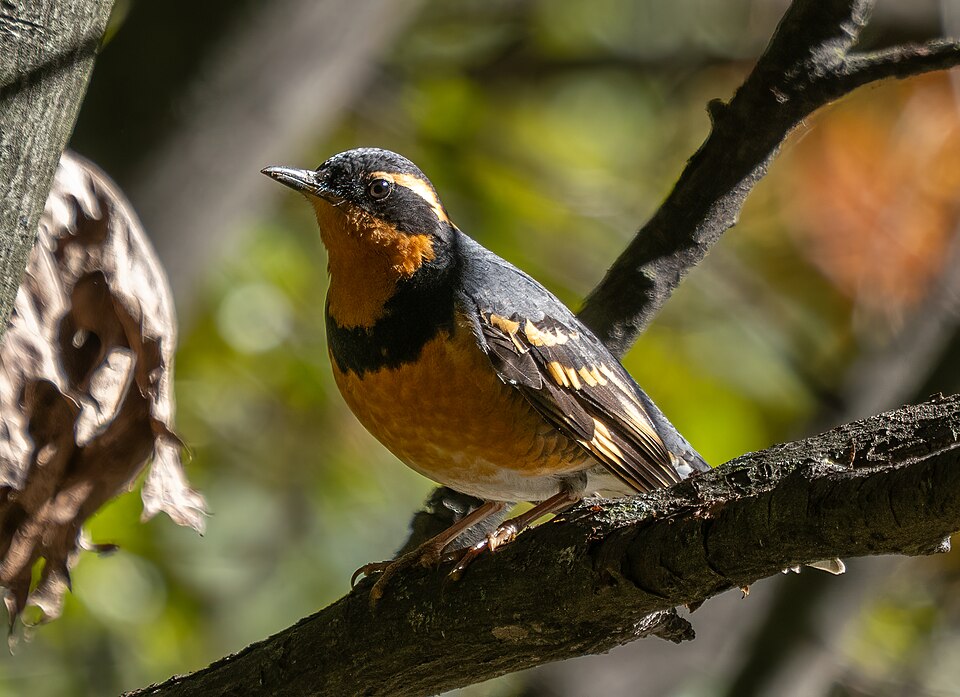
The Varied Thrush is one of the most striking and mysterious songbirds of the Pacific Northwest. At first glance it looks like an American Robin that has been splashed with bolder paint: the same upright posture and rounded body, but with a burnt-orange breast crossed by a dark band, orange eyebrows, and slashes of orange in the wings. It is a bird of cool, damp, mossy conifer forests, where it spends much of its time foraging quietly in the shadows. Many people hear its strange, otherworldly song long before they ever lay eyes on the bird itself.
Found from Alaska down through British Columbia and into the coastal ranges of the western United States, the Varied Thrush is the only member of its genus, Ixoreus. It matters to birders not just for its beauty but for its sensitivity to old, intact forest. Where dense, mature woods give way to clear-cuts and development, Varied Thrushes tend to thin out, making them a quiet indicator of forest health. In winter, hard weather sometimes pushes them down to lower elevations and into backyards, giving lucky birders a rare close look at a creature that usually keeps to the gloom.
Think of a robin's silhouette, then add bold patterning. The Varied Thrush is a stocky, medium-sized thrush with a relatively short tail, a fairly large rounded head, and a straight, sturdy bill. It often perches upright and hops on the ground much like a robin, but its plumage pattern is unmistakable once you see it well.
| Breast band | A dark band (black in males, grayer in females) crosses the orange breast, the single best field mark |
| Orange eyebrow | A bright orange stripe runs back over the eye, set against a darker face |
| Wing pattern | Two orange wingbars plus orange edging create bold bars on otherwise dark wings |
| Underparts | Rich orange throat and breast fading to whitish belly and undertail |
| Upperparts | Slate-blue to bluish-gray (males) or browner gray (females) back and crown |
| Size & shape | Robin-like but slightly smaller and stockier, with a shorter tail and rounder head |
Male vs. female
Males and females share the same overall pattern, so the sexes can look alike at a glance, but the contrast tells them apart. Adult males are crisp and bold: their upperparts are a clean slate-blue gray, the breast band is solid sooty black, and the orange tones are deep and saturated. Females and immatures are softer versions of the same design, the back is more brownish-gray, the breast band is fainter and grayish rather than black, and the orange is paler and more muted. With a good look, a sharp black chest band marks a male, while a washed-out gray band marks a female.
Juveniles
Juvenile Varied Thrushes resemble dull, scaly females. They show the basic orange-and-dark pattern but with a streaked or mottled, scalloped look on the breast and flanks, and the breast band is indistinct or broken rather than clean. The orange eyebrow and wingbars are present but subdued. As young birds molt into their first winter, they gradually take on the smoother, more clearly banded look of adults, with young males beginning to show darker, more defined chest bands.
The song is the most memorable thing about this bird, eerie, mechanical, and unlike almost any other North American songbird. A male delivers a single, long, quavering whistle on one pitch, holds it for a couple of seconds, then pauses and repeats it on a different pitch. The effect is a slow series of buzzy, ringing, slightly trembling notes that seem to float through the misty forest, often described as ventriloquial because it is hard to pin down the source. Many listeners compare it to a tuning fork, a distant referee's whistle, or a faintly electric hum.
Call notes are simpler. Birds give a soft, low chup or tup, and a thin, dry liquid note when alarmed or keeping contact. The unearthly, single-note song is by far the easiest way to detect a Varied Thrush in spring and early summer, when males sing from high perches in the conifers.
The Varied Thrush breeds across the moist coniferous forests of the Pacific Northwest, from Alaska and the Yukon south through British Columbia and into Washington, Oregon, northern California, and the northern Rocky Mountain edges of Idaho and Montana. It favors dense, mature, often old-growth or moss-draped forest, especially near water and in cool, shaded ravines.
In winter, many birds move downslope and southward, spreading through lowland forests, parks, and gardens along the West Coast as far as southern California. Numbers in winter can vary a lot from year to year depending on weather and food. In years of heavy snow or poor cone and berry crops farther north, Varied Thrushes can show up well outside their normal range, vagrants have turned up across the central and eastern United States, making the species a prized find for birders far from the Pacific.
Varied Thrushes are ground foragers for much of the year, hopping through leaf litter and damp forest floor and using their bill to flip aside leaves and probe the soil. In the breeding season they eat mostly invertebrates, beetles, ants, caterpillars, millipedes, sowbugs, earthworms, and other small creatures hidden in the moss and litter. This protein-rich diet fuels nesting and growing chicks.
In fall and winter the diet shifts heavily toward plant matter, especially berries and fruits such as snowberry, madrone, dogwood, mistletoe, and various wild and ornamental berries, along with acorns and seeds. This seasonal switch is part of why hard winters can push them into yards, where fallen fruit and food beneath feeders draw them out of the deep woods.
Nesting takes place in the cool conifer forest, usually with the nest placed on a horizontal branch against the trunk of a small to medium conifer, often several to a couple of dozen feet off the ground. The female builds a bulky open cup of twigs, moss, and bark strips, lining the inner cup with rotten wood, fine grass, and softer material, and often weaving in green moss on the outside that helps it blend into the mossy surroundings.
The female lays a clutch of pale blue eggs lightly speckled with brown and incubates them herself for roughly two weeks. Both parents then feed the nestlings, which leave the nest after another couple of weeks. Pairs may raise more than one brood in a season where conditions allow. Throughout nesting the birds are secretive and quiet around the nest, slipping in and out low through the understory rather than drawing attention.
The Varied Thrush is not a typical feeder bird, but it can become a memorable backyard visitor in winter, especially during cold snaps in or near its Pacific Northwest range. It rarely uses hanging feeders or tube feeders; instead it forages on the ground, so the trick is offering the right food at the right level in the right habitat.
- Scatter seed and cracked corn directly on the ground or on a low platform, these are ground foragers that ignore hanging feeders
- Offer fruit and berries: leave fallen apples, raisins, or chopped fruit, and plant native berry shrubs like snowberry, dogwood, and madrone
- Keep a section of leaf litter and natural mulch in shaded parts of the yard so they can flip leaves for insects
- Provide fresh, low water in a ground-level birdbath, especially during freezing weather
- Time your efforts for winter cold spells, when birds move downslope and are most likely to appear in yards
- Maintain shrubby cover and conifers near feeding areas, these shy birds want a quick escape route nearby
- American Robin: Similar size, posture, and orange breast, but a robin has a plain orange breast with no dark band, no orange eyebrow, and no orange wingbars.
- Spotted Towhee: Also dark above with rufous and ground-foraging habits, but towhees have red eyes, white wing and tail spots, and lack the orange breast band and eyebrow.
- Black-headed Grosbeak: Shares orange-and-black tones, but grosbeaks have a massive pale conical bill and lack the thrush's slim straight bill and breast band.
What bird looks like a robin but has a black band across its chest?
That is almost certainly a Varied Thrush. It shares the robin's shape and orange breast but adds a dark band across the chest, an orange eyebrow stripe, and orange bars in the wings. It is a Pacific Northwest forest bird that sometimes visits yards in winter.
What does a Varied Thrush sound like?
Its song is a single, long, eerie, quavering whistle held on one pitch, then repeated on a different pitch after a pause. People often compare it to a tuning fork, a faint referee's whistle, or a distant electric hum drifting through the forest.
Where do Varied Thrushes live?
They breed in cool, damp, mossy conifer forests from Alaska and British Columbia south through Washington, Oregon, and into northern California and the northern Rockies. In winter many move downslope and southward into lowland woods, parks, and gardens along the West Coast.
Will Varied Thrushes come to a bird feeder?
They rarely use hanging or tube feeders, but they will visit yards in winter to forage on the ground. Scattering seed or cracked corn on the ground, offering fruit, and planting native berry shrubs gives you the best chance, especially during cold snaps.
How do you tell a male Varied Thrush from a female?
Both sexes share the same pattern, but males are bolder, clean slate-gray above with a solid black breast band and deep orange tones. Females and young birds are browner gray with a fainter, grayish breast band and paler orange.