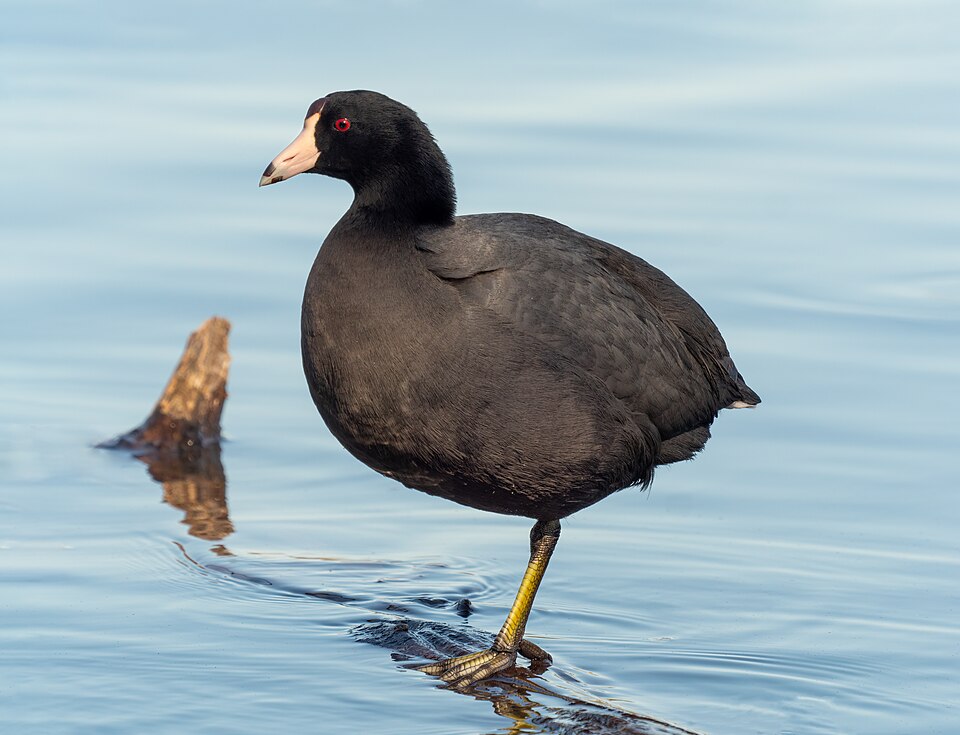
The American Coot is one of those birds that fools people every day. It swims on ponds and marshes alongside ducks, looks roughly duck-shaped from a distance, and paddles around in big rafts on open water. But it isn't a duck at all. It belongs to the rail family, and once you look closely the differences jump out: a plump, dark slate-gray body, a coal-black head, a bright chalky-white bill, and a pair of glowing red eyes. Coots are common, loud, and endlessly entertaining to watch, which makes them a favorite of beginning birders learning to look past the obvious.
Coots are found across much of North America on almost any open freshwater with some marshy edge, from city park ponds to vast prairie wetlands. They are abundant and adaptable, and in winter they gather in flocks that can number in the thousands. Their most surprising feature is hidden underwater: instead of webbed feet like a duck, coots have long greenish-yellow toes edged with broad, scalloped lobes of skin. Those lobed feet let them swim strongly, dive for food, and walk across mudflats and lawns with equal ease.
Look for a chunky, rounded waterbird that rides fairly high in the water and constantly pumps its head back and forth as it swims. The body is uniformly dark and the bright white bill stands out sharply against the black head, like a headlight. In flight, coots look ungainly, with feet trailing well past the short tail.
| Body | Plump and rounded, uniformly slate-gray to charcoal, slightly darker on the head and neck |
| Bill | Short, thick, and chalky white with a faint dark ring near the tip and a reddish-brown frontal shield above |
| Eyes | Deep red, often glowing in good light |
| Feet | Long greenish-yellow toes with broad scalloped lobes - not webbed like a duck |
| Undertail | Two white patches flash under the tail, especially obvious when the bird is agitated or displaying |
| Size | Smaller than most ducks, about the size of a small Mallard but rounder and shorter-necked |
Male vs. female
Males and females look essentially identical in the field. Both sexes share the slate body, black head, white bill, red frontal shield, and red eyes. Males average slightly larger and may show a marginally bigger frontal shield, but this is not reliable for telling individuals apart in the wild. The best clue to a pair is behavior during the breeding season, when a male and female defend a territory and tend a nest together.
Juveniles
Young coots look very different from adults and can be confusing. Newly hatched chicks are downy black with startlingly bright orange-red heads, bare reddish skin, and orange-tipped bills - one of the more bizarre-looking babies in the bird world. As they grow, juveniles become a pale, washed-out gray with a dull whitish bill, a duller eye, and an overall scruffy appearance. They gradually darken over their first fall and winter to match the clean slate-and-white look of adults.
Coots are noisy, and a marsh full of them is a constant babble of grunts, croaks, and clucks. They don't have a true musical song; instead they produce a wide variety of harsh, often comical calls. Common sounds include a sharp puhlk, a grating kuk-kuk-kuk, low croaking grunts, and high squeaky notes. Males and females have somewhat different voices, with males giving more of the higher, squeakier calls and females the lower clucking notes.
The volume picks up during squabbles, which are frequent. When two coots clash over space or food they erupt in a chorus of agitated clucks and splashing. At night on a winter pond, a flock can keep up a surprising amount of grunting chatter.
American Coots breed across much of the United States and Canada, with a stronghold in the freshwater marshes of the prairie pothole region and the western interior. They also breed in parts of Mexico and Central America. In the warmer southern and coastal parts of their range, including much of the southern U.S. and the Pacific coast, many coots are year-round residents.
Birds that breed in the colder northern interior migrate south for winter, often moving at night. Wintering flocks concentrate on lakes, reservoirs, coastal bays, and southern wetlands, sometimes gathering by the thousands. They are among the most numerous waterbirds on many lakes from fall through early spring.
Coots are mainly vegetarian, feeding heavily on aquatic plants such as pondweeds, algae, duckweed, and the leaves and seeds of many marsh plants. They are versatile foragers: they tip up like dabbling ducks, dive and swim underwater to reach submerged vegetation, graze on lawns and shorelines, and pick at the surface. They also eat insects, snails, small crustaceans, tadpoles, and the occasional small fish or eggs, especially during the breeding season when they need protein.
On land, flocks of coots often walk up onto golf courses, park lawns, and athletic fields to graze on grass, which is a familiar and sometimes unwelcome sight to groundskeepers. Coots are also notorious food thieves, frequently chasing and harassing diving ducks to steal the plants they bring up.
Coots nest in dense marsh vegetation over shallow water. Both members of a pair build a floating platform of dead cattails, reeds, and other plant stems, often anchored to standing vegetation and sometimes with a ramp leading down to the water. They may build several platforms, using some for nesting and others as resting or brooding sites.
The female typically lays a large clutch of buff eggs speckled with dark spots, and both parents share incubation. Chicks are precocial - they can swim and leave the nest within a day or two of hatching - but the parents continue to feed and guard them for weeks. Coots are known for elaborate parental behavior, including feeding favored chicks and producing more than one brood in a season where the climate allows.
The American Coot is a waterbird, not a feeder or backyard bird, so you won't attract it to a seed feeder or nest box. But if you have access to a pond, lake, or marsh, there are ways to enjoy them and even encourage their presence on suitable water.
- Coots need open freshwater with marshy edges - a pond or lake bordered by cattails, reeds, or other emergent plants is ideal habitat.
- If you manage a pond, leaving native aquatic and shoreline vegetation in place gives coots both food and nesting cover.
- Visit local lakes, reservoirs, and wetlands in fall and winter, when large rafts of coots gather and are easy to watch.
- They sometimes graze on lawns and grassy banks near water, so check shorelines and park edges, not just the open water.
- Avoid feeding them bread - it's poor nutrition; coots forage perfectly well on natural plants and you'll see more natural behavior by simply watching.
- Common Gallinule: A close relative with a red bill and frontal shield (not white) and a white side stripe along the flank; prefers more vegetated marsh edges.
- Pied-billed Grebe: Smaller and browner with a stubby pale bill that has a dark band; rides lower in the water and dives constantly rather than dabbling.
- Mallard: A true duck with a flat bill and webbed feet; females are mottled brown, not slate-gray, and ducks don't pump their heads while swimming.
- Ruddy Duck: A small diving duck with a stiff tail often cocked upward and a blue bill on breeding males; lacks the coot's white bill and black head.
Is an American Coot a duck?
No. Despite swimming with ducks and looking duck-like, the coot is a member of the rail family. The giveaway is its lobed feet (not webbed), its chunky white bill, and the way it pumps its head back and forth as it swims.
Why do coots have such strange feet?
Instead of webbing, coots have long toes lined with broad, scalloped lobes of skin. These lobes fold back on the forward stroke and spread out on the backstroke, giving good propulsion for swimming and diving while still letting the bird walk easily on mud and grass.
Can American Coots fly?
Yes, though they look clumsy doing it. Coots need a long running takeoff, pattering across the water surface before getting airborne. Once up, they are strong fliers and migrate long distances at night, but on the water they often prefer to swim or dive away from danger.
What do baby coots look like?
Coot chicks are striking and a little bizarre - black downy bodies with bright orange-red heads, bare reddish skin around the face, and orange-tipped bills. They look nothing like the gray adults and become a pale, scruffy gray before darkening over their first months.
Why are coots gathering in huge flocks on the lake?
In fall and winter, migrating and resident coots concentrate on open lakes, reservoirs, and bays where food is abundant. These winter rafts can number in the thousands and provide safety in numbers, though the birds still squabble noisily over space and food.