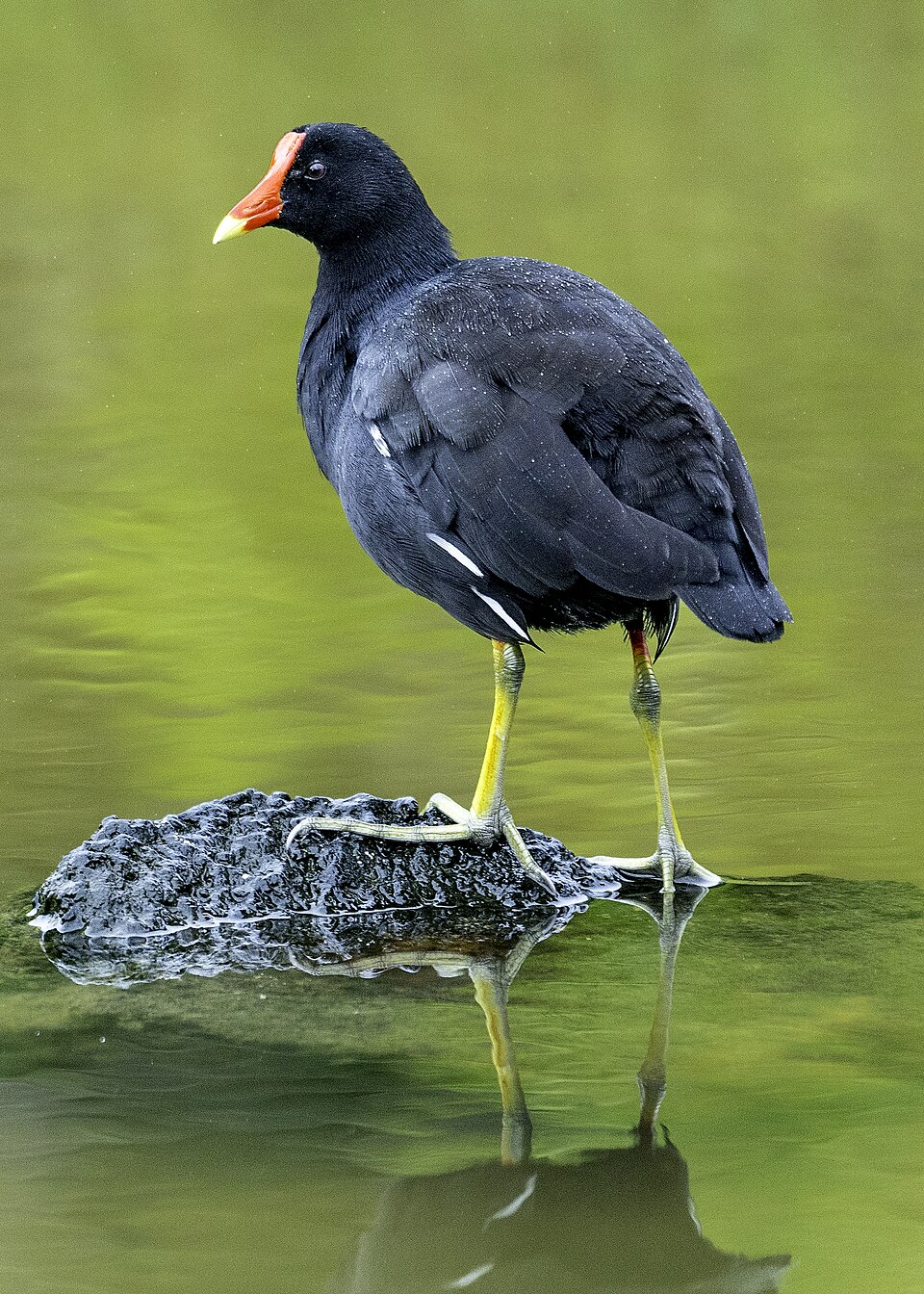
The Common Gallinule is a chicken-sized marsh bird that looks like someone dipped a slate-gray waterfowl's bill in fresh paint. That candy-red bill, tipped in yellow and topped by a bright red forehead shield, is the giveaway. Spend a few minutes at the edge of any cattail-fringed pond, lake, or slow river across the eastern and southern United States, and you stand a good chance of watching one pick its way along the water's edge, tail flicking with every nervous step. Until 2011 it was lumped with the Old World Moorhen under the name "Common Moorhen," and many older field guides still call it that.
It belongs to the rail family (Rallidae), the same group as coots, soras, and the secretive rails of the reedbeds. Unlike its shy rail cousins, the gallinule is relatively bold and easy to see, swimming in the open with a head-bobbing, jerky motion or clambering through emergent vegetation on long, unwebbed green toes. Those oversized feet let it walk across floating mats of weed and lily pads almost as easily as it swims, making it one of the most entertaining birds to watch on a quiet wetland.
Look for a plump, hen-shaped waterbird about the size of a small chicken, with a short cocked tail, a rounded body, and a small head it pumps back and forth as it swims. The overall impression is dark and sooty, but good light reveals real color and a face you cannot mistake for anything else on the pond.
| Bill & shield | Bright red bill with a yellow tip, topped by a red frontal shield on the forehead, the single best field mark |
| Body color | Slate gray to charcoal on the head, neck, and underparts, fading to a warmer brownish-olive on the back and wings |
| Flank stripe | A ragged line of white feathers along each flank, visible as a broken white streak when swimming |
| Undertail | White outer undertail coverts split by a black center; flashed conspicuously as the tail flicks up |
| Legs & feet | Long yellow-green legs with very long, unwebbed toes and a red 'garter' at the top of the leg |
| Size & shape | Chicken-sized, round-bodied, short-tailed; swims with a pumping head motion unlike a duck |
Male vs. female
Males and females look alike, so you cannot reliably sex a gallinule in the field by plumage. Both sexes wear the same slate body, red bill, and red shield. On average males are slightly larger and may show a marginally bigger frontal shield, but the overlap is so great that this is not a usable field distinction. Behavior during the breeding season, territorial calling, displaying, and which bird does most of the nest-building, is a better clue than appearance.
Juveniles
Juveniles are much drabber and easily confused with other marsh birds. They are dull grayish-brown overall, palest on the throat and belly, and crucially they lack the adult's red bill and shield, the bill is a dull olive-brown or grayish. They keep the white flank line and the split white undertail, which are useful for placing them as gallinules rather than young coots. Downy chicks are sooty black with a sparse fuzz of reddish bristles on the head and a tiny reddish bill, looking almost like little black puffballs as they trail after a parent.
The Common Gallinule is far more often heard than its skulking habits would suggest, and the voice is loud, varied, and frankly comical. The signature sound is an explosive, laughing series, a hard, complaining kek-kek-kek or a yelping kruk-kruk-kruk that often runs downhill and trails off into clucks. Birds also give sharp single kik or kup notes, drawn-out screeches, and a strange churring chatter.
Much of the racket comes from territorial disputes and pair contact among dense vegetation, so you will frequently hear an unseen bird scolding from the reeds. The overall effect is hen-like and slightly hysterical, once you learn it, that cackling laugh becomes a reliable way to detect gallinules on a marsh even when none are in view.
In North America the Common Gallinule breeds across the eastern and central United States, concentrated in freshwater marshes from the Great Lakes and the Northeast south through the Mississippi Valley to the Gulf Coast, and is a year-round resident across Florida, the Gulf states, much of the desert Southwest's wetlands, and coastal California. Beyond the U.S. it ranges widely through Mexico, Central America, the Caribbean, and into South America, where southern populations are also resident.
Northern breeders are migratory, pulling out of the inland marshes in fall and wintering in the southern states, the Gulf and Atlantic coasts, and farther south. Migration is largely nocturnal and inconspicuous; you are much more likely to simply notice that the local birds have arrived in spring or vanished by late fall than to see them on the move.
Common Gallinules are omnivorous and opportunistic. The bulk of the diet is plant matter, the leaves, stems, seeds, and fruits of aquatic and marsh plants such as pondweeds, sedges, smartweeds, and algae, supplemented by a good deal of animal food including aquatic insects and their larvae, snails, worms, small crustaceans, and the occasional tadpole or spider.
They forage by walking along the water's edge and across floating vegetation, swimming in the open while pecking at the surface, and tipping up or making short shallow dips for submerged food. Those long toes are key: they let the bird spread its weight over lily pads and weed mats to reach food a heavier bird could not. Gallinules are not deep divers like coots; they feed at or near the surface and along shorelines rather than working open water.
Nesting is tied to dense emergent vegetation, cattails, bulrushes, sedges, and reeds standing in shallow water. The nest is a bulky shallow bowl of woven dead plant stems and leaves, built in the marsh either anchored in vegetation just above the waterline or sometimes on a low platform; pairs often add a ramp of bent-down stems leading up to it. Both members of the pair build, incubate, and care for the young.
Clutches are large for a marsh bird, and gallinules raise more than one brood in a season where the climate allows. The chicks are precocial, covered in down and able to leave the nest and swim within a day or two of hatching, but they depend on the parents for food and protection for weeks. In a charming twist, chicks from an earlier brood often help feed and tend the younger siblings of a later brood, a cooperative behavior unusual among waterbirds.
The Common Gallinule is not a backyard or feeder bird in any practical sense, it is a wetland specialist that needs standing fresh water and thick marsh vegetation, not a lawn or a seed tray. You will not lure one to a suburban yard with a feeder. That said, there are real ways to encounter and even host them if you have the right habitat or access to it.
- Visit the right habitat: cattail- and bulrush-fringed freshwater ponds, marshes, slow rivers, and lake edges are where gallinules live, local wildlife refuges and wetland preserves are your best bet.
- Look at the vegetated margins, not open water. Scan where reeds meet the surface and watch for the tail-flicking walk along floating weed mats.
- If you own or manage a pond, preserve native emergent vegetation like cattails and sedges around the shoreline rather than clearing it to bare water, that cover is what they need.
- Keep at least part of any pond edge shallow and gently sloped so birds can walk and forage along it.
- Go early or late. Gallinules are most active and most vocal in the cooler hours, when their cackling calls give them away even before you spot one.
- Avoid stocking heavily and disturbing the shoreline; low human and predator pressure makes a marsh far more attractive to nesting pairs.
- American Coot: Similar slate body but has a white bill and forehead shield (not red), lobed toes, and no white flank line. Coots dive in open water; gallinules feed at the edge.
- Purple Gallinule: Stunningly colorful, purple-blue body, green back, pale blue shield, and yellow legs. No mistaking an adult, but young birds are buffier and trickier; check leg and shield color.
- Eurasian Moorhen: The Old World counterpart, formerly the same species. Nearly identical; separated mainly by range (Europe, Africa, Asia) and subtle shield shape, so location usually settles it.
- Pied-billed Grebe: Another small brownish waterbird of ponds, but has a stubby pale bill (with a black ring in breeding season), no white flank line, and dives constantly rather than walking the edge.
What is the difference between a Common Gallinule and a moorhen?
They are extremely close relatives that were considered the same species until 2011. The North American bird is now called the Common Gallinule (Gallinula galeata), while the Old World bird is the Eurasian (Common) Moorhen (Gallinula chloropus). They look almost identical; the practical difference is geography, gallinule in the Americas, moorhen across Europe, Africa, and Asia. Many older guides still use 'Common Moorhen' for the American bird.
Is a Common Gallinule the same as a coot?
No, though they share marshes and look superficially alike. Both are slate-gray rail relatives, but the coot has a white bill and white forehead shield, while the gallinule's bill and shield are bright red with a yellow bill tip. Gallinules also have a distinctive white stripe along the flank and walk the vegetated edges, whereas coots dive out in open water on lobed toes.
What does a Common Gallinule sound like?
Loud and laughing. The most familiar call is an explosive, complaining series of cackles, a hard kek-kek-kek or kruk-kruk-kruk that often tumbles downhill and trails into clucks. They also give sharp single kik notes and screeches. The voice is hen-like and slightly hysterical, and it often gives the bird away while it stays hidden in the reeds.
Where do Common Gallinules live?
In freshwater wetlands with thick vegetation, cattail and bulrush marshes, pond and lake edges, and slow rivers. In North America they breed across the eastern and central U.S. and are year-round residents in Florida, the Gulf and Southwest, and coastal California. Northern birds migrate south for winter. The species also ranges through Mexico, the Caribbean, and South America.
Why do gallinules have such big feet?
Their very long, unwebbed toes spread the bird's weight over a large area, letting it walk across floating plant mats, lily pads, and soft mud without sinking. This lets gallinules forage on surfaces that would not support a heavier, web-footed bird, and it makes them surprisingly nimble climbers among reed stems as well as competent swimmers.