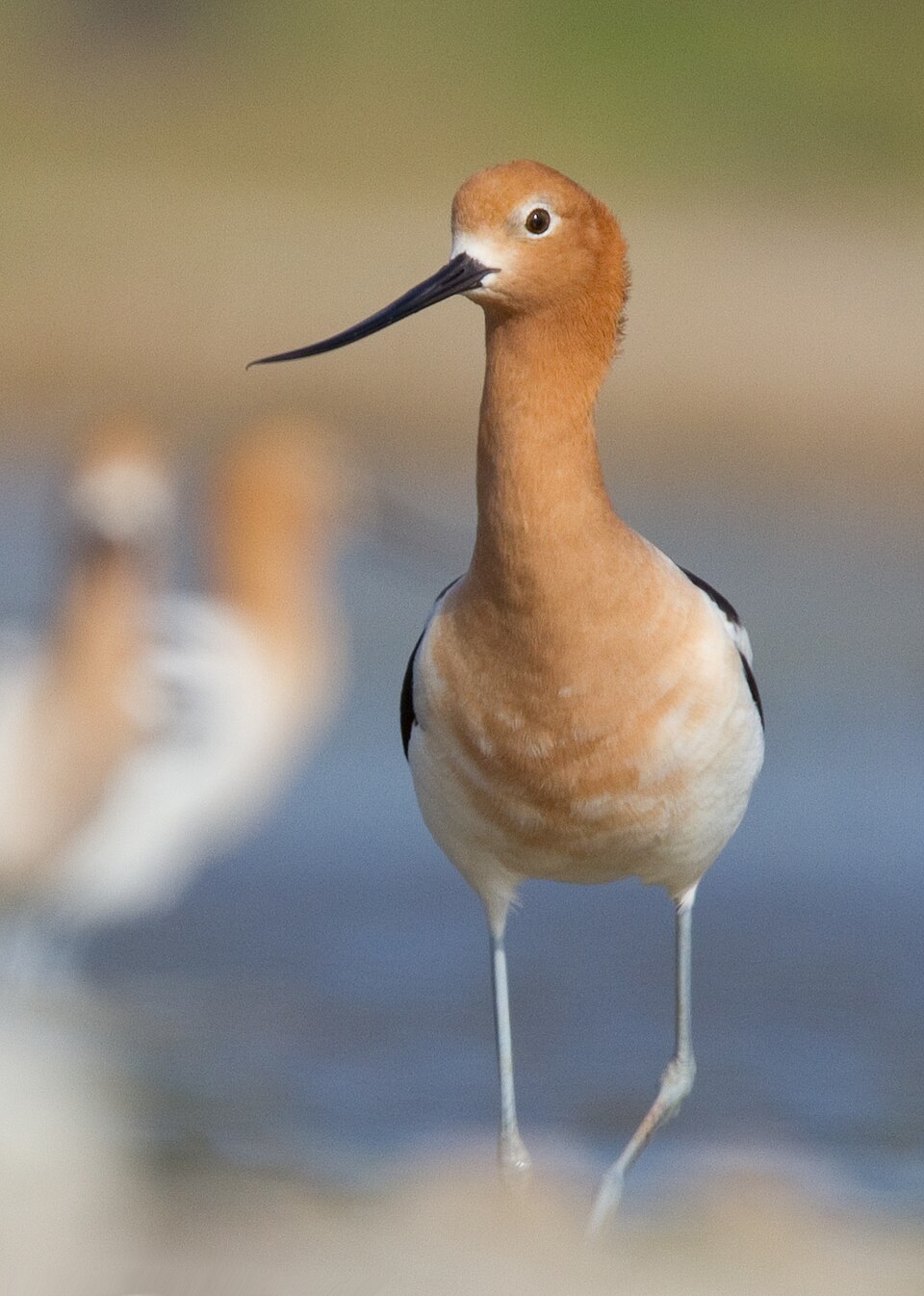
Few North American shorebirds turn heads quite like the American Avocet. Tall and long-legged, it stalks shallow water on slender pale-blue legs, swinging a thin, sharply upturned bill from side to side through the muck. In breeding season its head and neck flush a warm rusty-cinnamon, set against a crisp black-and-white body, making it one of the most strikingly patterned waders on the continent. It is a bird of open water and big skies, alkaline lakes, evaporation ponds, mudflats, and managed wetland impoundments across the American West.
For birders, the avocet is a payoff species: distinctive, photogenic, and often gathered in loose flocks where you can study its mesmerizing feeding sweep. It belongs to the small family Recurvirostridae, which it shares with the equally elegant Black-necked Stilt. Though not a backyard bird in any sense, it is a star attraction at wildlife refuges, sewage lagoons, and salt-pond complexes, exactly the kinds of places that reward a patient scope-toting birder.
The avocet's silhouette alone is diagnostic: a slim, long-necked wader standing high on thin legs, with a needle-fine bill that curves distinctly upward. At rest it can look almost ungainly; in flight it stretches into a clean black-and-white pattern that flashes far across a marsh.
| Bill | Long, thin, and conspicuously upturned (recurved); black. Females average a shorter, more sharply curved bill than males. |
| Head & neck (breeding) | Warm rusty-cinnamon to pale-tan wash over the head, neck, and upper breast. |
| Head & neck (nonbreeding) | Rusty tones replaced by clean pale gray, giving a frostier, more monochrome look. |
| Body & wings | Bold black-and-white pattern: white underparts with black-and-white striping across the back and folded wing. |
| Legs | Long and pale blue-gray, trailing well past the tail in flight. |
| Size & shape | Tall, elegant, and slender, clearly larger and longer-legged than most peeps and dowitchers. |
Male vs. female
Males and females wear the same overall plumage and are not reliably told apart by color. The most useful clue is the bill: females tend to have a shorter bill with a more pronounced upward curve, while males show a slightly longer, straighter-looking bill. The difference is subtle and best appreciated when a pair stands side by side. Males also average marginally larger. Outside of a breeding pair, assigning sex in the field is often impractical.
Juveniles
Juvenile avocets resemble nonbreeding adults but with a softer, warmer cast. Rather than the bright rust of breeding birds, young avocets show a gentle buffy or cinnamon-tinged wash on the head and neck, and their black wing markings may look a touch browner and less crisp. Downy chicks are precocial, pale and speckled, able to walk, swim, and feed within hours of hatching while staying close to attentive parents.
The avocet is a vocal bird, especially around nesting colonies and when alarmed. Its signature call is a sharp, insistent wheet or kleet, often repeated in an excited, rising series as birds wheel overhead or scold an intruder near the nest. The overall effect is a piercing, slightly yelping quality that carries well across open water.
During disputes and distraction displays the calls run together into an agitated kleet-kleet-kleet. There is no musical song in the songbird sense; avocets communicate through these clear, penetrating notes rather than melody.
The American Avocet is primarily a bird of the West and the Great Plains. It breeds across the interior West, from the prairie-pothole region of the northern Great Plains and the intermountain basins of states like Utah, Nevada, and California, south into parts of the Southwest and adjacent Canada. It favors shallow, often alkaline or saline wetlands with sparse vegetation.
In winter, avocets shift to coasts and milder southern wetlands, concentrating along the California coast, the Gulf Coast, parts of the southern Atlantic seaboard, and into Mexico. Migration brings them through the central and western states; east of the Mississippi they are scarce but regular, and a wandering avocet on an inland lake or coastal flat always draws a crowd of birders.
Avocets eat small aquatic invertebrates, brine shrimp, aquatic insects and their larvae, small crustaceans, and tiny seeds, gleaned from shallow water and soft mud. Their most distinctive technique is scything: wading slowly with the bill submerged and held slightly open, sweeping it rhythmically from side to side to detect and snap up prey by touch. This tactile feeding lets them forage efficiently in murky, food-rich water where sight would fail.
They will also pick visually at the surface, upend like dabbling ducks in slightly deeper water, and sometimes swim while feeding. In the hyper-saline lakes where they often gather, dense swarms of brine shrimp and alkali-fly larvae can fuel enormous concentrations of avocets.
American Avocets nest in loose colonies on open ground near water, often on islands, dikes, or bare flats that offer some protection from mammalian predators. The nest is a simple scrape on the ground, sometimes lined with bits of grass, pebbles, or other debris the birds add as incubation proceeds. Both members of the pair share incubation duties.
A typical clutch is around four eggs, olive-buff and blotched with dark markings that blend into the substrate. The chicks hatch ready to go, leaving the nest within a day to feed themselves under close parental guard. Avocets are fierce defenders, mobbing intruders with loud calls and dramatic distraction displays, including feigning injury or a crippled-wing act, to lure threats away from eggs and young.
The American Avocet is not a backyard or feeder bird, it needs open shallow wetlands and will never visit a seed feeder or birdbath. The way to "attract" it is to go where it lives and create or protect the habitat it depends on.
- Visit the right habitat: National wildlife refuges, salt-pond complexes, sewage and evaporation lagoons, and managed wetland impoundments in the West are reliable spots.
- Bring a scope: Avocets feed on open flats and gather in flocks, often at a distance, a spotting scope turns distant white specks into detailed views.
- Time it right: Look in spring and summer for breeding adults in rusty plumage; check coastal flats and southern wetlands in winter.
- Support wetland conservation: Protecting shallow saline and freshwater wetlands from drainage and development is the single biggest thing that helps avocets.
- Scan mixed flocks: Avocets often share flats with stilts, dowitchers, and yellowlegs, so check shorebird gatherings carefully.
- Black-necked Stilt: Same family and habitats, but stilts have a straight (not upturned) bill, glossy black-and-white plumage with no rusty head, and extremely long bright-pink legs.
- American White Pelican: Shares western wetlands and shows black-and-white wings in flight, but is vastly larger with a huge bill and pouch, confusable only at a great distance to a beginner.
- Willet: A chunkier gray shorebird of similar habitats that flashes a bold black-and-white wing pattern in flight, but has a straight bill, gray legs, and no rusty head.
- Greater Yellowlegs: A tall, slim wader that shares the flats, but has a straight (or barely upturned) bill, bright yellow legs, and gray-streaked rather than black-and-white plumage.
Why does the American Avocet have an upturned bill?
The recurved bill is a feeding adaptation. Avocets wade with the bill submerged and sweep it side to side through shallow water and mud, snapping up small invertebrates by touch. The upward curve helps them skim prey just above the bottom efficiently in murky water.
What is the difference between an avocet and a stilt?
Both belong to the same family and share wetland habitats. The avocet has a thin, upturned bill, blue-gray legs, and a rusty head and neck in breeding season. The Black-necked Stilt has a straight bill, very long bright-pink legs, and a clean glossy black-and-white pattern with no rusty tones.
Where can I see American Avocets?
Look at shallow open wetlands in the western and central United States, national wildlife refuges, alkaline lakes, salt-pond complexes, and sewage or evaporation lagoons. In winter they move to coastal flats and southern wetlands, including the California and Gulf coasts and into Mexico.
Do American Avocets change color through the year?
Yes. In breeding plumage the head and neck are a warm rusty-cinnamon. In nonbreeding (winter) plumage those tones fade to clean pale gray, while the bold black-and-white body pattern stays the same year-round.
Are American Avocets endangered?
No. The American Avocet is listed as Least Concern and remains locally common, sometimes gathering in large flocks at favored lakes. Its main long-term concern is the loss and degradation of the shallow wetlands it depends on for feeding and nesting.