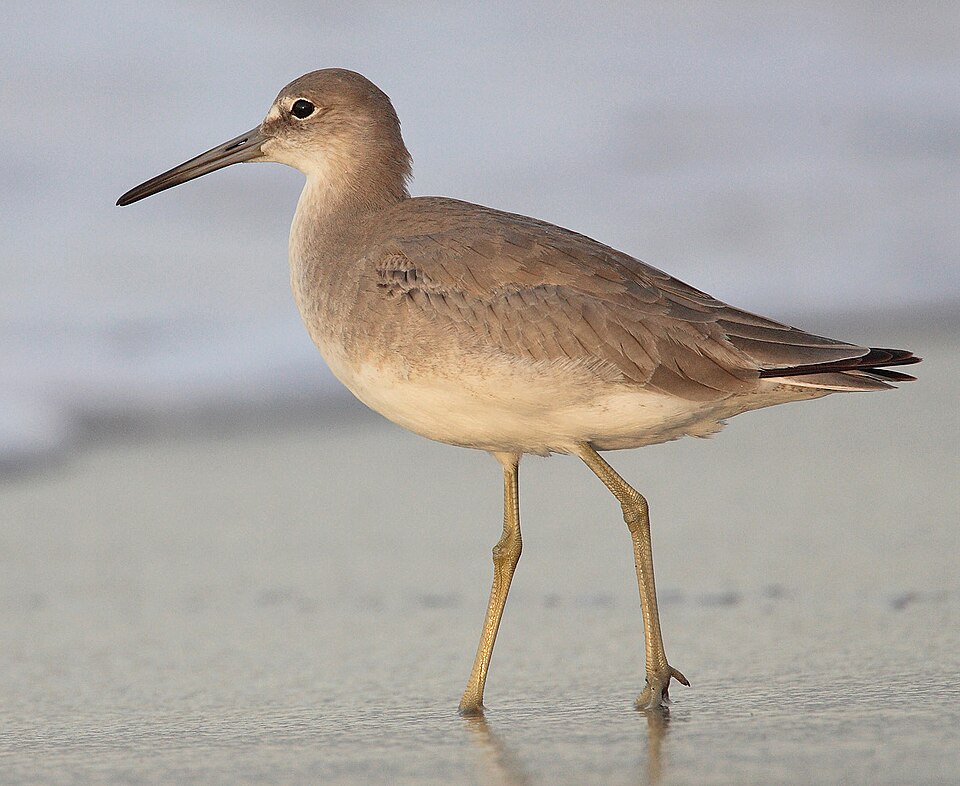
The Willet is one of those birds that looks almost deliberately boring until it opens its wings. Standing on a mudflat or beach, it appears as a stocky, grayish shorebird with long bluish-gray legs and a heavy, straight bill, easy to overlook among flashier sandpipers and plovers. Then it flushes, flashes a bold black-and-white wing pattern, and shouts its name across the marsh, and suddenly it is unmistakable. This contrast between drab and dramatic is exactly what makes the Willet a favorite of coastal birders.
Willets belong to the sandpiper family and are large members of the genus Tringa, the same group that includes the yellowlegs. They are birds of two worlds: salt marshes and beaches along the coasts, and the grassy prairie wetlands of the interior West. North America actually hosts two distinct populations, an Eastern coastal form and a larger, paler Western form, that differ enough in size, voice, and habitat that some ornithologists have argued they could be separate species. For most birders, though, the Willet is simply the loud sentinel of the shore.
Think of the Willet as a heavy-bodied, medium-large shorebird, bigger and bulkier than a Greater Yellowlegs, with thick, straight gray bill and long, sturdy legs. The most reliable mark is invisible until it flies: a striking black-and-white band running the length of each wing. On the ground it is a study in grays and the wing flash is your best friend.
| Wing pattern | Bold black-and-white stripe across each wing, obvious in flight and during display, the single best field mark |
| Bill | Long, thick, straight, and gray, slightly heavier than most similar shorebirds |
| Legs | Long, sturdy, bluish-gray to gray (not bright yellow) |
| Size & shape | Large and stocky for a sandpiper, with a full chest and thick neck |
| Breeding plumage | Brownish-gray above with heavy barring and streaking on the breast and flanks |
| Nonbreeding plumage | Plain, uniform pale gray above and whitish below, very subdued |
Male vs. female
Males and females look essentially alike in plumage, so you cannot reliably sex a Willet by sight in the field. Females average slightly larger and longer-billed than males, but this is only noticeable when a pair stands side by side, and even then the overlap is considerable. Both sexes share the same gray tones and the same black-and-white wing flash.
Juveniles
Juvenile Willets resemble nonbreeding adults but look neater and more patterned up close, with pale buff or whitish edges to the feathers of the back and wings that create a subtly scaled or scalloped appearance. They lack the heavy barring of breeding adults and show the same plain gray underparts. By their first winter they are very hard to separate from adults, and in flight they show the identical bold wing stripe.
The Willet is famously, almost relentlessly vocal, and it is named for its signature call: a ringing, repeated pill-will-willet, pill-will-willet delivered on the breeding grounds, often from a fence post, marsh hummock, or even in flight. The phrase is loud, rolling, and carries far across open wetlands.
Away from the nesting season, and especially when alarmed or flushed, Willets give a sharp, insistent series of kip-kip-kip or kleep notes and a loud, screaming kweh. They are quick to sound off at intruders, which makes them excellent natural alarm clocks for everything else in the marsh.
Willets breed in two broad regions. The Eastern population nests in coastal salt marshes from the Canadian Maritimes south along the Atlantic and Gulf coasts. The Western population breeds across the interior of the western United States and the Prairie Provinces of Canada, favoring grassland wetlands, prairie pothole country, and the edges of alkaline lakes.
In migration and winter, both populations head for the coasts. Willets winter along the Pacific, Atlantic, and Gulf shores of the southern United States, through Mexico and Central America, the Caribbean, and into northern South America. Interior breeders make a notable move to saltwater coasts for the nonbreeding season, so a Willet on a winter beach could have come from a prairie pond hundreds of miles inland.
Willets are opportunistic foragers that work mudflats, sandy beaches, marsh edges, and shallow water. Their diet is dominated by small invertebrates: crabs (especially fiddler crabs along the coast), marine worms, mollusks, aquatic insects, and small crustaceans. Inland breeders also take grasshoppers and other terrestrial insects from grassland and pond margins.
Their feeding style is steady and deliberate. A Willet will probe into mud and sand with its strong bill, pick prey from the surface, and wade into shallow water to snatch swimming or burrowing animals. They forage by both sight and touch, and because their bill has sensitive nerve endings near the tip, they can feel for hidden prey even in murky water or at night.
Willets nest on the ground, with the placement depending on the population. Coastal Eastern birds typically nest in salt-marsh grass or among dune vegetation, while Western birds nest in grassland near water, sometimes well away from the wetland itself. The nest is a shallow scrape lined with grasses and other plant material, often partly hidden in a clump of vegetation.
A typical clutch is four eggs, olive to buff colored with dark blotching that camouflages them against the ground. Both parents share incubation, which lasts roughly three to four weeks, and the chicks are precocial, down-covered and able to leave the nest and feed themselves soon after hatching. Adults are fierce nest defenders, calling loudly and dive-bombing intruders, including people who wander too close. Willets generally raise a single brood per season.
The Willet is not a backyard or feeder bird, so there is no seed mix or feeder setup that will bring one to your yard. It is a specialist of coastal beaches, salt marshes, and prairie wetlands, and you will need to go to its habitat rather than the other way around. That said, you can absolutely improve your odds of finding and enjoying them.
- Visit coastal beaches, mudflats, and salt marshes at lower tide, when foraging shorebirds spread out and feed actively.
- In the interior West, scan prairie wetlands, alkaline lake edges, and flooded grassland in spring and summer for breeding Western Willets.
- Time visits for spring and fall migration, when numbers swell along both coasts and birds gather at staging sites.
- Listen first, the loud pill-will-willet call often reveals a bird before you spot it, especially on the breeding grounds.
- Watch for the black-and-white wing flash when a distant gray shorebird takes flight; it confirms the ID instantly.
- If you support coastal conservation, protecting undisturbed beach and marsh habitat directly helps nesting Willets and other shorebirds.
- Greater Yellowlegs: Smaller and slimmer with bright yellow legs and no wing stripe; gives a clear three-note whistle rather than the Willet's name-call.
- Lesser Yellowlegs: Noticeably smaller and more delicate, with thin yellow legs and a finer bill; lacks the bold black-and-white wing flash.
- Marbled Godwit: Similar size and cinnamon tones but has a long, upturned, two-toned bill; shows warm buffy wings rather than a black-and-white stripe.
- Whimbrel: Comparable bulk but unmistakable long downcurved bill and bold head stripes; plain brown wings without the Willet's flash.
Why is it called a Willet?
The name comes directly from the bird's loud, ringing breeding call, which sounds like "pill-will-willet" repeated over and over. Like the Killdeer and the Chickadee, the Willet is named for the sound it makes.
What is the easiest way to identify a Willet?
On the ground a Willet looks like a plain gray shorebird with long gray legs and a thick straight bill. The instant giveaway comes when it flies: each wing shows a bold black-and-white stripe, a pattern no similar shorebird has.
What is the difference between Eastern and Western Willets?
They are two populations of the same species. Eastern Willets nest in coastal salt marshes and are a bit smaller and darker, while Western Willets breed in interior prairie wetlands and are larger, paler, and longer-billed. Both winter along the coasts.
Do Willets come to bird feeders?
No. Willets are shorebirds that eat crabs, worms, mollusks, and insects from beaches, mudflats, and wetlands. They will not visit feeders, so the way to see one is to go to coastal or prairie wetland habitat.
When and where can I see Willets?
Look on coastal beaches and salt marshes year-round in the southern U.S., and in interior western wetlands during the spring and summer breeding season. Migration in spring and fall is the best time for big numbers along both coasts.