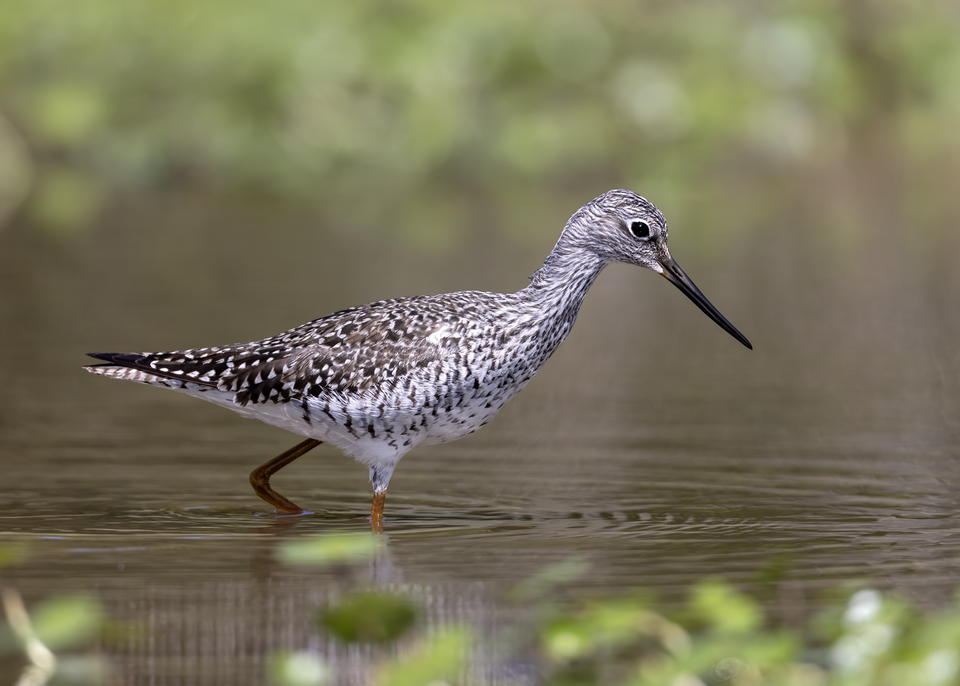
The Greater Yellowlegs is a tall, alert shorebird that seems to appear out of nowhere on the muddy edges of marshes, flooded fields, and shallow ponds across North America. It is one of those birds you often hear before you see: a loud, ringing alarm call carries across the water as it flushes and circles, earning it the old nickname "tattler" or "telltale" because it announces every intruder, much to the frustration of hunters and predators alike. Lanky, gray, and streaky, it stalks the shallows on its trademark long, bright yellow legs.
For most birders it is a bird of passage, glimpsed on migration in spring and fall as it travels between far-northern breeding bogs and southern wintering wetlands. It is rarely abundant in any one place, usually turning up as ones and twos rather than the dense flocks of smaller sandpipers. That habit of being scattered and conspicuous, combined with its readiness to sound off, makes it a satisfying bird to learn, and a useful "yardstick" against which beginners measure the trickier shorebirds around it.
This is a medium-large, leggy sandpiper with a slim build, a long neck, and a long, slightly upturned bill. Its overall impression is one of height and alertness: it stands tall, bobs its head and front of its body when nervous, and moves with deliberate, high-stepping strides. Size is the trap here, since it looks much like the smaller Lesser Yellowlegs unless you have something for scale.
| Legs | Long and bright yellow to orange-yellow, the signature field mark in any plumage. |
| Bill | Long (clearly longer than the head is wide), slightly upturned, and often two-toned with a paler grayish base. |
| Breeding plumage | Heavily streaked and barred above and on the breast and flanks, giving a dark, busy, scaly look. |
| Nonbreeding plumage | Plainer gray-brown above with fine streaking, a pale face, and a whitish belly. |
| In flight | Bold white rump and lower back contrasting with dark wings and a faintly barred tail; no white wing stripe. |
| Voice clue | Loud, ringing, three- to four-note descending call that often confirms the ID before plumage does. |
Male vs. female
Males and females look alike in the field. There is no difference in plumage color or pattern between the sexes, and the size overlap is too great to judge a lone bird. Females average very slightly larger and longer-billed on average, but this is impossible to use reliably without a bird in the hand or a direct side-by-side comparison.
Juveniles
Juveniles, the birds most often seen in late summer and fall, are neatly marked: gray-brown above with crisp pale spotting along the feather edges that gives a finely speckled, "beaded" look, and fine streaking on the neck and breast that fades to a clean white belly. They lack the heavy black barring of breeding adults and look tidier and more uniform overall, but the long yellow legs and long, slightly upturned bill identify them right away.
The voice is the best single feature for clinching this species. The flight and alarm call is a loud, ringing, slightly descending series of usually three or four notes, often written as tew-tew-tew or dear-dear-dear, full-throated and carrying. The three-or-four-note pattern and emphatic, almost strident quality are key.
The smaller Lesser Yellowlegs gives a similar but softer, flatter call of typically one or two notes, less ringing and less insistent. On the breeding grounds, Greater Yellowlegs add a rolling, repeated song often rendered toowhee-toowhee-toowhee, delivered in display flight over the bogs.
Greater Yellowlegs breed across the boreal zone of Canada and Alaska, favoring remote muskeg, bogs, and wet coniferous forest openings, a habitat so difficult to work that their nesting biology is among the least-studied of common North American shorebirds. They winter along the coasts and in wetlands from the southern United States south through Mexico, Central America, the Caribbean, and much of South America.
Across the rest of the continent they are a migrant, and one of the earliest and latest shorebirds to move: northbound birds appear in spring, often while wetlands are still partly iced, and southbound adults can show up by midsummer, with juveniles following into fall. Their broad migration window means you can find them over many months wherever there is shallow water and mud.
This is an active, often energetic feeder. It wades through shallow water picking and probing for small fish, aquatic insects, crustaceans, snails, worms, and occasionally tadpoles and small frogs. Unlike the more methodical plovers, it frequently dashes after prey, sweeping its bill side to side through the water or running in short bursts to chase minnows into the shallows.
It will feed singly or loosely with other shorebirds along pond margins, flooded fields, tidal flats, and the edges of impoundments. The slightly upturned bill is well suited to skimming and lateral sweeping as well as straightforward picking from the surface and shallow probing in soft mud.
Nesting takes place in the boreal forest and muskeg, where pairs are widely scattered and notoriously hard to study. The nest is a simple shallow scrape on the ground, often near water and sometimes set among moss, low shrubs, or at the base of a small tree, lined sparsely with whatever vegetation is at hand.
A typical clutch is four eggs, buff to olive and marked with darker blotches, laid in a single brood per season. Both parents share incubation, and the precocial young leave the nest soon after hatching to feed themselves, with the adults staying nearby and noisily mobbing intruders. The loud, persistent alarm-calling that gives the species its "telltale" reputation is at its most intense around the nest and young.
The Greater Yellowlegs is not a backyard or feeder bird, so you will not coax one in with seed or suet. It is a wetland specialist, and the way to "attract" it is to go where it already wants to be, or to manage land that creates the shallow, muddy habitat it needs.
- Look at shallow water with exposed mud: flooded fields, pond edges, sewage lagoons, tidal flats, and rain pools are far more productive than open lakes.
- Time your visits to migration, roughly spring and again from midsummer through fall, when most non-breeding sightings happen.
- If you manage a pond or wetland, keeping gently sloping, vegetation-free muddy margins and varying water levels creates ideal feeding habitat for migrating shorebirds.
- Listen first. The ringing three- to four-note call often reveals a bird before you spot it, and may flush it into view as it circles.
- Bring a spotting scope: yellowlegs are wary and often feed at a distance, and a scope lets you study leg color, bill shape, and size for a confident ID.
- Scan the edges, not the open water, and check any taller, leggier shorebird among flocks of smaller peeps.
- Lesser Yellowlegs: Nearly identical but smaller and daintier, with a shorter, straighter, all-dark needle-like bill (roughly the length of the head) and a softer one- or two-note call versus the Greater's longer, ringing three- to four-note call.
- Solitary Sandpiper: Smaller with dull greenish (not bright yellow) legs, a bold white eyering, and a dark rump in flight; tends to favor wooded pools and forest puddles.
- Willet: Bulkier and grayer with gray legs and a heavier, straighter bill, and shows a striking black-and-white wing pattern in flight that yellowlegs lack.
- Stilt Sandpiper: Similar leggy look with greenish-yellow legs, but smaller with a longer, drooping (downcurved) bill and, in breeding plumage, heavy rufous-toned barring below.
How do you tell a Greater Yellowlegs from a Lesser Yellowlegs?
Focus on bill and voice. The Greater's bill is long (clearly longer than the head), slightly upturned, and often paler at the base, while the Lesser's is shorter, straight, needle-thin, and all dark. The Greater gives a loud, ringing three- to four-note call; the Lesser gives a softer one- or two-note call. Size helps only when both are side by side.
Why is it called Yellowlegs?
For the obvious reason: its long legs are bright yellow to orange-yellow, and this color shows in every plumage and at every age. The leg color is the quickest way to separate it from look-alikes like the Solitary Sandpiper (greenish legs) or Willet (gray legs).
Where and when am I most likely to see one?
On shallow, muddy wetlands, flooded fields, tidal flats, and pond edges during migration. Across most of North America it is a passage migrant in spring and again from midsummer into fall, and it winters along southern coasts and wetlands. It is uncommon as a breeder outside the remote Canadian and Alaskan boreal zone.
Will Greater Yellowlegs come to a backyard feeder?
No. They are wetland shorebirds that eat small fish, insects, and aquatic invertebrates, not seed-eaters. You will only find them near shallow water with mud, never at a seed or suet feeder.
Why does it call so loudly and constantly?
It is famously wary and vocal, sounding a ringing alarm whenever something approaches. This habit earned it old nicknames like tattler and telltale, because its calls warn every other bird in the marsh, and it is especially noisy and persistent when defending a nest or young.