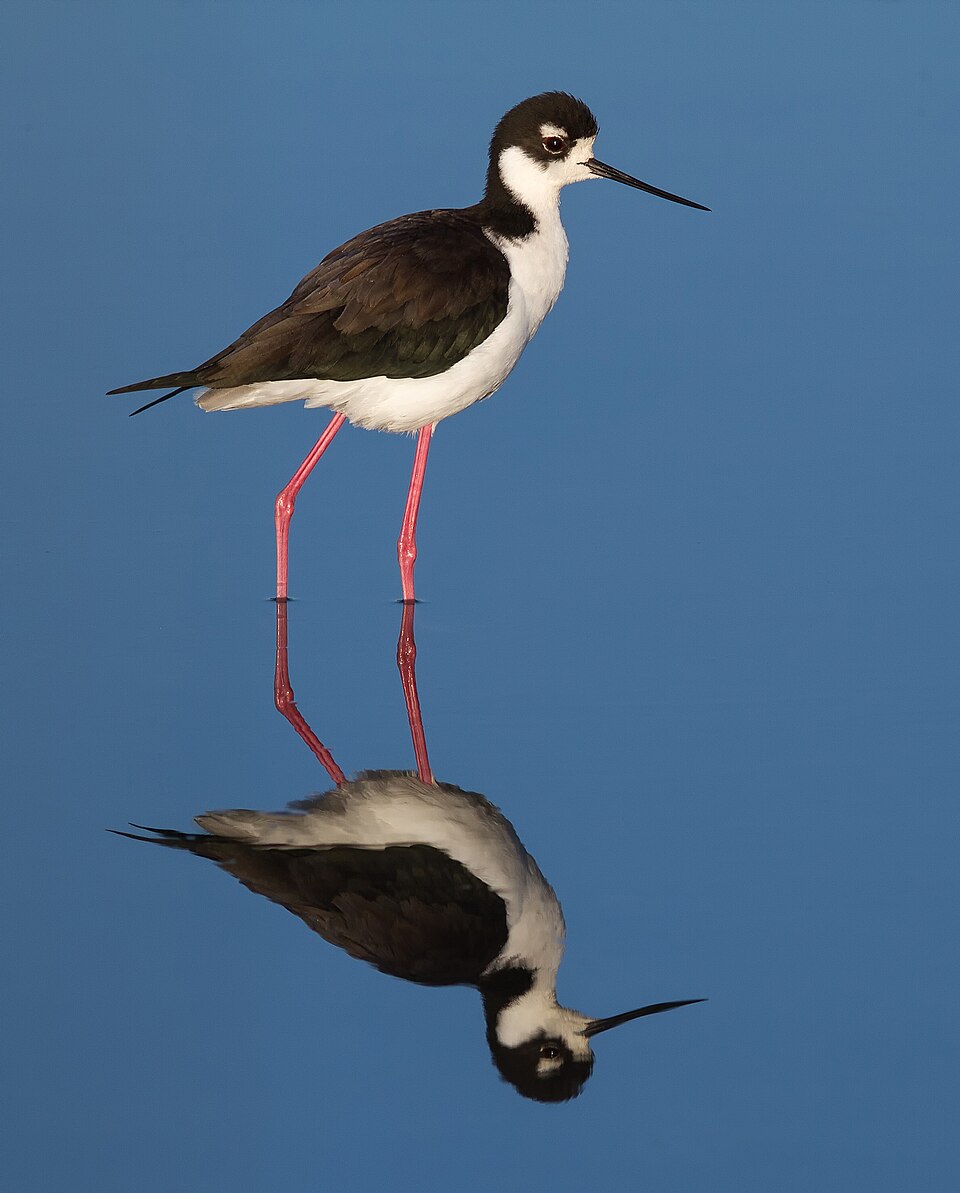
Few North American shorebirds are as instantly recognizable as the Black-necked Stilt. With a crisp tuxedo of glossy black above and clean white below, a needle-thin black bill, and absurdly long, bubble-gum-pink legs, it looks more like a wading bird drawn by a cartoonist than a real animal. Stand near any shallow wetland in the West, along the Gulf Coast, or across much of the southern United States and you have a good chance of spotting one stalking the shallows on those impossibly stilted legs.
This is a bird of open, shallow water: alkaline lakes, flooded fields, evaporation ponds, salt-pans, sewage lagoons, and marsh edges. Stilts are noisy, social, and highly visible, often feeding and nesting in loose colonies. Their relative the American Avocet frequently shares the same pools. For backyard birders, the stilt is not a feeder visitor, but it is one of the most rewarding birds to seek out on a trip to a local marsh or refuge, where its long-legged elegance and sharp, yapping calls make it impossible to miss.
The Black-necked Stilt has one of the most unmistakable silhouettes of any shorebird: a small-bodied, slender wader perched on extraordinarily long, thin legs, with a fine, straight, needle-like bill held level. In flight the legs trail far behind the tail, and the wings are entirely black above and below, with no white wing-stripe.
| Legs | Very long and thin, bright pink to reddish-pink, the single most distinctive feature |
| Bill | Long, fine, straight, and black; needle-like, never upturned |
| Upperparts | Glossy black (or blackish-brown in females) covering crown, nape, back, and wings |
| Underparts | Clean, bright white from chin to undertail, with a white wedge up the back |
| Head | White face with a small white spot above and behind the eye; black cap and hindneck |
| In flight | All-black wings above and below with no white stripe; long pink legs trail well past the tail |
Male vs. female
The sexes look very similar and both show the trademark pink legs and pied pattern, but with a good look you can often tell them apart. On males the upperparts are a glossy, greenish-black; on females the back and scapulars are browner, a dark chocolate or brownish-black rather than true glossy black, contrasting slightly with the blacker wings. Females also average a touch larger. In mixed pairs the difference is easiest to judge, but in poor light or on a lone bird, sexing can be uncertain.
Juveniles
Juveniles resemble adults in overall pattern but look softer and browner. Their upperparts are dark brown rather than black, with pale buff or sandy edges to the back and wing feathers giving a scaly, scalloped appearance. The legs are duller, more grayish-pink or orange-pink, brightening to the adult color over time. Young birds reach essentially adult-like plumage within their first year.
Black-necked Stilts are vocal and persistent, especially around nesting areas, where they earn the nickname "marsh poodle" for their incessant yapping. The main call is a sharp, high, repeated kek-kek-kek-kek or yip-yip-yip, dog-like and far-carrying. When agitated by an intruder or a predator near the nest, the rate accelerates into a frantic, scolding rattle.
They have no true song; communication is built around these emphatic calls. A whole colony erupting in alarm produces a chorus of yelping that draws every other stilt and avocet into the air. Birds also give softer contact notes among themselves while feeding.
The Black-necked Stilt breeds across the western United States, throughout the Great Basin, California, the Southwest, the southern Great Plains, and along the Gulf and southern Atlantic coasts, with strongholds in places like the Great Salt Lake, the Central Valley, and Texas coastal wetlands. The species ranges south through Mexico, Central America, the Caribbean, and into South America, where resident populations persist year-round.
Northern breeders are migratory, withdrawing in fall to the southern United States, Mexico, and Central America, while birds in the Deep South, Florida, and the tropics are largely resident. Over recent decades the species has expanded its breeding range, partly because artificial wetlands such as flooded farm fields, wastewater ponds, and salt-evaporation basins create the shallow, open habitat it favors.
Black-necked Stilts feed mainly on aquatic invertebrates: brine shrimp, brine flies and their larvae, water beetles, dragonfly and damselfly larvae, midges, snails, and small crustaceans. In some wetlands they also take tiny fish, tadpoles, and floating seeds. Brine flies and brine shrimp are especially important at hypersaline lakes, where stilts can occur in large numbers.
They feed by wading steadily through shallow water, picking prey from the surface or just below with quick, precise jabs of the slender bill. Unlike the avocet, which sweeps its upturned bill side to side, the stilt is a visual picker, snatching individual items it sees. It will also probe soft mud and occasionally plunge its head underwater to grab prey. Those long legs let it forage in water deeper than most other small shorebirds can manage.
Stilts nest on the ground, usually on open ground near water, a low mudflat, dike, island, or the margin of a pond. The nest is a simple scrape that the pair lines with whatever is nearby: bits of grass, pebbles, shell fragments, or mud. If water levels rise, the birds will pile up material to raise the nest above the threat. They frequently nest in loose colonies, sometimes alongside avocets, gaining safety in numbers.
A typical clutch is four buff-colored eggs heavily marked with dark blotches, well camouflaged against the substrate. Both the male and female incubate, sharing duties for around 24 to 27 days. The chicks are precocial, leaving the nest within a day of hatching and feeding themselves while the attentive parents stand guard. Adults defend the nest aggressively, performing dramatic distraction displays, feigning injury or running in a hunched, broken-winged crouch, and dive-bombing intruders while screaming. Pairs generally raise one brood per year.
The Black-necked Stilt is a wetland specialist, not a backyard or feeder bird, so you will not lure one to a seed feeder or birdbath. To see one, you go to it, but there are good ways to improve your chances.
- Visit shallow, open wetlands: flooded fields, salt-pans, sewage lagoons, refuge impoundments, and the muddy edges of alkaline lakes are prime stilt habitat.
- Time your trips for spring through late summer in the breeding range, when stilts are most numerous, vocal, and active around colonies.
- Listen for the loud, yapping kek-kek-kek alarm calls, you will often hear a stilt before you see it, especially near a nest.
- Scan the same pools for American Avocets, which frequently share habitat; sorting the two is good practice.
- If you manage land with seasonal water, maintaining shallow flooded areas with open mud margins can attract foraging and even nesting stilts.
- Bring a scope and keep your distance from nesting birds, stilts are easily disturbed and will abandon defense to scold you from the air.
- American Avocet: Similar long-legged, pied wetland bird, but larger with a distinctly upturned bill, bluish-gray legs, and rusty head/neck in breeding plumage (white in winter).
- Willet: A bulkier gray shorebird with shorter, gray legs and a thicker bill; lacks the stilt's stark black-and-white contrast and shows bold black-and-white wing flashes in flight.
- Greater Yellowlegs: Another tall, slim wader, but mottled gray-brown overall with bright yellow legs, not the stilt's clean black-and-white body and pink legs.
Why does the Black-necked Stilt have such long legs?
Those long legs let stilts wade and feed in deeper water than most small shorebirds can reach, opening up shallow ponds, flooded fields, and lake margins where they pick aquatic insects and shrimp from the surface and shallow mud.
Are Black-necked Stilts and American Avocets the same bird?
No, but they are close relatives in the same family and often share habitat. The quickest difference is the bill: a stilt has a straight, needle-thin bill and pink legs, while an avocet has a noticeably upturned bill, bluish-gray legs, and a rusty head in breeding season.
What is that loud yapping sound coming from the marsh?
It is very likely a Black-necked Stilt. Their sharp, dog-like kek-kek-kek alarm call is given persistently near nests and feeding areas, which has earned them the nickname 'marsh poodle.'
Where can I see a Black-necked Stilt?
Look at shallow, open wetlands across the western and southern United States: refuge impoundments, flooded fields, salt-evaporation ponds, sewage lagoons, and alkaline lake edges. They are common in places like California's Central Valley, the Great Salt Lake, and the Texas Gulf Coast.
Do Black-necked Stilts migrate?
Northern and interior breeders migrate south in fall to the southern U.S., Mexico, and Central America, while birds in Florida, the Deep South, and the tropics are largely year-round residents.