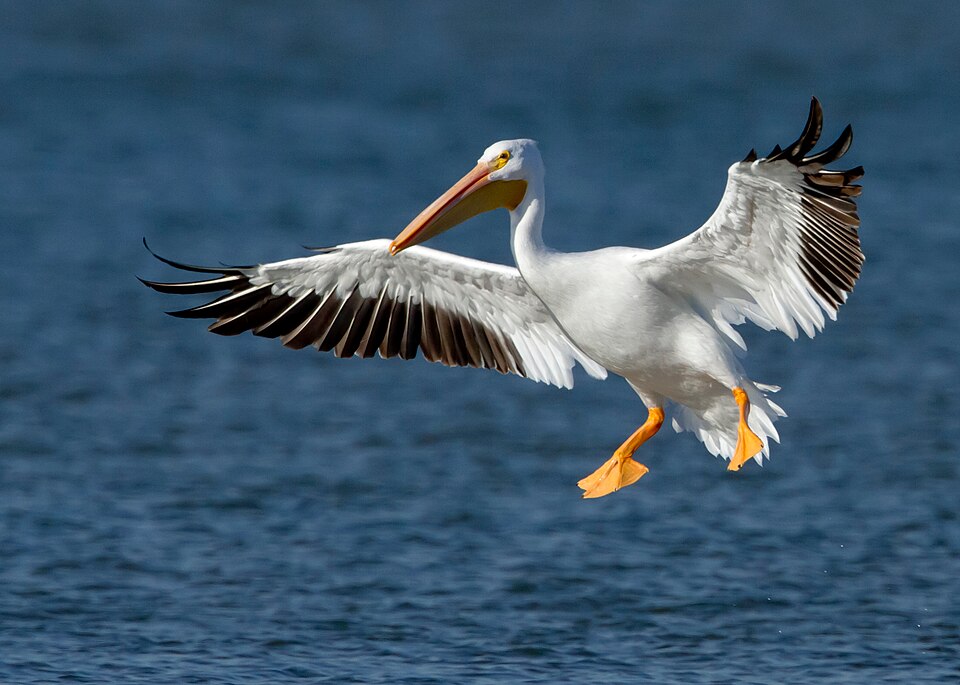
The American White Pelican is a bird built on a grand scale. With a wingspan that can stretch past nine feet, it ranks among the largest flying birds on the continent, yet for all that bulk it moves through the air with astonishing grace. Flocks ride thermals in slow, wheeling spirals, their black-and-white wings flashing as they bank, and a single line of pelicans gliding low over a lake is one of the great spectacles of inland North America. Despite the name, this is overwhelmingly a bird of the interior West and the southern coasts rather than the open ocean.
Unlike the Brown Pelican, which crashes headfirst into the sea, the White Pelican feeds with quiet teamwork, swimming in coordinated groups to herd fish into the shallows. It breeds on remote islands in prairie and mountain lakes, then winters along the Gulf Coast, in California, and well down into Mexico. Once heavily impacted by pesticides and habitat loss, the species has rebounded and is again a familiar sight to anyone who watches big water in the right season.
There is almost nothing else like an adult American White Pelican in flight or on the water. Look for an enormous, heavy-bodied white bird with a long flat bill, a saggy throat pouch, and a short tail. In the air the giveaway is the wing pattern: brilliant white forewings contrasting sharply with jet-black flight feathers along the trailing edge and wingtips, visible from a great distance.
| Size | Massive - among the largest birds in North America, with a wingspan often exceeding 8-9 feet |
| Plumage | Bright white overall with black primaries and outer secondaries that show only in flight or when wings are open |
| Bill | Long, flat, yellow-orange bill with an expandable throat pouch; can look pale orange or pinkish |
| Breeding plate | In spring, a flat horny plate or 'horn' grows on the upper mandible, then is shed after eggs are laid |
| Legs and feet | Short orange legs with fully webbed feet; appears squat and waddling on land |
| In flight | Flies with neck folded back, head resting on shoulders, alternating slow flaps with long glides, often in lines or V-formations |
Male vs. female
Males and females look essentially identical in plumage, so you cannot reliably tell them apart in the field. Males average noticeably larger and longer-billed, which can be apparent when a pair stands side by side, but the difference is one of degree rather than a clear field mark. Both sexes develop the same yellow bill, breeding crest, and the curious horn-like plate on the bill during the breeding season.
Juveniles
Juvenile and immature White Pelicans are mostly white like adults but look duller and a bit dingy, often with a wash of gray or brownish on the head, neck, and upperwing coverts. The bill, pouch, and legs are paler and more muted, lacking the bright yellow-orange of a breeding adult, and young birds never show the breeding horn. They gradually clean up to full adult brightness over their first year or two.
Adult American White Pelicans are surprisingly quiet away from the breeding colony. For most of the year you may watch a flock for hours and hear nothing at all, which makes them seem all the more serene as they soar.
At the nesting islands they become more vocal, giving low, piglike grunts and hoarse, guttural croaks - a soft uhh-uhh or growling arrh. Nestlings are far noisier, producing loud, whining, squealing begging calls described as a grating chee or piercing squeals when adults return with food. Outside the colony, listen instead for the rush of air through those enormous wings.
American White Pelicans breed across the interior of western and central North America, from the prairie provinces of Canada south through the northern Great Plains and the Great Basin, nesting on isolated islands in large freshwater and alkaline lakes. A handful of colonies also occur along the Texas Gulf Coast.
In winter they shift to milder waters: the Gulf and southern Atlantic coasts, the lakes and rivers of the Southwest, California's Central Valley, and far down into Mexico and Central America. Migration is a daytime affair, with flocks riding thermals and soaring in long lines, sometimes thousands of feet up. During migration and winter, birds may turn up almost anywhere on large lakes, reservoirs, and slow rivers across the continent.
The American White Pelican is a fish specialist, taking mostly small, abundant, non-game fish such as minnows, shiners, carp, and suckers, along with crayfish, salamanders, and other aquatic prey. An adult can eat several pounds of fish a day. Rather than diving, it feeds while swimming, dipping that great bill and pouch into the water to scoop up fish and water together, then tipping the bill down to drain the water before swallowing.
Its most remarkable habit is cooperative feeding. Groups of pelicans line up and swim forward in unison, beating their wings and driving fish into a tight, panicked mass in the shallows where they are easy to scoop. This teamwork lets them exploit shallow lakes and wetlands far from the deep open water that diving pelicans require, and they will also follow other waterbirds or feed at fish concentrations near dams and inlets.
White Pelicans are highly colonial, nesting in dense groups on low, predator-free islands in interior lakes. The nest itself is modest - a shallow scrape on the bare ground, ringed and lined with a low rim of soil, gravel, and bits of vegetation that the parents scrape together. Colonies can hold hundreds or thousands of pairs packed close together.
The female typically lays two chalky white eggs, and both parents share incubation, warming the eggs on top of their broad webbed feet. Usually only one chick survives to fledge, as the larger, older sibling out-competes the younger. Chicks leave the nest after a few weeks to gather in mobile groups called creches, where they huddle for warmth and safety while parents continue to feed them until they can fly at around two and a half to three months old. Colonies are extremely sensitive to disturbance, and a single intrusion can cause adults to abandon nests in large numbers.
The American White Pelican is not a backyard or feeder bird, and there is no realistic way to draw one to a typical yard. It needs large open water and abundant fish, so the way to enjoy it is to go where it lives rather than to bring it to you.
- Visit large lakes, reservoirs, and slow rivers during spring and fall migration, when soaring flocks are most likely.
- Scan the Gulf Coast, California, and the Southwest in winter, where wintering flocks loaf on sandbars and shallows.
- Look for them in the morning and on warm afternoons when rising thermals let flocks circle high overhead.
- Bring binoculars or a spotting scope - pelicans often feed and rest far out, and a scope reveals the bill horn and feeding behavior.
- Watch for cooperative feeding in shallow water, a behavior unique among North America's pelicans and well worth the patience.
- Keep your distance from any nesting islands - colonies abandon eggs easily, so never approach breeding sites by boat or on foot.
- Brown Pelican: Smaller, mostly gray-brown rather than white, and a strictly coastal saltwater bird that plunge-dives from the air instead of feeding while swimming.
- Wood Stork: Also a large white waterbird with black flight feathers, but has a dark, bare scaly head, a heavy down-curved bill, and trails its legs in flight rather than tucking its neck back.
- Snow Goose: White with black wingtips like a pelican but far smaller, with a short pink bill, faster wingbeats, and noisy honking flocks rather than silent soaring lines.
- Whooping Crane: Tall and white with black wingtips, but slim-bodied with long trailing legs, a red crown, and a loud bugling call - it flies with neck extended, not folded.
What is the difference between an American White Pelican and a Brown Pelican?
The American White Pelican is much larger, bright white with black wingtips, lives mostly on interior lakes and southern coasts, and feeds by swimming and scooping in shallow water. The Brown Pelican is smaller, grayish-brown, strictly coastal, and famous for plunge-diving headfirst into the sea to catch fish.
How big is an American White Pelican?
They are enormous. Body length runs roughly 50 to 65 inches, and the wingspan often stretches past nine feet - between eight and ten feet across - making them one of the largest flying birds in North America.
Why do American White Pelicans have a horn on their bill?
The flat plate, or 'horn,' on the upper bill grows only during the breeding season and is thought to play a role in courtship and competition. After the eggs are laid, the horn is shed, so you only see it in spring and early summer.
Do American White Pelicans dive for fish?
No. Unlike Brown Pelicans, White Pelicans do not dive. They feed while swimming, dipping their bill and pouch to scoop up fish, and they often work in coordinated groups to herd fish into the shallows.
Where and when can I see American White Pelicans?
They breed on lake islands across the interior West and northern Great Plains in summer, then winter along the Gulf Coast, in California, and through the Southwest and Mexico. Large lakes and reservoirs during spring and fall migration are reliable places to find soaring flocks.