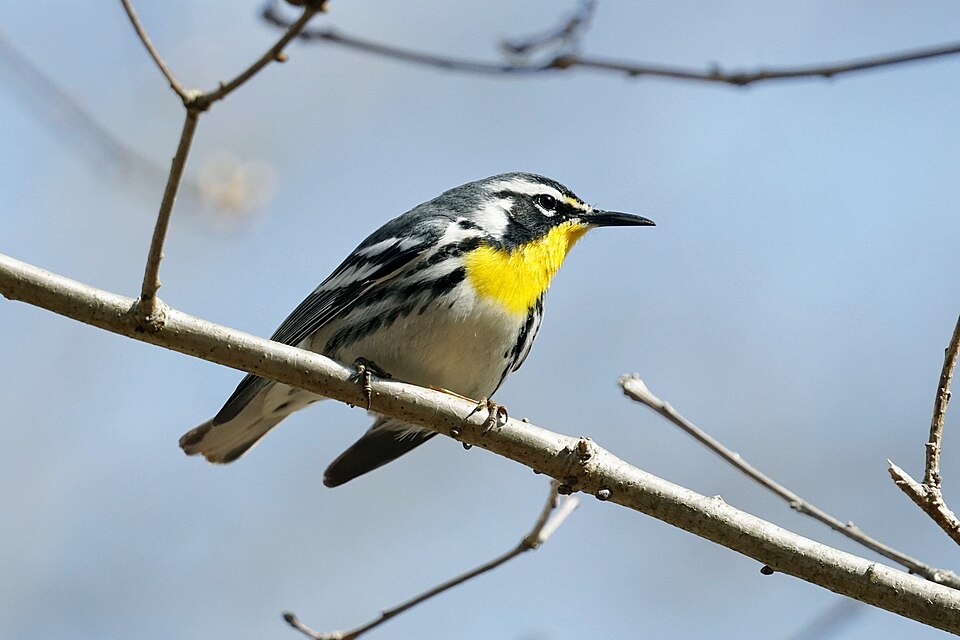
The Yellow-throated Warbler is one of the most elegant songbirds of the southeastern United States, and one of the easiest warblers to learn once you know where to look. Clean gray above and white below, it wears a vivid lemon-yellow bib at the throat, a bold black mask, and a striking white slash behind the eye. Unlike the frenetic, leaf-flitting warblers that frustrate beginners, this one moves slowly and deliberately, creeping along high branches and probing bark crevices almost like a nuthatch or a Brown Creeper. That methodical foraging style, combined with its love of tall pines, sycamores, and bald cypress, gives it a distinctive personality among North American wood-warblers.
It is a bird of the treetops and the waterside. Across much of the South you will find it in mature pine woods, in the live oaks draped with Spanish moss along the coastal plain, and especially in the big sycamores and cypress that line rivers and swamps. Because it is an early migrant and sings a clear, ringing song from late winter into spring, it is often one of the first warblers birders detect each year. It is not a feeder bird in the usual sense, but its strong tie to specific habitats and its relatively confiding behavior make it a rewarding target for anyone willing to look up.
This is a slim, medium-sized warbler with a notably long, pointed bill suited to probing bark and pine needle clusters. The overall impression is of a tidy gray-white bird with a single bright spot of color at the throat, set off by a strong black-and-white face pattern. It often holds a horizontal posture as it creeps along limbs, which together with its plumage makes it fairly distinctive.
| Throat | Bright lemon-yellow bib confined to the chin, throat, and upper breast; sharply set off from white underparts |
| Face | Bold black mask through the eye and across the cheek, with a clean white patch on the side of the neck behind the ear |
| Eyebrow | White (or yellow-tinged at front) supercilium above the black mask, often meeting a small spot above the bill |
| Upperparts | Plain blue-gray back and crown with no streaking; two white wingbars |
| Flanks | White underparts marked with black streaks along the sides |
| Bill | Long, fine, and pointed for a warbler, used to probe bark crevices and needle clusters |
Male vs. female
Males and females look very much alike, which is unusual among the more colorful warblers. Both sexes show the yellow throat, black mask, white neck patch, and gray upperparts. Females and immatures average slightly duller, the black of the mask and side streaks can be a touch grayer and less crisp, and the yellow may be marginally paler, but the difference is subtle and often impossible to judge in the field. For practical purposes, treat the sexes as identical and identify the bird by its overall pattern rather than trying to sex it.
Juveniles
Juveniles fresh from the nest are browner and washed-out, with an indistinct face pattern and only a hint of yellow at the throat. They quickly molt into a first-fall plumage that closely resembles the adult, showing the yellow throat, gray back, and wingbars, though the black markings tend to be softer and less sharply defined. By the time most birders encounter young birds on migration or in fall, they look essentially like duller adults.
The song is a clear, ringing series of descending whistled notes that speeds up and often rises slightly at the very end, frequently written as tee-tee-tee-tee-tew-tew-tew-wi or swee swee swee swee swee-o. It carries well across open pine woods and riverside forest and has a sweet, slurred quality similar to an Indigo Bunting or a Louisiana Waterthrush, but more even and structured. Because it sings early in the season, sometimes by late February in the Deep South, it is a reliable first sign that spring migration is underway.
Calls include a high, sharp chip or tsip, thinner and less smacking than many warbler call notes. In flight or when agitated, birds give a high, buzzy seet. Learning the song is the single most useful skill for finding this species, since it spends so much time hidden high in the canopy.
The Yellow-throated Warbler breeds across the southeastern United States, from the mid-Atlantic and Ohio River valley south through the Gulf states and Florida, and west into eastern Texas and parts of the lower Midwest. It has been expanding northward in recent decades, with breeding now reaching into the Great Lakes region and the Northeast. Two broad populations exist: a coastal-plain form tied to live oak and pine, and an interior form especially associated with sycamores along rivers.
It is a short-distance migrant. Most birds winter along the Gulf Coast, in Florida, the Caribbean, and parts of Mexico and Central America, while some remain year-round in the Deep South and Florida. It is among the earliest warblers to return north in spring and one of the earlier ones to depart in late summer and fall, so the window to catch migrants is shifted earlier than for most of its relatives.
The Yellow-throated Warbler is primarily insectivorous, feeding on caterpillars, beetles, true bugs, ants, moths, spiders, and other small arthropods gleaned from bark and foliage. Its long bill is the key to its foraging niche: it probes into bark furrows, pine-needle clusters, and clumps of Spanish moss, extracting prey that shorter-billed warblers cannot reach. The effect is almost creeper- or nuthatch-like as it works methodically along the undersides and tops of high limbs.
Foraging usually takes place well up in the canopy of pines, sycamores, cypress, and oaks, which is why it can be hard to see despite being common in the right habitat. In winter it will take some small fruits and occasionally visits suet or comes to feeders, but for most of the year it is a dedicated bark-and-foliage gleaner of the treetops.
Nesting is placed high, often very high, in a tall tree, frequently saddled on a horizontal limb of a pine or sycamore, or tucked into a clump of Spanish moss in the coastal plain. The female builds a compact open cup of grasses, plant fibers, and bark strips, lined with soft material such as plant down and feathers; in moss-draped country the nest can be almost completely concealed within the hanging moss.
The female lays a small clutch of grayish or greenish eggs spotted with brown and incubates them, while both parents feed the nestlings. Pairs in the South often raise two broods in a season, taking advantage of the long warm period. Because nests are typically far overhead and well hidden, they are seldom found by casual observers.
The Yellow-throated Warbler is not a typical backyard feeder bird, but it is more approachable than most warblers and you can improve your odds of hosting one, especially if you live within its range and near the right trees.
- Have the right trees. This bird is tied to tall pines, sycamores, bald cypress, and live oaks. If your property or neighborhood has mature stands of these, particularly along water, you have a real chance.
- Offer suet, especially in winter and early spring. Wintering and migrating birds will occasionally visit suet feeders, which is one of the few reliable ways to draw one in closer.
- Provide a clean water source. A birdbath or dripper near tall trees can tempt foraging birds down from the canopy for a quick drink or bath.
- Preserve Spanish moss if you live in the coastal plain, it is prime foraging substrate and nesting material for this species.
- Learn the song and listen up high. The best way to enjoy this bird is to detect it by ear in spring; it spends most of its time in the treetops where it is easy to overlook.
- Avoid pesticides. A healthy population of caterpillars and bark insects in your trees is exactly what this warbler is looking for.
- Pine Warbler: Also a pine-loving bird with a yellow throat, but the yellow is dingier and extends onto the breast, it lacks the bold black mask and white neck patch, and the back is olive rather than clean gray.
- Grace's Warbler: A close western counterpart with a yellow throat and gray back, but it is smaller-billed, the yellow is paler and bordered with yellow (not white) in the eyebrow, and ranges in southwestern mountain pine forests rather than the Southeast.
- Blackburnian Warbler: Has a fiery orange (not lemon-yellow) throat and a strongly patterned black-and-orange face and back; favors spruce forests and is a long-distance migrant, unlike the gray-backed, southern Yellow-throated.
- Black-and-white Warbler: Shares the creeping, bark-probing habit but is boldly streaked black-and-white all over with no yellow throat.
How do I tell a Yellow-throated Warbler from a Pine Warbler?
Look at the face and the crispness of the yellow. The Yellow-throated Warbler has a bright, clean lemon throat sharply cut off from white underparts, a bold black mask, a white neck patch, and a clean gray back. The Pine Warbler has duller, more diffuse yellow that blends onto the breast, a plain face without the strong mask, and an olive-tinged back. The Yellow-throated also has a longer, finer bill and creeps along bark more deliberately.
Where is the best place to find a Yellow-throated Warbler?
Look in mature trees high overhead, especially tall pines, sycamores along rivers, bald cypress in swamps, and Spanish moss-draped live oaks across the southeastern coastal plain. Listening for its clear descending song is far more effective than scanning, because the bird spends most of its time in the canopy.
Will a Yellow-throated Warbler come to my feeder?
It is not a regular feeder bird, but it sometimes visits suet, particularly in winter and during migration, and may come to a water feature near tall trees. Most of the year it feeds on insects probed from bark and foliage high in the canopy, so feeders are a bonus rather than a reliable draw.
What does the Yellow-throated Warbler's song sound like?
It is a clear, ringing series of whistled notes that descends and slightly accelerates, often ending on a higher slurred note, something like tee-tee-tee-tew-tew-wi. It is sweet and even, recalling an Indigo Bunting or Louisiana Waterthrush, and it is sung early in the season, sometimes by late February in the Deep South.
Is the Yellow-throated Warbler rare or declining?
No. It is listed as Least Concern and is common within its southeastern range. In fact, it has been expanding its breeding range northward in recent decades, now reaching into the Great Lakes region and the Northeast. Healthy mature pine and riparian forests are key to keeping its populations strong.