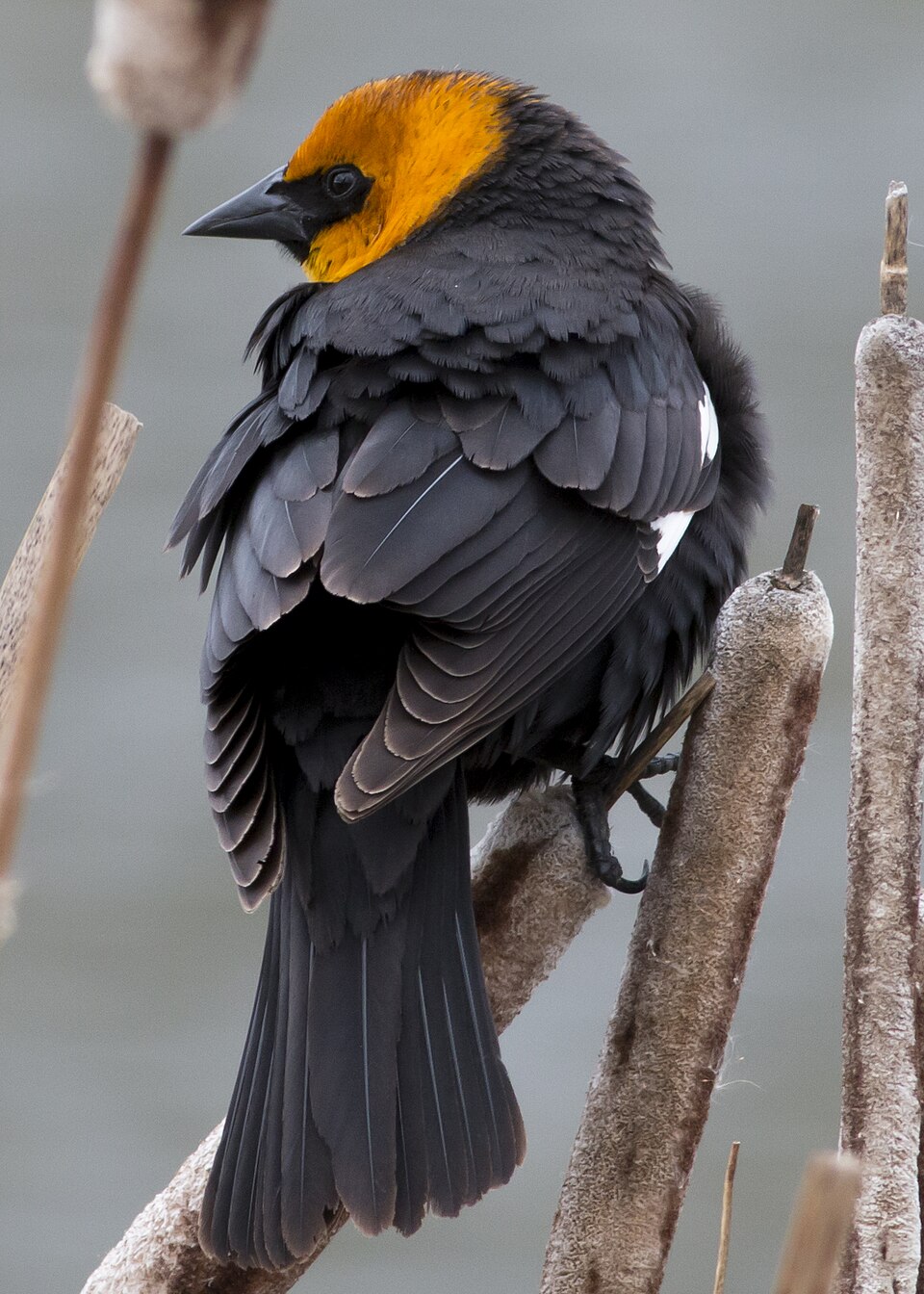
Few birds make a first impression quite like a male Yellow-headed Blackbird. Picture a glossy black bird the size of a small robin, but with a head and chest the color of a ripe lemon, perched atop a cattail with its tail cocked and its wings half-spread. Then it opens its bill and produces one of the most memorably awful sounds in North American birding, a strangled, grinding buzz that has been compared to a rusty gate or a dying engine. The contrast between the bird's elegant looks and its graceless voice is part of what makes it such a beloved sight in the wetlands of the American West and the prairie provinces of Canada.
This is a bird of big, wet, productive marshes. Yellow-headed Blackbirds nest in loose, noisy colonies over standing water, usually choosing the deepest, densest stands of cattails and bulrushes, often the very same marshes that Red-winged Blackbirds use, though the two species sort themselves out, with the larger Yellow-heads commandeering the prime deep-water real estate. In late summer and fall they abandon the breeding marshes and gather into enormous flocks, sometimes mixing with other blackbirds and grackles, and stream south to wintering grounds in the southwestern United States and Mexico. For birders east of the Great Plains, a single Yellow-headed Blackbird turning up in a flock of Red-wings is a genuine red-letter find.
This is a stocky, broad-shouldered blackbird, noticeably larger and bulkier than a Red-winged Blackbird, with a fairly long, conical, sharp-pointed bill and a tail it often holds cocked or fanned during display. Size and shape alone separate it from most marsh birds, but on an adult male the gleaming yellow head against an inky body is unmistakable even at a great distance.
| Adult male | Glossy black body with a brilliant yellow head, neck, and upper breast; a bold white patch at the bend of the wing (the primary coverts) flashes in flight. |
| Black face mask | A small patch of black feathering surrounds the eye and base of the bill, set off sharply against the yellow. |
| Female | Dusky brown overall with a dull yellow wash on the face, throat, and breast; no white wing patch. |
| Bill | Long, sharply pointed, and conical, heavier and straighter than a Red-winged Blackbird's. |
| Size & build | Larger and chunkier than a Red-winged Blackbird, roughly the heft of a small grackle. |
| Flight | On the male, the white wing patches blink conspicuously with each wingbeat; flight is direct and somewhat heavy. |
Male vs. female
The sexes look strikingly different. The adult male is the showpiece: a deep black body offset by a saturated yellow head and breast, a black mask around the eye, and a white patch on the wing that flashes in flight. The female is much plainer and considerably smaller, overall a sooty brown rather than black, with only a muted, washed-out yellow on the face, throat, and upper chest, often with faint pale streaking on the lower breast. Crucially, females lack the male's white wing patch. A female Yellow-head can briefly puzzle birders expecting the gaudy male, but the yellowish throat and her noticeably larger, heavier build separate her from a female Red-winged Blackbird.
Juveniles
Juveniles look broadly like dull, buffy versions of females. Fresh young birds are warm cinnamon-buff to tawny on the head and breast rather than clean yellow, with pale buff edges to the wing feathers that can show as a faint wing bar, and a dingy, streaky underside. Young males begin to acquire patchy yellow and black through their first fall and winter, so a first-year male can look like a muddled mix of brown, gold, and black before molting into the clean adult plumage. By their first breeding season males show full adult color.
The song is famous for being almost comically unmusical. A displaying male leans forward, spreads his wings and tail, and forces out a low, strangled introductory note followed by a long, harsh, grinding buzz, often written as kuh-koh-koh-WAAAAAAA, that trails off like a rusty hinge being slowly pried open, or like machinery grinding to a halt. There is nothing pretty about it, and that is precisely why it is so easy to learn and remember.
Away from the full song, both sexes give a low, hoarse krrt or kruk as a contact and alarm note. A marsh full of displaying males produces a continuous, scraping, otherworldly chorus that carries well across open water and is one of the signature sounds of a healthy western wetland in spring.
Yellow-headed Blackbirds breed across the wetlands of western and central North America, from the prairie provinces of Canada south through the Great Plains, the Intermountain West, and into the Southwest, reaching westward into the marshes and irrigated valleys of California and the Pacific states. The breeding range is tied tightly to permanent and semi-permanent freshwater marshes, so it is patchy and concentrated wherever good cattail and bulrush habitat exists.
They are migratory. After breeding, birds gather into large flocks and move south to winter primarily in the southwestern U.S. and across much of Mexico, where they forage in open country, farm fields, and feedlots, often alongside other blackbirds. East of the Great Plains the species is a scarce but regular vagrant, and birders in the East and Midwest most often encounter lone individuals scanning through large mixed blackbird flocks during migration and winter.
Yellow-headed Blackbirds shift their diet with the seasons. During the breeding season they feed heavily on aquatic and emergent insects, dragonflies and damselflies, beetles, caterpillars, and especially the abundant midges and other insects that hatch out of productive marshes. This protein-rich food is essential for feeding nestlings, and adults forage by gleaning from cattail stems, snatching emerging insects from the water's surface, and probing in vegetation and mud at the marsh edge.
Outside the breeding season the diet swings strongly toward grains and seeds. Migrating and wintering flocks forage in stubble fields, grasslands, and around feedlots and dairies, where they eat waste grain, weed seeds, and cultivated cereals. It is in this season that their habit of flocking can bring them into agricultural areas in large numbers.
This is a colonial, polygynous marsh nester. A male defends a territory in the densest, deepest part of the marsh and may attract several females to nest within it. The female alone builds the nest, weaving a sturdy, bulky cup out of wet, dead aquatic vegetation and lashing it directly to standing cattail or bulrush stems over open water, often a foot or more above the surface. As the wet plant material dries, it shrinks and cinches the nest tightly to its supports.
Clutches typically number three to five eggs, pale gray to greenish-white and speckled with brown. The female incubates and does the great majority of the brooding and feeding, with males contributing relatively little parental care, especially at nests of their secondary mates. Nesting over deep water gives some protection from ground predators, though the colonies still contend with marsh-wading predators and brood parasitism. Most pairs raise a single brood per season.
The honest truth is that this is not a backyard feeder bird in any reliable sense. The Yellow-headed Blackbird is a wetland specialist, and you are far more likely to enjoy it by going to good marsh habitat than by waiting for one to show up at your feeders. That said, migrants and wintering birds do sometimes visit feeding stations, especially in the western states near suitable habitat.
- Go to the marsh. The surest way to see one is to visit a large, healthy freshwater marsh with extensive cattails or bulrushes in the West or Great Plains during the breeding season.
- If you live in or near the western range, offer cracked corn and mixed grain on the ground or on platform feeders, blackbirds favor grain over small seeds, and migrants may stop in.
- Scan mixed blackbird flocks. In migration and winter, single Yellow-heads often travel with Red-winged Blackbirds, grackles, and cowbirds in fields and feedlots, so check the flock carefully.
- Protecting and restoring wetland habitat does far more for this species than any feeder; support local marsh conservation if you want to help it.
- Listen first. The grinding, rusty-gate song carries a long way and will often tip you off to a marsh colony before you spot the birds.
- Red-winged Blackbird: Shares the same marshes but the male is all black with red-and-yellow shoulder patches rather than a yellow head; Red-wings are smaller and slimmer, and females are streaky brown with no yellow throat.
- Western Meadowlark: Also yellow-and-black, but a grassland bird with a yellow underside and a bold black 'V' on the chest, not a yellow head on a black body; it has a flutey, musical song instead of a buzz.
- Bobolink: Breeding males are black below with a buffy-yellow nape patch (the reverse pattern of a Yellow-head); a smaller grassland bird with a bubbling, tinkling song.
- Brewer's Blackbird: A common western blackbird often in the same winter flocks, but glossy black all over with a pale eye in males and no yellow anywhere.
What does a Yellow-headed Blackbird sound like?
The male's song is famously harsh and unmusical, a strangled introductory note followed by a long, grinding, rusty-hinge buzz, often written as kuh-koh-koh-WAAAAAA. Both sexes also give a low, hoarse krrt call note. A marsh full of singing males produces a continuous scraping chorus.
Where do Yellow-headed Blackbirds live?
They breed in large freshwater marshes across western and central North America, from the Canadian prairies south through the Great Plains and Intermountain West into California and the Southwest. They winter mainly in the southwestern U.S. and Mexico. East of the Plains they are scarce migrants and winter visitors.
How can I tell a male from a female Yellow-headed Blackbird?
The male is glossy black with a brilliant yellow head and breast, a black face mask, and a white wing patch. The female is much smaller and duller, sooty brown overall with only a muted yellow wash on the face and throat, and she has no white wing patch.
Will Yellow-headed Blackbirds come to a backyard feeder?
Not reliably. They are wetland specialists, so feeders are a long shot. Migrants and wintering birds in the western states occasionally visit platform or ground feeders offering cracked corn and grain, but the best way to see one is to visit a good marsh.
What is the difference between a Yellow-headed and a Red-winged Blackbird?
They often share the same marshes, but the male Yellow-head has a yellow head and a white wing patch, while the male Red-wing is all black with red-and-yellow shoulder epaulets. Yellow-heads are also noticeably larger and bulkier, and they tend to nest in the deeper-water parts of the marsh.