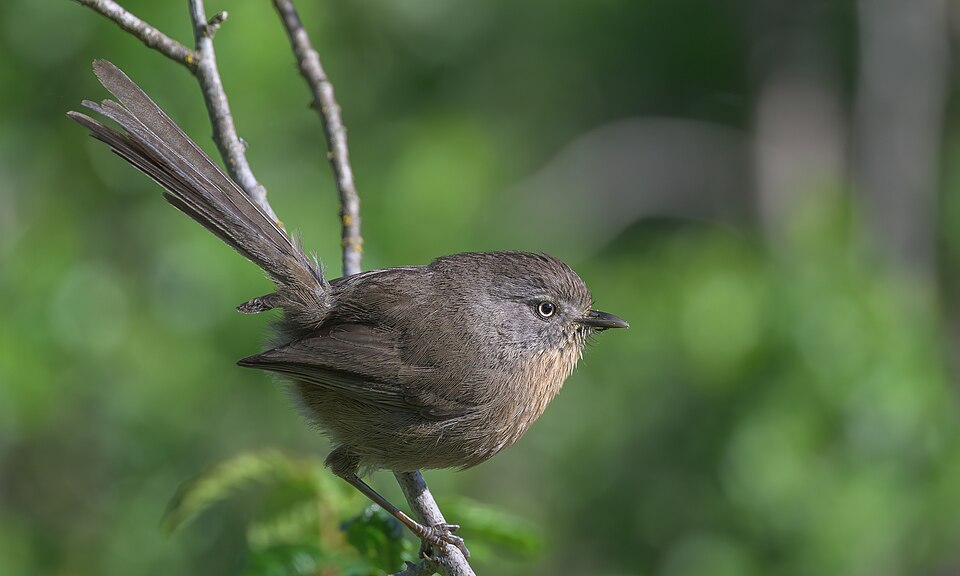
The Wrentit is one of the West Coast's great voices-without-a-face. You will almost certainly hear it long before you see it: a hollow, accelerating series of notes pouring out of a dense thicket of coyote brush, manzanita, or chaparral. Then the singer melts back into the shrubbery and goes quiet. Small, plain, and brownish-gray, the Wrentit is a creature of tangled cover, and it spends nearly its whole life within a few acres of dense scrub.
For all its plainness, the Wrentit is genuinely special. It is the only New World member of an Old World family of babblers (sometimes placed in its own small family), and it has one of the most sedentary lifestyles of any North American songbird. A pair will hold the same patch of brush year-round, for life, rarely flying more than a few yards in the open. Birders treasure it precisely because it makes you work: learning its song is the key that unlocks one of the most characteristic sounds of California and Pacific Coast scrubland.
Think small, round, and long-tailed, with a posture that is more like a wren than its plain plumage suggests. The Wrentit is a soft brownish-gray bird that often cocks its long, loosely held tail upward as it creeps through dense twigs. The single best mark, when you can get a look, is the eye.
| Eye | Striking pale, creamy-white iris that stands out against the plain face, the giveaway field mark |
| Overall color | Soft brownish-gray to gray-brown, slightly warmer and pinkish-buff below, with faint dusky streaking on the breast |
| Tail | Long, rounded, and loosely cocked, often held up at an angle; gives a wren-like jizz |
| Bill | Short, stout, and slightly down-curved, typical of a brush-skulking babbler |
| Size & shape | Small and rounded, roughly sparrow-sized, with a short-winged, long-tailed silhouette |
| Coastal vs. interior | Coastal birds tend to be browner and darker; interior populations are grayer and paler |
Male vs. female
Male and female Wrentits look alike, there is no reliable plumage difference between the sexes in the field. Both show the same plain gray-brown body and pale eye. Behavior can offer a hint during the breeding season: the bright, full bouncing-ball song is given mainly by males, while females give a slower, more even-paced trill, so a singing bird's pace can suggest its sex even when the two look identical.
Juveniles
Juvenile Wrentits resemble dull adults but are even plainer, with softer, looser plumage and less obvious breast streaking. The key difference is the eye: young birds have a darker, grayish-brown iris that gradually pales as they mature, so a Wrentit with a muddy rather than creamy eye is likely a bird of the year. Juveniles stay within the parents' territory for a time before dispersing only a short distance to establish their own.
The song is the reason most people ever detect a Wrentit, and it is unmistakable once learned. The classic male song is often described as a bouncing ping-pong ball: a series of clear, evenly pitched pit... pit.. pit.pit.pitpitpitprrrr notes that start slow and accelerate into a rapid trill at the end. Picture a ball dropped on a hard floor, bouncing faster and faster until it rattles to a stop.
Females sing too, but their version typically stays on a steady, even tempo without the speeding-up run, ending in a simple trill rather than an accelerating one. Both sexes give a low, dry, scolding churr or rrrr rattle when agitated or keeping contact within the pair. Wrentits sing year-round, which makes the song a dependable clue in every season.
The Wrentit is a Pacific Coast specialty. Its range runs from the Columbia River in Oregon south through Washington's southwest corner, down through the length of California, and into northwestern Baja California, Mexico. It is tied to dense low scrub, chaparral, coastal sage, coyote-brush slopes, riparian thickets, and brushy canyon edges, from sea level into the foothills.
Famously, it barely moves. The Wrentit is among the most sedentary birds in North America; individuals often spend their entire lives within a small home range and may never cross open ground wider than a road or river. This reluctance to fly over gaps means populations can become locally isolated, and it explains why the species is essentially absent as a vagrant far outside its core range.
Wrentits are mostly insectivorous through the warmer months, gleaning small insects, spiders, caterpillars, ants, beetles, and other arthropods from twigs, bark, and foliage deep inside shrubs. They forage methodically and acrobatically, often hanging or hitching along stems and probing into clusters of leaves rather than chasing prey in the open.
In fall and winter they shift toward plant foods, taking small berries and fruits such as those of poison oak, elderberry, coffeeberry, and other chaparral shrubs, along with some seeds. This mixed diet, plus a sip of nectar at certain flowers, helps them stay put on the same territory all year without needing to migrate to find food.
Wrentits form tight, lifelong pair bonds and defend the same territory together year-round. The nest is a compact, neatly woven open cup placed low in a dense shrub, usually within a few feet of the ground and well hidden in a fork of twigs. Both members of the pair build it, binding plant fibers, bark strips, and grasses together with spider silk and often lining it with finer material.
The female typically lays three to four pale greenish-blue, unmarked eggs. Both parents share incubation, notably, the male commonly takes the night shift, and both feed the nestlings. Pairs may raise one or two broods in a season. Their cooperative, stay-at-home approach to family life is unusual and part of what makes the species so well studied by behavioral ornithologists.
The Wrentit is not a feeder bird, and it almost never comes to seed, suet, or hummingbird feeders. It is, however, very much a "habitat" bird: if you live within its range and along the edge of native scrub, the way to attract it is to give it the dense, brushy cover it cannot live without.
- Preserve or plant dense native shrubs, coyote brush, manzanita, ceanothus, coffeeberry, and coastal sage, to create the thick tangles Wrentits require.
- Leave brush piles and unmanicured shrubby corners rather than clearing everything; Wrentits avoid open, tidy yards.
- Provide berry-producing native plants (elderberry, coffeeberry, toyon) for their fall and winter diet.
- Offer a quiet ground-level or low water source near cover, a dripper beside a thicket is far more useful than an exposed birdbath.
- Avoid pesticides, since insects and spiders are the core of their breeding-season diet.
- Most of all, locate near existing chaparral or coastal scrub, Wrentits rarely cross open gaps to colonize isolated yards.
- Bewick's Wren: Has a bold white eyebrow stripe and a long tail flicked side to side; Wrentit lacks the eyebrow and shows a pale eye instead.
- Bushtit: Tiny, travels in active flocks, and has a dark eye (females pale-eyed); Wrentit is larger, solitary or paired, and skulks rather than flits.
- California Towhee: Larger and chunkier with a thicker bill and rusty undertail; shares chaparral but is more terrestrial and lacks the Wrentit's pale eye and bouncing song.
- Blue-gray Gnatcatcher: Slimmer, bluer-gray with a white eye-ring and a long black-and-white tail it flips constantly; Wrentit is browner and far more secretive.
What does a Wrentit sound like?
The male's song is famously compared to a bouncing ping-pong ball: clear, even notes that start slow and accelerate into a fast trill, pit... pit.. pit.pit.pitpitprrrr. Females give a similar series but at a steady, even tempo. Both also make a dry, scolding churr. You will usually hear a Wrentit long before you see it.
Why is it so hard to see a Wrentit?
Wrentits spend almost their entire lives inside dense shrubs and rarely fly across open ground. They creep through tangled twigs and tend to fall silent and slip deeper into cover when approached. Patience near a singing bird, plus learning the song, is the most reliable way to finally glimpse one.
Is the Wrentit actually a wren or a tit?
Neither, the name just describes its look. It is the only New World representative of an Old World babbler lineage, often placed in its own small family. Its cocked tail recalls a wren and its rounded shape recalls a tit, but it is not closely related to either group.
Where can I find a Wrentit?
Look in dense chaparral, coastal sage scrub, coyote-brush slopes, and brushy canyon edges along the Pacific Coast from southwest Oregon through California into northwestern Baja California. It is a year-round resident throughout that range and does not migrate.
Will a Wrentit come to my bird feeder?
Very rarely. Wrentits do not use seed or suet feeders and avoid open yards. The way to attract them is to provide dense native scrub and berry-bearing shrubs near existing chaparral habitat, they respond to cover, not to feeders.