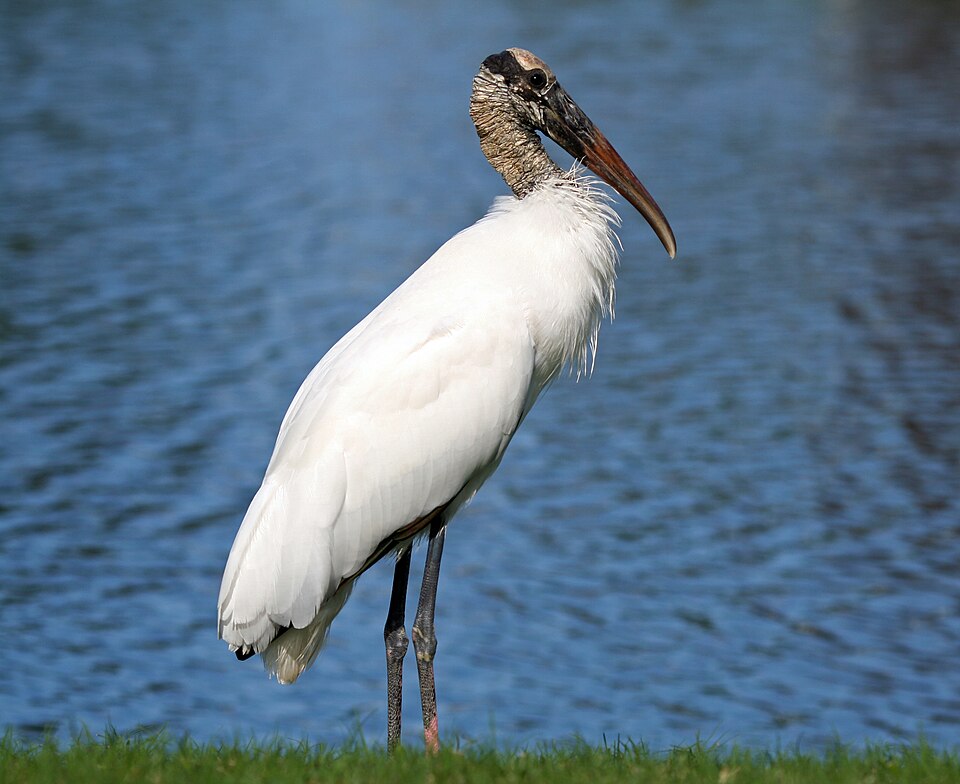
The Wood Stork is a bird you will not mistake for anything else once you have seen it well. It is a huge, long-legged wading bird with a body of clean white feathers, jet-black flight feathers and tail, and a dark, scaly, featherless head and neck that gives it a famously homely appearance up close. At a distance, soaring overhead on broad wings, it can look almost angelic. It is the only stork that breeds in the United States, and for generations Florida birders have known it by the old folk name "wood ibis" or "flinthead."
Wood Storks are creatures of warm, shallow wetlands: cypress swamps, mangrove estuaries, flooded marshes, and managed impoundments across Florida, the Gulf Coast, and increasingly the broader Southeast. They are deeply tied to the rhythm of wet and dry seasons, gathering in spectacular numbers where receding water concentrates fish into shrinking pools. Once in serious decline in the United States, the species has rebounded enough to be downlisted from endangered to threatened, a quiet conservation success story written across the swamps of the Southeast.
Start with size and shape. The Wood Stork is enormous, standing roughly three feet tall with a stout, gently downcurved bill and a long, dark, unfeathered head and neck. The body is bulky and white, and in flight the neck is held outstretched (unlike herons, which fold theirs back), with legs trailing well beyond the tail.
| Overall | Large white wading bird with black flight feathers and tail; very heavy, thick build |
| Head & neck | Bare, dark gray to blackish skin, scaly and bald-looking; no feathers from the shoulders up |
| Bill | Long, thick, dusky, and decurved (downcurved toward the tip), unlike the straight bills of egrets |
| Legs & feet | Dark legs with dull pinkish feet; feet often appear paler than the legs |
| In flight | Neck outstretched, legs trailing; soars on flat wings with black trailing edge and black wingtips clearly visible |
| Wingspan | Up to nearly 6 feet, one of the largest of any North American wading bird |
Male vs. female
Male and female Wood Storks look alike in plumage, so you cannot reliably tell them apart by color or pattern in the field. Males average somewhat larger and heavier, with a noticeably bigger bill, but this difference is only obvious when a pair stands side by side at the nest. There is no seasonal change in their basic appearance, and outside of breeding behavior the sexes are effectively indistinguishable to a casual observer.
Juveniles
Young Wood Storks are easy to age. Juveniles have a feathered, dusky-gray head and neck rather than the bald black head of adults, and their bill is dull yellowish rather than dark. The body is white, often a bit grubbier than the clean adult plumage. As birds mature over their first few years, the head and neck gradually lose their feathering and darken, and the bill turns dusky, slowly transforming a fuzzy-headed youngster into the scaly-headed adult.
Adult Wood Storks are remarkably quiet for such a large bird. They lack a true song and have no functioning syrinx, so away from the nest they are nearly silent, communicating mostly through bill-clattering, a dry, rattling castanet sound made by snapping the mandibles together. This clattering is a common greeting and threat at colonies.
The real noise comes from the nest. Nestling Wood Storks are loud and persistent, giving harsh, nasal braying and a repeated nyah-nyah-nyah begging call that can make a busy colony sound like a barnyard full of complaining animals. Adults add hissing and grunting notes during displays, but if you hear a Wood Stork "talking," it is almost always a hungry youngster.
In the United States the Wood Stork is a bird of the Southeast, centered on Florida and extending up the Atlantic coastal plain into Georgia, South Carolina, and increasingly North Carolina, and west along the Gulf Coast. Florida remains the heart of its range, especially the Everglades, Big Cypress, and the state's many wetlands and water-management impoundments. The species ranges far beyond the U.S. as well, breeding through Mexico, Central America, and much of South America.
Movements are driven more by water levels than by calendar. Wood Storks are largely resident or short-distance wanderers in the Southeast, dispersing widely after breeding, with birds turning up well outside the usual range in late summer. Their nesting timing shifts with the dry season, when falling water concentrates prey and triggers colonies to form.
Wood Storks are specialists at fishing by touch rather than by sight. A foraging stork wades through shallow water with its bill open and partly submerged, sweeping it side to side and shuffling its feet to stir up prey. When a fish brushes the inside of the bill, the stork snaps it shut with one of the fastest reflexes measured in any vertebrate, closing in a fraction of a second. This tactile method lets them feed efficiently in muddy or murky water where visual hunters struggle.
Their diet is dominated by small fish, especially the sunfish, minnows, and other species that get trapped in drying pools, along with crayfish, frogs, large insects, and the occasional small reptile. Because they rely on concentrated prey, Wood Storks depend on the natural cycle of flooding and drying; healthy nesting often hinges on water levels dropping at the right time to pack fish into shrinking pools the storks can exploit.
Wood Storks are colonial nesters, often gathering in large, noisy rookeries with dozens to hundreds of pairs. They build bulky stick nests in trees standing in or over water, classically in cypress and mangroves, where the surrounding water helps protect eggs and chicks from raccoons and other climbing predators. The male gathers most of the sticks and the female does most of the building, lining the nest with greenery and finer material.
A typical clutch is three to four eggs, and pairs raise a single brood per year, though they may re-nest if a first attempt fails early. Both parents incubate for about a month and then share the heavy work of feeding the chicks, regurgitating fish into the nest. Success is tightly linked to water conditions: in years when wetlands dry too early or stay too high, whole colonies may abandon nests, while a well-timed dry-down can fledge thousands of young.
The Wood Stork is not a backyard or feeder bird in any practical sense, so there is nothing to put out that will draw one to a typical yard. It needs expanses of shallow, fish-rich wetland and tall nesting trees, conditions found only in larger natural and managed landscapes. That said, there are real ways to encounter and support them.
- Visit the right habitat: cypress swamps, mangrove estuaries, freshwater marshes, and managed impoundments across Florida and the Southeast are where storks reliably gather.
- Time it with the dry season, when falling water concentrates fish and storks pack into shrinking pools to feed, often alongside herons, egrets, and ibis.
- Look up in late summer: dispersing storks soar high on thermals and can appear far outside their core range, so scan kettles of circling wading birds.
- If you own acreage with wetlands, protect natural water-level cycles and keep tall trees over water, which gives storks the foraging and nesting conditions they need.
- Support wetland conservation and water-management efforts in the Southeast, which do far more for this species than any backyard feature could.
- White Ibis: Much smaller and slimmer with a slender, bright reddish-pink decurved bill and a feathered white head; shows only small black wingtips in flight rather than the stork's broad black trailing edge.
- Great Egret: All-white with no black in the wings, a straight yellow bill, and a fully feathered head; lacks the stork's bare dark head and black flight feathers.
- American White Pelican: Also huge with black-and-white wings, but has a massive orange bill and pouch and a feathered white head, and flies with its neck folded back rather than outstretched.
- Whooping Crane: Tall white bird with black wingtips, but it has a feathered head with a red crown patch, a straight bill, and stands more upright; cranes also fly with the neck extended but lack the stork's bald black head.
Is the Wood Stork the bird that delivers babies?
No. The stork-delivering-babies myth comes from European folklore tied to the White Stork of the Old World. The Wood Stork is a different species native to the Americas and has no connection to that legend, though it is a true stork.
Why does the Wood Stork have a bald head?
Adult Wood Storks have bare, scaly skin on the head and neck instead of feathers. The reason is not fully settled, but bald heads are common in birds that feed in messy, wet situations and crowd together at colonies, where feathers would be hard to keep clean. The look earned it the nickname 'flinthead.'
Are Wood Storks endangered?
They were once listed as endangered in the United States, but the population has recovered enough that they were downlisted to threatened, and globally the species is considered Least Concern. They remain dependent on healthy wetlands, so habitat protection is still important.
How can I tell a Wood Stork from a White Ibis?
Size and head are the giveaways. The Wood Stork is enormous with a bald, dark, scaly head and a thick dusky bill, and shows broad black flight feathers. The White Ibis is much smaller with a fully feathered white head, a slender reddish-pink curved bill, and only small black wingtips.
Where is the best place to see a Wood Stork?
Florida is the stronghold, with the Everglades, Big Cypress, and many state wetlands and impoundments offering reliable sightings, especially in the dry season. They also occur along the Gulf Coast and up the Atlantic coastal plain into Georgia and the Carolinas.