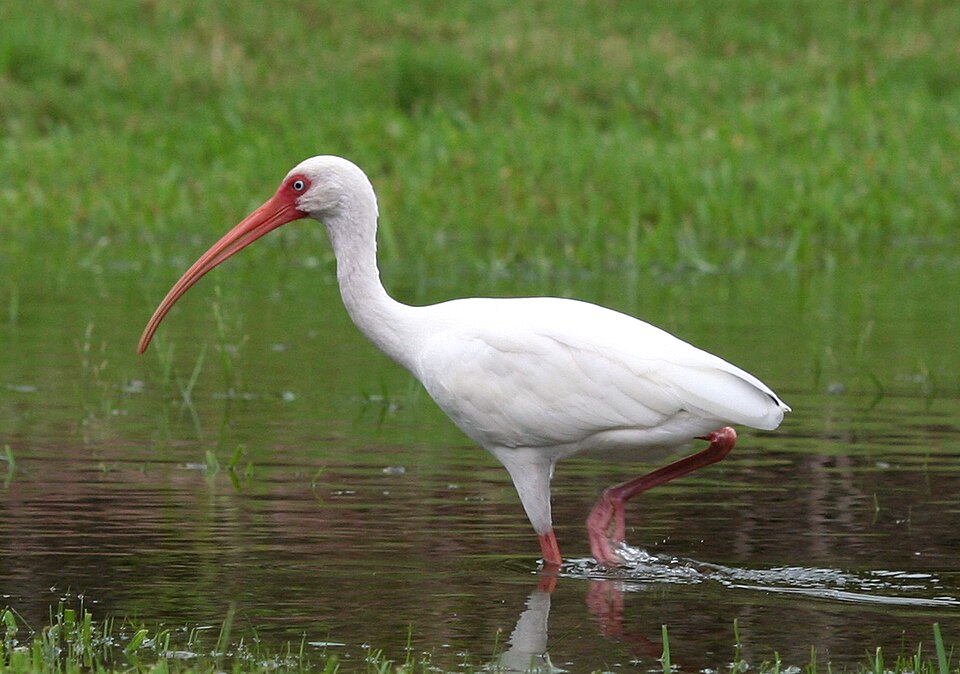
The White Ibis is one of the most recognizable wading birds of the southeastern United States, a gleaming white bird with a long, downcurved red bill and a face the color of a boiled crawfish. Where it occurs it tends to be abundant and conspicuous, foraging in loose flocks across mudflats, flooded fields, lawns, and the shallow edges of marshes. In Florida it is practically a fixture of suburban life, probing soccer fields and golf course ponds with the same enthusiasm it brings to a salt marsh.
This is a sociable, restless bird that does almost everything in company. Flocks feed together, roost together, and stream across the sky in long undulating lines at dawn and dusk. The combination of bright white plumage, glowing pink-red legs and face, and that distinctive sickle-shaped bill makes the adult nearly unmistakable. For many visitors to the Gulf and Atlantic coasts, the White Ibis is the first wading bird they learn to name with confidence.
Look for a medium-large, long-legged wading bird with a slim body, a long neck often held in a gentle curve, and an unmistakable long bill that curves smoothly downward. In flight ibises show a distinctive profile, flying with neck and legs outstretched rather than tucked like a heron.
| Bill | Long, slender, and smoothly decurved; bright reddish-pink in adults, with a darker tip |
| Plumage | Adults entirely white except for black wingtips, visible mainly in flight |
| Face & legs | Bare reddish-pink facial skin and pink-red legs; colors intensify and turn deeper red in breeding season |
| Eye | Pale blue to whitish iris set in the red facial skin |
| Flight shape | Neck and legs fully extended; flocks alternate quick flaps with short glides, often in lines or V formations |
| Size | Larger than a crow, smaller than a Great Egret; stocky-bodied with a noticeably long bill |
Male vs. female
Males and females look essentially alike in color and pattern, so you cannot reliably sex a White Ibis in the field by plumage. The main difference is size: males are noticeably larger and heavier-bodied, with longer, thicker bills, while females are smaller with proportionally shorter bills. This is most obvious when a pair stands side by side, but a lone bird usually cannot be sexed with confidence.
Juveniles
Juveniles look strikingly different from adults and often confuse beginners. A young White Ibis is mostly brown above, with a brown head, neck, and back, a white belly and rump, and dull pinkish-gray bill and legs. As the bird matures over its first couple of years it becomes progressively patchier, molting into a mottled brown-and-white state before finally acquiring the clean white adult plumage. A blotchy brown-and-white ibis is simply a White Ibis in transition, not a separate species.
The White Ibis is not a songbird and has no true song. Its usual sounds are low, grunting and honking notes given especially around colonies and roosts. Foraging and flying birds give a nasal, slightly muffled hunk-hunk-hunk or a grunting urnk, and flocks together produce a soft, conversational chorus of these grunts.
At breeding colonies the noise level rises considerably, with squealing, croaking, and grunting calls as birds display, squabble over nest material, and greet mates. Compared with the harsh squawks of herons and egrets, ibis calls are lower-pitched and more pig-like, a useful clue when a feeding flock is hidden in tall marsh grass.
In the United States the White Ibis is centered on the Southeast and Gulf Coast, abundant in Florida and common along the coasts of the Carolinas, Georgia, the Gulf states, and southern Texas. Its range continues south through coastal Mexico, Central America, and the Caribbean to northern South America, where it inhabits coastal lagoons, mangroves, and freshwater wetlands.
White Ibises are highly mobile rather than strongly migratory. They wander widely in response to water levels and food, dispersing inland and northward after breeding, with individuals occasionally turning up well outside the normal range. In much of Florida they are present year-round, while populations farther north along the Atlantic coast are more seasonal, concentrating where shallow water and abundant prey can be found.
The White Ibis is a tactile forager that feeds largely by feel. Walking slowly through shallow water or soft mud, it probes the bottom with its long curved bill, sweeping and jabbing to detect prey by touch rather than sight. Crayfish and crabs are favorite foods, along with aquatic insects, small fish, snails, worms, and other invertebrates. In coastal areas fiddler crabs are a major part of the diet.
This species is flexible and opportunistic, which is why it thrives around people. Flocks readily exploit flooded lawns, ditches, retention ponds, and freshly watered or mowed grass, where they pick at insects and earthworms. They typically feed in groups, and a foraging flock will work its way steadily across a field or shoreline, heads down, bills busy in the mud.
White Ibises are colonial nesters, often breeding in very large, dense colonies shared with herons, egrets, and other wading birds. Colonies are usually placed in trees or shrubs over or near water, frequently on islands or in flooded woodland and mangroves that offer protection from ground predators. Timing of nesting is closely tied to water conditions and the resulting abundance of prey.
The nest is a platform of sticks, leaves, and other vegetation, often built largely by the female from material the male gathers and delivers. A typical clutch is two to three eggs, pale greenish or buff and marked with brown blotches. Both parents incubate and both feed the young, regurgitating food for the rapidly growing chicks. The pair bond and nest-building are accompanied by considerable display and calling within the noisy colony.
The White Ibis is not a feeder bird, so you won't draw it with seed or suet. It is, however, very much a bird of open suburban habitats in the right region, and you can encourage it by making your property and neighborhood appealing for foraging.
- You will only attract White Ibis if you live within its range, mainly Florida, the Gulf Coast, and the southeastern Atlantic coast.
- Maintain open, short grass; ibises love probing freshly mowed or watered lawns, parks, and athletic fields for insects and worms.
- A shallow pond, ditch, or wet swale with muddy edges gives them the invertebrate-rich foraging they prefer.
- Avoid lawn pesticides and grub treatments, these wipe out the insects and earthworms ibises come to find.
- Don't try to hand-feed them bread or scraps; it harms their health and encourages unhealthy crowding around people.
- Be patient and let flocks forage undisturbed, ibises are wary, and a calm, predictable yard is more likely to host them regularly.
- Glossy Ibis: Same body and bill shape, but dark chestnut-and-iridescent-green plumage rather than white; overlaps in range, especially in Florida marshes.
- White-faced Ibis: Another dark ibis with the same silhouette; western counterpart of the Glossy Ibis, told from White Ibis by its overall dark coloration.
- Snowy Egret: Also white and found in the same wetlands, but has a straight black bill (not decurved), yellow feet, and feeds by active stalking rather than probing.
- Wood Stork: Larger white wading bird with black flight feathers, but has a heavy, slightly downcurved dark bill and a bare gray-black head; feeds with bill held open in the water.
Why are White Ibises walking around on my lawn?
They are foraging for insects, grubs, and earthworms in the soft, short grass. Freshly mowed or watered lawns, sports fields, and golf courses mimic the wet, prey-rich ground ibises naturally probe, which is why flocks wander through suburban yards in places like Florida.
Why is this ibis brown instead of white?
A brown or blotchy brown-and-white ibis is a young White Ibis. Juveniles are mostly brown with a white belly, and they gradually molt into clean white adult plumage over their first year or two, passing through a patchy in-between stage.
What is the difference between a White Ibis and an egret?
The easiest clue is the bill. White Ibises have a long, downcurved reddish bill and red face and legs, and they probe the mud by feel. Egrets such as the Snowy or Great Egret have straight, dagger-like bills and hunt visually, standing or stalking before striking.
Are White Ibises rare or endangered?
No. The White Ibis is common and listed as Least Concern, with large populations across Florida, the Gulf Coast, and the wider tropics. It remains dependent on healthy wetlands, but it is one of the more abundant and adaptable wading birds in its range.
Should I feed White Ibises?
No. Feeding them bread or scraps is unhealthy, leads to dependence, and encourages unnatural crowding. The best way to help them is to keep lawns pesticide-free and protect nearby wetlands and ponds so they can find their natural diet of crabs, crayfish, and insects.