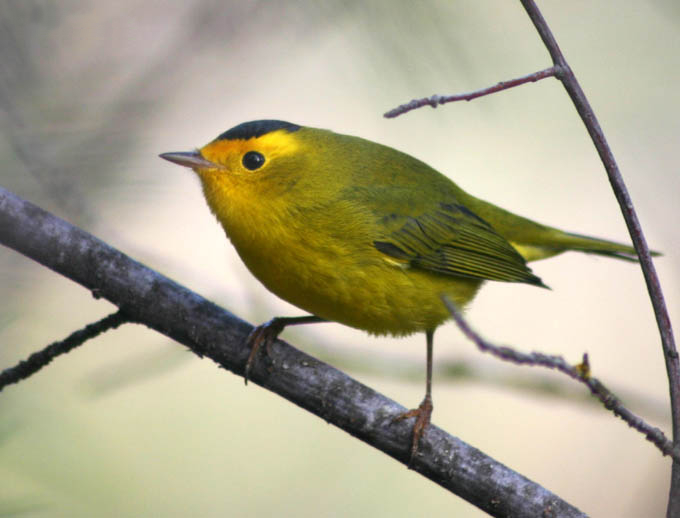
Wilson's Warbler is one of the smallest and most charismatic of North America's wood-warblers, a feather-light scrap of bright lemon-yellow that rarely sits still. Most birders meet it during spring or fall migration, when it flits low through willows, alder thickets, and shrubby edges, constantly flicking its tail and snatching insects from leaf tips. The male's neat black cap, set against an otherwise unmarked yellow head, gives the bird a tidy, almost comical look, as if it were wearing a little beret cocked to one side.
Named for the pioneering Scottish-American ornithologist Alexander Wilson, this warbler breeds across a huge swath of the boreal forest and western mountains and winters in Mexico and Central America. Though still common overall, it has shown long-term declines in parts of its range, particularly in the West, likely tied to the loss and degradation of the moist willow and shrub habitats it depends on. For a backyard birder, spotting one is usually a seasonal treat rather than an everyday event, but its energy and color make it a favorite the moment it appears.
Wilson's Warbler is small even by warbler standards, with a rounded head, a short, thin, pointed bill, and a fairly long, narrow tail that it often holds slightly cocked and flicks expressively. The overall impression is of a plain, vivid yellow bird with no wing bars and no streaking, which already rules out a surprising number of look-alikes.
| Overall color | Bright olive-yellow above, vivid lemon-yellow below, with no streaks, spots, or wing bars. |
| Black cap | Glossy black patch on the crown, sharply defined on males; reduced, dull, or absent on females and immatures. |
| Face | Plain yellow face with a large, dark, beady eye that stands out against the unmarked cheeks. |
| Wings & tail | Plain olive wings (no wing bars) and a longish tail often flicked or held cocked. |
| Bill | Small, thin, pointed, and pale-based, typical of an active insect-gleaning warbler. |
| Size | Tiny and round-headed, noticeably smaller than a Yellow Warbler when seen together. |
Male vs. female
The sexes look broadly similar but differ mainly in the cap. The adult male wears a solid, glossy black cap that contrasts crisply with his bright yellow forehead and face. Females are duller overall, and their cap is variable, some show a partial, smudgy blackish crown, others a greenish-tinged cap with little or no black at all. A bright female can closely resemble a dull male, so the cap is best treated as a strong hint rather than an absolute rule. Both sexes share the same unmarked yellow underparts, plain wings, and big dark eye.
Juveniles
Juvenile and first-fall birds are yellow but noticeably duller and greener than adults, often washed with olive on the head and flanks. Immature females typically show no black cap whatsoever, just a plain olive-yellow crown, which can make them easy to overlook or confuse with other plain warblers. Even on these drab individuals, the combination of small size, plain unmarked plumage, big dark eye, and active tail-flicking helps clinch the identification.
The song is a quick, dry, chattering series of chee-chee-chee-chee-chet-chet notes that typically speeds up and drops in pitch toward the end, giving it a tumbling, run-down quality. It is loud for such a small bird and has a slightly staccato, hard-edged tone rather than a musical warble. Western and eastern populations sing somewhat different versions, so the exact pattern varies geographically.
The most useful call is a sharp, flat, nasal chuf or jip, a distinctive husky chip note that many experienced birders learn to recognize even before seeing the bird. During migration, listening for this dry chip in low thickets is often the first clue that a Wilson's Warbler is nearby.
Wilson's Warbler has one of the broadest breeding ranges of any North American warbler. It nests across the boreal forest of Alaska and Canada and southward through the mountains of the western United States, the Rockies, Sierra Nevada, Cascades, and Pacific coastal ranges, favoring moist willow and shrub habitats near water. Three subspecies groups exist, with the brightest, most orange-tinged birds breeding along the Pacific coast.
It is a long-distance migrant, wintering from Mexico south through Central America to Panama. Across most of the lower 48 it appears only as a migrant, passing through in waves during spring (roughly April to May) and again in late summer through fall (August to October). In the East it is an uncommon but regular migrant, while in the West it is often abundant on passage.
Wilson's Warbler is almost entirely insectivorous, feeding on caterpillars, beetles, aphids, leafhoppers, small bees and wasps, spiders, and other small arthropods. It forages actively and low, working the outer leaves and twigs of shrubs and small trees, often hovering briefly to pick prey from the undersides of leaves or sallying out flycatcher-style to grab flying insects in midair.
This restless, acrobatic foraging style, combined with its near-constant tail-flicking, is itself a useful field mark. On the wintering grounds it will also take some berries and may visit flowering trees for nectar and the insects they attract, but insects and spiders remain the core of its diet year-round.
Wilson's Warbler nests on or very near the ground, typically hidden in dense low vegetation, sedges, or the base of a shrub in moist habitat. The female builds a bulky open cup of leaves, grasses, moss, and bark fibers, lined with finer grass and hair, often tucked into a depression or against a tussock where it is well concealed from above.
The female lays a clutch of about 4 to 6 eggs, which are creamy white with fine reddish-brown speckling, and she does the incubating for roughly 11 to 13 days. Both parents feed the nestlings, which leave the nest after only about 9 to 11 days, often before they can fly well. Pairs typically raise a single brood per season across most of the range, reflecting the short summers of their northern and montane breeding grounds.
Wilson's Warbler is not a feeder bird, it eats insects, not seed, so it will not be tempted by tube feeders or suet. That said, you can absolutely draw migrants to a yard with the right habitat, especially if you live along a migration corridor or near water.
- Plant and keep dense native shrubs, willows, dogwoods, alders, and other moist-loving thickets are exactly the low cover this warbler hunts in.
- Provide moving water: a dripper, mister, or shallow bubbling bath is one of the best ways to pull in migrating warblers of all kinds.
- Avoid pesticides. A yard rich in caterpillars, aphids, and small flying insects is a yard a Wilson's Warbler will actually stop to feed in.
- Let part of the yard grow shrubby and a little wild near a wet spot or stream edge rather than manicuring everything to lawn.
- Time your watching to spring and fall migration, when these birds move through low thickets, that is when a yard is most likely to host one.
- Grow native trees and shrubs that host lots of leaf-eating insects, which provide the protein-rich prey migrants need to refuel.
- Yellow Warbler: Larger and rounder, with a plain yellow head (no black cap), yellow edges in the wings and tail, and faint reddish breast streaks on males. Song is a sweeter, more musical 'sweet-sweet-I'm-so-sweet.'
- Hooded Warbler: Bigger, with a full black hood enclosing the yellow face (not just a cap) and bold white tail spots it constantly flashes. An eastern bird of forest understory rather than the West.
- Yellow-rumped Warbler: Shows wing bars, streaking, and a bright yellow rump patch; much grayer overall and never the clean unmarked lemon-yellow of a Wilson's.
- Orange-crowned Warbler: Drabber and more olive than yellow, with blurry breast streaks and a faint eyeline; lacks the bright clean yellow and the black cap entirely.
How do I tell a Wilson's Warbler from a Yellow Warbler?
Look at the head and size. A male Wilson's has a neat black cap on an otherwise plain yellow head, while a Yellow Warbler has no cap at all and shows yellow edges in the wings and tail (plus faint reddish breast streaks on males). Wilson's is also noticeably smaller and tends to flick its longer tail more.
Do female Wilson's Warblers have the black cap?
Sometimes, but it's variable. Many adult females show a partial, dull, or smudgy cap, and immature females usually have no black at all, just a plain olive-yellow crown. Treat the cap as a strong clue for males but not a requirement for identifying the species.
Will Wilson's Warblers come to my bird feeder?
No. They are insect-eaters and won't take seed or suet. The way to attract them is with habitat, dense native shrubs, no pesticides, and a moving water feature like a dripper or mister, especially during spring and fall migration.
Where and when can I see a Wilson's Warbler?
They breed across Alaska, Canada, and the western mountains in moist willow and shrub habitats, and winter in Mexico and Central America. Most people see them as migrants moving through low thickets in spring (April-May) and fall (August-October). They're abundant on passage in the West and uncommon but regular in the East.
What does a Wilson's Warbler sound like?
The song is a dry, fast, chattering series of chip notes that speeds up and drops in pitch at the end, like a little run-down trill. The most distinctive sound is its sharp, husky 'chuf' or 'jip' call note, which is often the first clue that one is hiding in nearby brush.