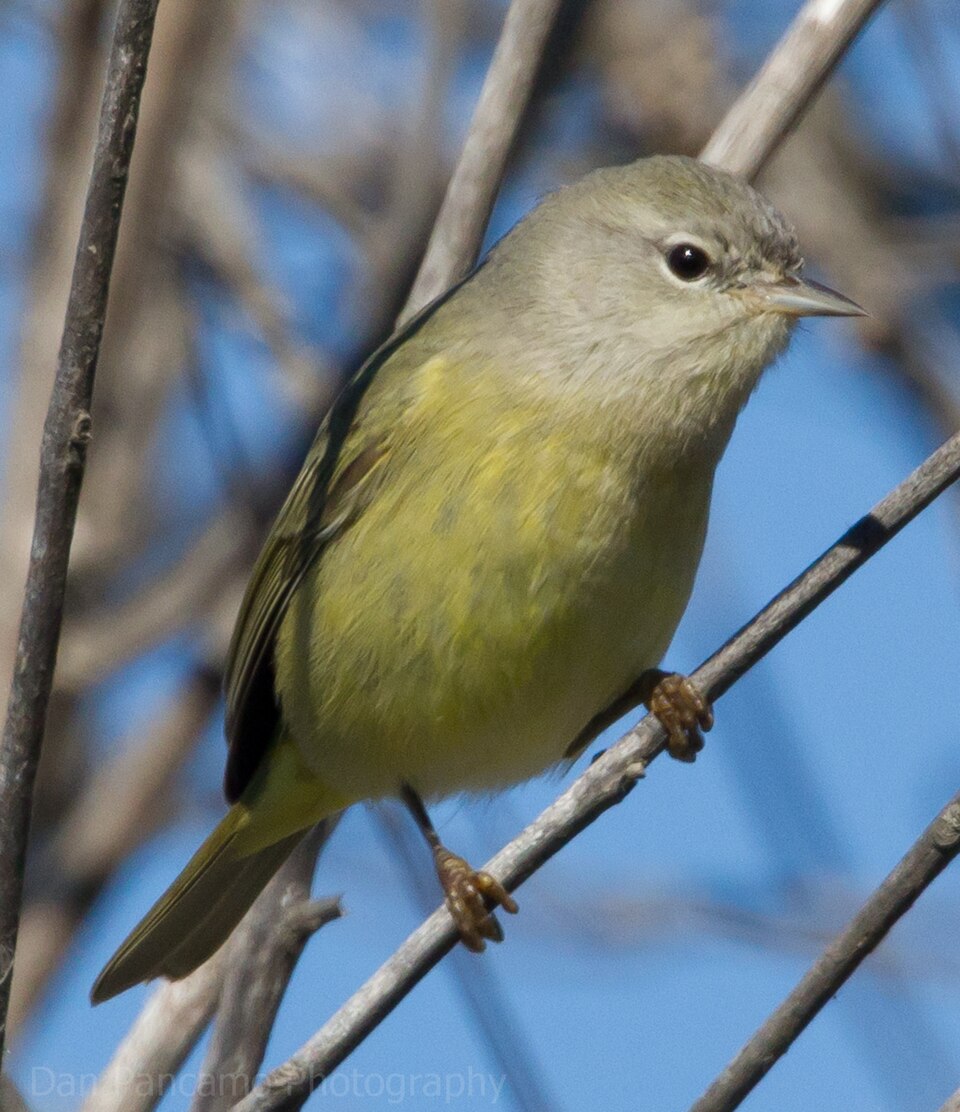
The Orange-crowned Warbler is one of North America's least flashy wood-warblers, and that plainness is its calling card. While most warblers wear bold patterns of black, white, and brilliant yellow, this bird is a study in muted olive and yellow-green with almost no field marks to grab onto. Birders sometimes joke that the way to identify it is by its lack of identification points. The "orange crown" of its name is a small patch of rusty-orange feathers on the top of the head that stays hidden under the olive crown feathers almost all the time, flashing into view only when the bird is excited or agitated.
Despite being overlooked, it is a widespread and successful species, breeding across a huge swath of the West, Alaska, and Canada, and wintering farther north than nearly any other warbler. It is hardy, adaptable, and quietly common, foraging low in shrubs and brushy tangles where it is easy to miss. For backyard birders in the South and along the coasts, it is a familiar cool-season visitor, occasionally even coming to feeders for suet or sugar water when insects are scarce.
This is a small, slim, sharp-billed warbler with a gentle, rounded look and a habit of foraging actively but unobtrusively low in vegetation. Its overall impression is "plain greenish-yellow bird with a fine pointed bill" and a faint dark line through the eye. The trick to identifying it is ruling out the more strongly patterned warblers it resembles.
| Overall color | Drab olive-green above, dull yellowish below, with no wing bars and no bold pattern anywhere |
| Crown patch | A small rusty-orange patch on the crown, usually hidden; rarely visible except when the bird is agitated |
| Eye line & arc | Thin dark line through the eye and a faint, broken pale eye-ring or arcs above and below the eye |
| Undertail | Bright yellow undertail coverts, often the most colorful part of the bird |
| Breast streaking | Faint, blurry, diffuse streaking on the breast (best seen in good light), unlike clean-breasted lookalikes |
| Bill & shape | Fine, sharply pointed dark bill; slim body; relatively long tail it often flicks |
Male vs. female
Males and females look essentially alike and cannot be reliably separated in the field. Both sexes share the same plain olive-yellow plumage and the concealed orange crown patch, though the crown patch tends to be a little larger and brighter on males. In the hand, banders may find males average slightly brighter and larger, but for backyard observers, assume the sexes are identical.
Juveniles
Juveniles and first-fall birds are even plainer and grayer than adults, often looking dingy gray-olive with little yellow and almost no trace of the orange crown, which is reduced or absent in young birds. Fall immatures can be especially confusing, appearing washed-out and featureless; focus on the yellow undertail coverts, the faint blurry breast streaks, and the lack of wing bars to confirm the identification.
The song is a high, thin trill that characteristically changes pitch or speed partway through, often dropping or weakening at the end so it seems to trail off or "fall apart." A common rendering is a dry tititititi-tetetete that starts on one pitch and drops to a lower, slower note near the finish. It is easy to confuse with the trills of Chipping Sparrow or Dark-eyed Junco, but the warbler's trill is usually thinner, less even, and tends to taper rather than stay machine-like.
The most useful sound for identification is the call note: a sharp, hard, metallic stik or chip with a distinctive clipped, almost stony quality. Once learned, this call reliably betrays the bird as it works through low brush.
Orange-crowned Warblers breed across western North America, from Alaska and the boreal forests of Canada south through the Rocky Mountains and the Pacific states. They favor shrubby openings, brushy hillsides, willow thickets, chaparral, and the edges of woodlands rather than deep mature forest.
They are notably hardy migrants and winter farther north than most warblers, common across the southern United States, the Gulf Coast, the Southwest, California, and down into Mexico and Central America. Some linger along the Atlantic and Pacific coasts well into the cold season. For much of the southern and coastal U.S., this is primarily a fall, winter, and early-spring bird, arriving as the breeding warblers depart.
The Orange-crowned Warbler is mainly an insectivore, gleaning small caterpillars, beetles, true bugs, aphids, spiders, and other invertebrates from leaves, twigs, and flower clusters. It forages actively and acrobatically, often hanging upside down to probe curled leaves and frequently visiting flowering shrubs and trees to feed on the insects drawn to blossoms.
It is unusually flexible for a warbler and readily supplements its diet with plant matter, taking berries, fruit, and especially nectar and sap. It will visit hummingbird feeders for sugar water, drink from sap wells drilled by sapsuckers, and probe flowers directly. This willingness to eat soft plant foods is part of why it can survive farther north in winter than its strictly insect-eating relatives.
Orange-crowned Warblers are ground or near-ground nesters, an unusual habit among warblers. The female typically builds a bulky open cup of grasses, leaves, bark strips, and fine plant fibers, lined with fur and fine grass, tucked into a hollow on a slope, at the base of a shrub, or low in dense vegetation where it is well hidden.
The female does most of the nest-building and incubation, with the male helping to feed the young. Eggs are creamy white with fine reddish-brown speckling, often concentrated at the larger end. The well-concealed ground nests make this an easy species to overlook on the breeding grounds.
Orange-crowned Warblers are not classic seed-feeder birds, but in fall and winter across the South and coasts they are one of the more feeder-tolerant warblers, and a thoughtfully planted, shrubby yard can host them regularly.
- Offer suet, suet dough, or bark butter smeared on trees or in feeders; these soft, insect-substitute foods are the most reliable draw in winter.
- Put up a hummingbird feeder with sugar water and keep it up through the cool season; Orange-crowned Warblers will sip from the ports.
- Plant native berry shrubs and nectar-rich flowering plants, and leave brushy edges and leaf litter intact so they can glean insects low to the ground.
- Provide a shallow water source or dripper; these active foragers will visit baths for drinking and bathing.
- Avoid pesticides so caterpillars, aphids, and spiders remain available; the warblers do real pest control as they forage your shrubs.
- Watch low, shrubby, brushy areas rather than the treetops; this bird forages near the ground and rarely sits high in the open.
- Tennessee Warbler: Cleaner and grayer-headed with a sharper white eyebrow and bright white (not yellow) undertail coverts; lacks the blurry breast streaking.
- Nashville Warbler: Has a gray head contrasting with a bold complete white eye-ring and a brighter yellow throat and breast; cleaner-looking overall.
- Yellow Warbler: Much brighter, uniformly yellow with a plain face and yellow wing edgings; males show reddish breast streaks. No olive drabness.
- Wilson's Warbler: Brighter yellow below with a beady black eye on a plain yellow face; males show a neat black cap. More animated tail-flicking.
Why can't I see the orange crown on an Orange-crowned Warbler?
The orange crown patch is almost always concealed beneath the olive crown feathers. It only flashes into view when the bird is excited, agitated, or displaying, and on many individuals (especially females and young birds) it is small or nearly absent. Most birders go their whole lives rarely or never seeing it, so do not rely on it for identification.
How do I tell an Orange-crowned Warbler from other plain warblers?
Look for the combination of no wing bars, dull olive-yellow plumage, faint blurry streaking on the breast, a thin dark eye line, and especially the bright yellow undertail coverts. The hard, metallic chip call is also distinctive. Compare carefully with Tennessee, Nashville, and Yellow Warblers, which are all cleaner or brighter.
When and where am I most likely to see one?
In most of the southern and coastal U.S. it is a fall, winter, and early-spring visitor, arriving after the breeding warblers leave. Search low in shrubs, brushy edges, willow thickets, and weedy tangles rather than in treetops. In the West, Alaska, and Canada it breeds in shrubby habitats through the warmer months.
Will Orange-crowned Warblers come to feeders?
They are not seed eaters, but among warblers they are unusually feeder-friendly in winter. They will take suet, suet dough, and bark butter, and they readily sip sugar water from hummingbird feeders. Native berry and nectar plants plus a brushy, pesticide-free yard improve your chances.
Are Orange-crowned Warblers rare or declining?
No. They are common and widespread, listed as Least Concern, and their populations are generally stable. They are simply overlooked because they are plain, forage low and quietly, and are easy to mistake for other drab birds.