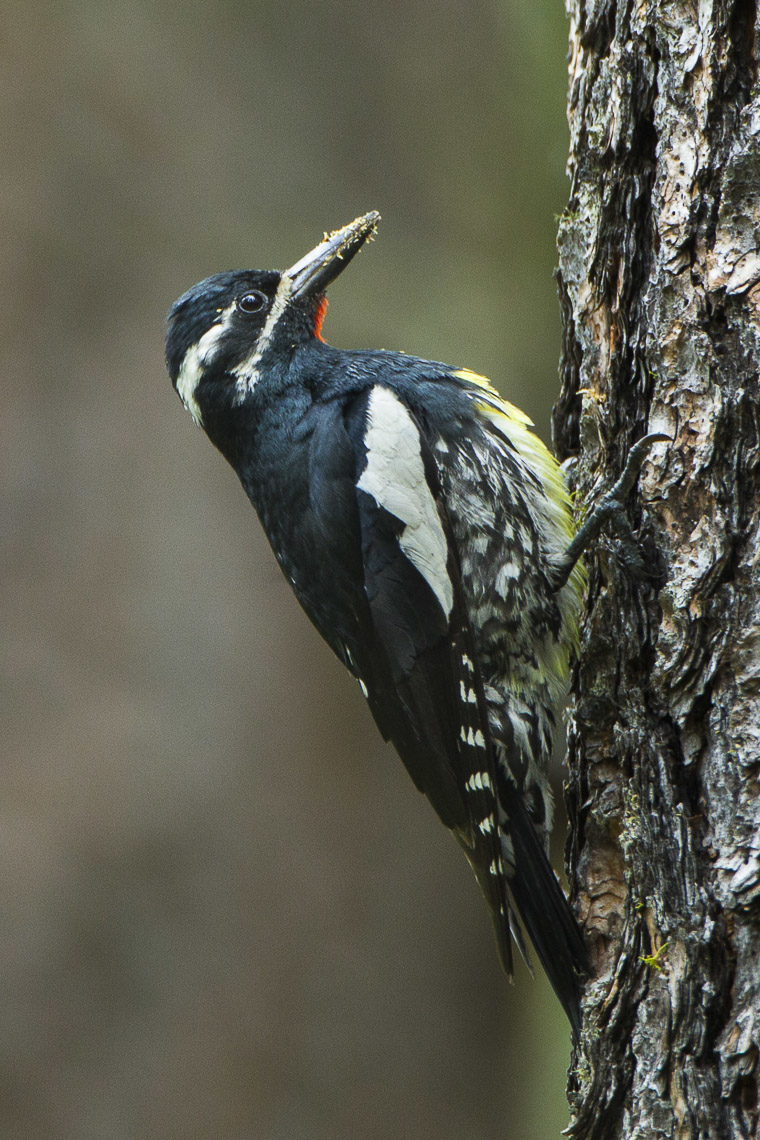
Williamson's Sapsucker is a striking, mountain-loving woodpecker of the western conifer forests, and it owns one of the most famous backstories in North American birding. The male and female look so unalike that early naturalists described them as two entirely separate species for nearly two decades. The boldly black-and-white male was called "Williamson's Sapsucker," while the brown, heavily barred female went by "Black-breasted Woodpecker." Only when a pair was finally watched at the same nest hole did ornithologists realize they were male and female of one bird. No other woodpecker in North America shows such extreme differences between the sexes.
This is a bird of high elevations, tied closely to pines, firs, and especially larches and other conifers across the mountain West. Like other sapsuckers, it drills neat rows of small wells in tree bark and feeds on the sap that flows out, along with the insects the sap attracts. It is generally quieter and less conspicuous than its cousin the Red-naped Sapsucker, and birders often track it down by listening for its distinctive irregular drumming or its harsh, descending call echoing through a stand of old conifers.
A medium-sized, sturdy woodpecker with a stout chisel bill, fairly long wings, and a stiff tail used as a prop against tree trunks. Size and shape are similar to other sapsuckers, but the plumage is unmistakable once you know which sex you are looking at, and the two sexes look nothing alike.
| Male overall | Mostly glossy black with a bold white wing patch, white facial stripes, a bright yellow belly, and a small red throat patch. |
| Female overall | Cryptic brown with dense black barring on the back, wings and flanks; a brown head and pale-barred body, looks like a totally different bird. |
| Wing patch | On the male, a large clean white patch on the folded wing is a key field mark, obvious in flight and at rest. |
| Rump | Both sexes show a bright white rump that flashes conspicuously when the bird flies away. |
| Belly | Both sexes have a yellow belly, though it is brighter and more obvious on the black male. |
| Bill and posture | Straight, chisel-tipped bill; clings vertically to trunks and braces with a stiff tail like all woodpeckers. |
Male vs. female
This is the textbook case of extreme sexual dimorphism in woodpeckers. The male is mostly glossy black with two thin white stripes on the face, a large white patch on the wing, a yellow belly, a white rump, and a small red throat patch. The female is brown overall with fine black-and-white barring across her back, wings, and sides, a plain brownish head, a black patch on the breast, and a yellow belly. They are so different that for nearly 20 years they were catalogued as two separate species. If you see a black-and-white bird and a brown barred bird working the same conifer, you are very likely watching a mated pair.
Juveniles
Juveniles resemble a duller, plainer version of the adult of their sex but lack the crisp markings. Young males begin showing the black-and-white pattern and yellow belly but with less gloss and a weaker or absent red throat early on. Young females look much like adult females, brown and barred, but more muted, with a less distinct breast patch. By their first winter, birds are largely adult-like, and the sexes are again easy to tell apart.
Williamson's Sapsucker is not a true songbird, so "song" really means its calls and drumming. The most frequent vocalization is a harsh, slightly nasal, descending cheeer or cheeurr, often given a few times in a row and a bit lower and rougher than the mewing calls of Red-naped Sapsucker. You may also hear a softer chatter or a series of chyah notes around the nest.
The drum is one of the best clues to its presence: an irregular, stuttering roll that starts with a few strong, evenly spaced taps and then trails off into a faster, fading flurry, described by many birders as a Morse-code-like pattern rather than the steady machine-gun roll of some woodpeckers. Once learned, this broken cadence is a reliable way to pick the species out in a quiet conifer forest.
Williamson's Sapsucker breeds in the mountains of western North America, from the interior of British Columbia south through the Rockies, the Great Basin ranges, the Sierra Nevada, and the mountains of the Southwest into the highlands of northern Mexico. It is a bird of mid-to-high elevation conifer forest, favoring stands of ponderosa pine, lodgepole pine, fir, and larch, often where mature trees and a mix of conifers come together.
It is a partial migrant. Northern and high-elevation breeders move south and downslope for winter, with many wintering in the mountains and pine-oak woodlands of the southwestern United States and Mexico. Some birds in milder parts of the range shift only short distances. In winter it is generally scarcer and more easily overlooked, and stray individuals occasionally turn up well outside the normal range.
True to its name, this sapsucker relies heavily on tree sap. It drills tidy, shallow wells in the bark of conifers, and during the breeding season strongly favors a single "tap tree" or two that it tends like a small orchard. The bird laps up the sap with its brush-tipped tongue and also eats the insects, especially ants, that the sap and wells attract. Ants are an especially important food, and parents feed great quantities of them to their nestlings.
Its feeding shifts with the seasons: more sap in spring as it gets the wells flowing, more insects through summer, and a mix of sap, insects, and some fruit and conifer products at other times. Because it depends on living conifers for sap, it is more tightly bound to coniferous forest than most other sapsuckers, which is part of why it is found at the elevations and habitats it is.
Williamson's Sapsuckers are cavity nesters. The pair excavates a fresh hole in a dead or dying tree, often a large conifer or sometimes an aspen with heart rot that makes digging easier, frequently fairly high off the ground. Interestingly, pairs often reuse the same nest tree (though usually a new cavity) over successive years, so a good "sapsucker tree" can host the species for a long time.
The female lays a clutch of white eggs, and both parents share incubation, with the male typically taking the night shift. Both adults feed the young, ferrying loads of ants and other insects into the cavity. After the nestlings fledge, the parents continue to tend them for a while as they learn to forage. The species normally raises a single brood per year.
This is not a backyard feeder bird in any typical sense, it does not come to seed, suet, or nectar feeders the way chickadees or downy woodpeckers do, and it needs mature mountain conifer forest. You won't lure one to a suburban yard. But if you live in or visit its range, there are real ways to find and support it.
- Go where it lives: search mid-to-high elevation conifer forests, ponderosa and lodgepole pine, fir, and larch stands, during the breeding season for your best odds.
- Look for sap wells: rows of neat, shallow holes drilled in conifer bark are a tell-tale sign; a tended "tap tree" may have a resident bird nearby.
- Listen for the broken drum: learn the irregular, stuttering, fading drum pattern and the harsh descending cheeer call to locate birds you can't see.
- Protect mature and dead trees: if you own forested mountain land, leaving large live conifers and standing dead snags provides both sap sources and nesting cavities.
- Watch for pairs: a black-and-white bird and a brown barred bird in the same conifer almost always means a mated pair, a great way to confirm the species.
- Red-naped Sapsucker: Both sexes have a red forehead and bold white wing stripe with a red throat; far less difference between sexes, and favors aspen and willow more than pure conifer.
- Red-breasted Sapsucker: Has a fully red head and breast in both sexes; a Pacific bird with no extreme male/female difference.
- Yellow-bellied Sapsucker: Eastern counterpart; males and females look similar to each other with a red forehead and white wing stripe, nothing like the black male Williamson's.
- Hairy Woodpecker: Black-and-white but with a long bill and clean white back, no yellow belly or white rump, and males show only a small red nape patch.
Why do male and female Williamson's Sapsuckers look so different?
They show the most extreme sexual dimorphism of any North American woodpecker. The male is glossy black with white face stripes, a white wing patch and yellow belly, while the female is brown and heavily barred. The difference is so dramatic that for years they were described as two separate species before a nesting pair revealed the truth.
Were Williamson's Sapsuckers really once thought to be two species?
Yes. The black-and-white male was named Williamson's Sapsucker and the brown female was named the Black-breasted Woodpecker. They were treated as separate species for nearly two decades until observers watched a male and female attending the same nest and realized they were one bird.
Where can I see a Williamson's Sapsucker?
Look in mid-to-high elevation conifer forests of the mountain West, from British Columbia and the Rockies through the Great Basin, Sierra Nevada, and southwestern mountains into northern Mexico. Stands of ponderosa pine, lodgepole pine, fir, and larch are prime habitat, especially in the breeding season.
What does a Williamson's Sapsucker eat?
Mainly tree sap, which it gets by drilling neat rows of wells in conifer bark, plus insects, especially ants, that it laps up and feeds heavily to its young. Its diet shifts toward more sap in spring and more insects in summer, with some fruit at other times.
Will Williamson's Sapsuckers come to a backyard feeder?
Generally no. They are tied to mature mountain conifer forest and feed on sap and insects rather than seed or suet, so they don't visit typical backyard feeders. The best way to see one is to visit its forest habitat and watch for sap wells and listen for its drumming.