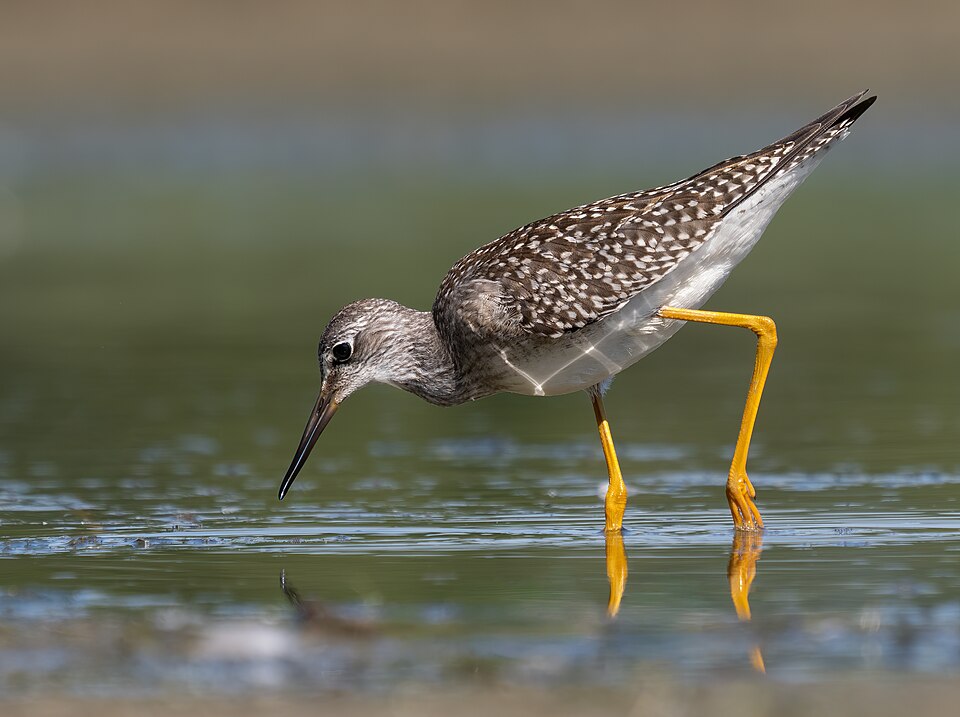
The Lesser Yellowlegs is one of North America's most graceful sandpipers, a slender, long-legged wader instantly recognized by its slim build and bright, almost neon-yellow legs. Trim and active, it picks its way through the shallows of mudflats, flooded fields, and marsh edges with a light, dancing step, often pausing to bob its head and front half of its body in a gentle teetering motion. For many birders, it is the quintessential migrant shorebird of late summer and fall, turning up in small flocks wherever shallow water meets open ground.
Though it breeds in the remote boreal forest and subarctic of Canada and Alaska, the Lesser Yellowlegs is most familiar to people far to the south during migration, when it passes through the Lower 48 in large numbers on its way to and from wintering grounds spread across the southern United States, the Caribbean, and South America. It is a long-distance traveler that has, unfortunately, declined sharply in recent decades, making every sighting of this elegant bird a small reminder of the long journeys shorebirds make twice each year.
Look for a medium-small, distinctly slim shorebird that stands tall on long legs, with a body roughly the size of a robin but appearing larger because of those legs and neck. The silhouette is delicate and balanced, with a straight, thin, needle-like bill about as long as the head and a smoothly rounded body that tapers to a longish tail. In flight it shows plain wings without a wing stripe and a clean white rump and lower back.
| Legs | Long and bright yellow to yellow-orange, the signature field mark, vivid even at a distance |
| Bill | Thin, straight, and dark, roughly equal to the head length; fine and needle-like, not upturned |
| Body | Slim and elegant; gray-brown above with fine pale spotting, paler and streaked on the neck and breast, white belly |
| Rump in flight | Bright white rump and lower back contrasting with plain, unmarked dark wings (no wing stripe) |
| Size & shape | Medium-small, trim, long-necked; noticeably smaller and more delicate than the Greater Yellowlegs |
| Behavior | Picks daintily at the surface, often wades belly-deep, gives a soft head-bobbing teeter |
Male vs. female
Males and females look essentially alike in plumage and cannot be reliably told apart in the field by color or pattern. Females average very slightly larger than males, but the overlap is so great that this is rarely useful when watching a single bird. Both sexes wear the same gray-brown breeding plumage, mottled above and finely streaked across the neck and breast, and both fade to a plainer, grayer nonbreeding look in winter.
Juveniles
Juvenile Lesser Yellowlegs, the birds most often seen migrating south in late summer and early fall, are particularly crisp and neat. Their upperparts are warm brownish-gray, each feather edged and spotted with buff and white, giving a finely beaded, scaly appearance that is cleaner and more uniform than the worn, mottled look of adults at that season. The breast shows a soft gray-buff wash with fine streaking rather than bold markings. As always, the bright yellow legs and slim straight bill remain the most reliable clues to the bird's identity.
The most familiar sound is the flight call, a soft, mellow tu or tu-tu, typically just one or two notes, gentle and somewhat flat. This short, even call is one of the best ways to separate it from the Greater Yellowlegs, which gives a louder, more emphatic three-to-four-note tew-tew-tew that carries farther and sounds more ringing and insistent.
On the breeding grounds, displaying birds give a rolling, repeated song often written as pill-a-wee, pill-a-wee, delivered from the air or from a perch atop a spruce. When alarmed near a nest or chicks, adults launch into persistent, scolding yelps and will circle and call overhead until the intruder moves on.
Lesser Yellowlegs breed across the boreal forest, wooded tundra, and subarctic wetlands of Alaska and northern Canada, favoring open bogs, marshy clearings, and burned forest near water. They are long-distance migrants: in spring they move north through the interior and along both coasts, and in fall, often beginning as early as July with failed breeders and adults, followed by juveniles into September and October, they spread widely across the continent.
During migration they can show up almost anywhere there is shallow water, from coastal mudflats and salt marshes to inland ponds, flooded fields, sewage lagoons, and reservoir edges. Wintering birds occupy the southern United States (especially the Gulf and southern Atlantic coasts), Mexico, Central America, the Caribbean, and a broad swath of South America, with some traveling as far as Argentina and Chile.
The Lesser Yellowlegs feeds mainly on small aquatic invertebrates, insects and their larvae, tiny crustaceans, worms, snails, and the occasional small fish or seeds. It forages by walking briskly through shallow water and soft mud, picking food from the surface or just below it with quick, delicate jabs of its thin bill. Unlike some sandpipers that probe deep into mud, it tends to feed at or near the surface, often snatching prey it spots visually.
It will sometimes wade up to its belly, sweep its bill side to side through the water, or dash a few steps to chase down active insects. Lesser Yellowlegs frequently feed in loose, sociable groups, mixing with other shorebirds, and are commonly seen at the edges of flooded agricultural fields and shallow impoundments where insect life is abundant.
Nesting takes place in the northern boreal and subarctic, where pairs settle in open, marshy clearings, bogs, and recently burned forest. The nest is a simple, well-hidden scrape on the ground, often near a fallen log, low shrub, or clump of grass, lined sparingly with leaves and lichen. Both parents share incubation duties.
A typical clutch is four eggs, buff or olive and heavily blotched with brown, arranged points-inward in the nest. There is a single brood per year. The downy young leave the nest soon after hatching and feed themselves, while the watchful adults stand guard, frequently perching conspicuously on treetops and giving loud alarm calls, even dive-bombing intruders that wander too close to the chicks.
The Lesser Yellowlegs is not a backyard or feeder bird, and you won't draw it in with seed or suet. It is a wetland specialist, so the way to "attract" it is to put yourself near the shallow, open water it favors during migration, or, if you have the land and the water, to create that habitat.
- Visit shallow wetland habitat in migration: mudflats, flooded fields, sewage lagoons, and reservoir edges are reliable hotspots, especially July through October.
- Time your search for fall migration, when juveniles and adults move south in numbers, early mornings and falling water levels concentrate the birds.
- If you manage land, maintain shallow, muddy-margined water with gently sloping edges; flooded or partially drawn-down impoundments are magnets for foraging shorebirds.
- Scan flocks of mixed shorebirds carefully, Lesser Yellowlegs often feed alongside dowitchers, peeps, and other sandpipers.
- Bring a spotting scope: their bright yellow legs and slim shape are easiest to confirm at a distance across open flats.
- Avoid flushing feeding flocks, keep your distance so migrating birds can refuel undisturbed.
- Greater Yellowlegs: Larger and bulkier with a longer, slightly thicker bill that often looks faintly upturned; gives a loud, ringing three-to-four-note call versus the Lesser's soft one or two notes.
- Solitary Sandpiper: Smaller with dull greenish (not bright yellow) legs, a bold white eyering, and a dark rump with barred tail sides in flight; usually seen alone at wooded pond edges.
- Stilt Sandpiper: Similar long greenish-yellow legs but has a longer, drooping bill and feeds with a deliberate, sewing-machine probing motion; shows a rusty cheek patch in breeding plumage.
- Wilson's Phalarope: Comparable slim build but spins in circles on the water to feed and has a needle-fine bill; legs are not the vivid yellow of the yellowlegs.
How do you tell a Lesser Yellowlegs from a Greater Yellowlegs?
Size and structure are the keys: the Lesser is noticeably smaller and slimmer with a thin, straight bill about as long as its head. The Greater is bulkier with a longer, slightly thicker bill that often looks faintly upturned. Voice is the clincher, the Lesser gives a soft one- or two-note 'tu,' while the Greater gives a loud, ringing three- or four-note call.
Why are they called yellowlegs?
For the obvious reason: both yellowlegs species have long, bright yellow to yellow-orange legs that stand out vividly against mud and water. The leg color is one of their most reliable field marks, visible even from a distance.
When and where can I see Lesser Yellowlegs?
They are most widespread during migration. Fall passage runs from July into October, when they appear on mudflats, flooded fields, pond edges, and lagoons across much of the continent. Spring migration is more concentrated. They breed in the far northern boreal forest and winter in the southern U.S., the Caribbean, and South America.
Are Lesser Yellowlegs rare or declining?
They are still common and listed as Least Concern globally, but populations have declined substantially in recent decades. Habitat loss along migration routes and unregulated hunting in parts of the Caribbean and South America are believed to be major factors, making them a shorebird of conservation concern.
What does a Lesser Yellowlegs eat?
Mostly small aquatic invertebrates, insects and their larvae, tiny crustaceans, worms, and snails, with occasional small fish or seeds. It feeds by walking through shallow water and picking prey from the surface with quick jabs of its thin bill, sometimes wading belly-deep.