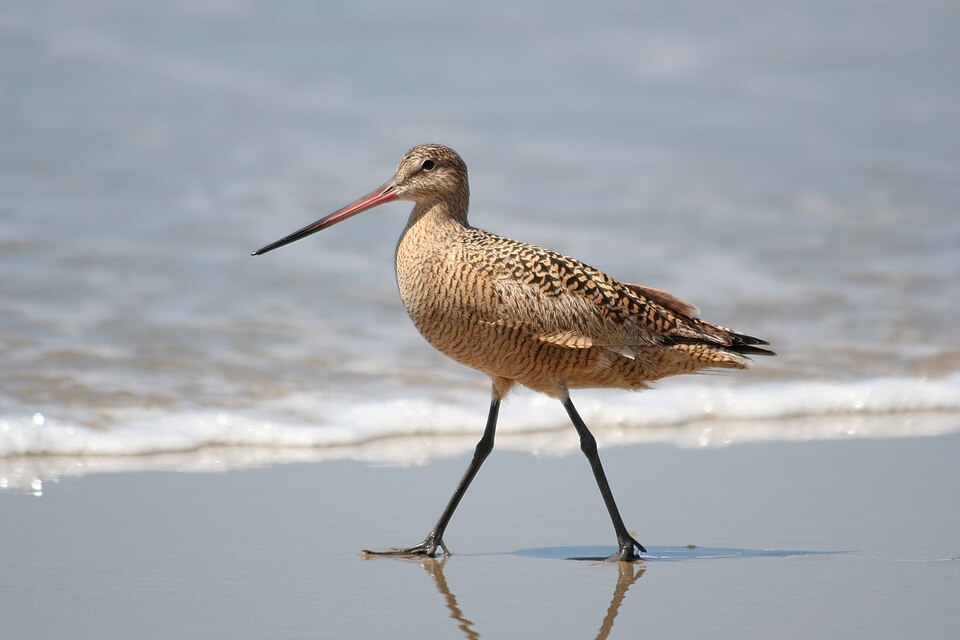
The Marbled Godwit is one of North America's largest and most striking shorebirds, a long-legged wader the warm color of buttered toast. Stand on a mudflat at low tide and you can pick it out from a distance: a tall, bulky sandpiper with a remarkably long, slightly upturned bill that fades from bright pink at the base to black at the tip. Whether wading belly-deep in a Gulf Coast estuary in winter or striding through a shortgrass prairie in summer, it carries itself with an unhurried, deliberate grace.
For all its size and beauty, the Marbled Godwit lives a bit of a double life. Most birders meet it on the coasts, where it gathers in flocks on tidal flats and beaches. But it breeds far inland, on the northern Great Plains, where its survival is tied to native grassland and shallow prairie wetlands. That makes it both a familiar coastal sight and a species worth caring about, since the prairie habitat it depends on for nesting has shrunk dramatically over the past century.
Size and that bill do most of the identification work. The Marbled Godwit is a heavy, long-necked, long-legged shorebird, noticeably bigger than the dowitchers and Willets it often feeds alongside. The single best field mark is the long bill: distinctly upturned and two-toned, pink to orange at the base and dark toward the tip. The overall plumage is warm buffy-cinnamon, mottled and barred above ("marbled," as the name promises), giving it a uniform tawny look at a glance.
| Bill | Very long, slightly upturned, two-toned: pinkish-orange at base fading to black at the tip |
| Overall color | Warm cinnamon-buff throughout, with mottled barring on the back and underparts |
| Size & shape | Large and bulky, long-necked and long-legged; one of the biggest shorebirds in its range |
| Wings in flight | Bright cinnamon underwing linings flash conspicuously; no bold wing stripe |
| Legs | Long and bluish-gray to dark gray |
| Breeding vs nonbreeding | Heavier dark barring below in breeding season; plainer, more uniform buff in winter |
Male vs. female
Males and females look essentially alike in plumage, both showing the same warm cinnamon tones and two-toned upturned bill. The main difference is size: females average noticeably larger than males and tend to have longer bills. In a mixed group you may be able to pick out a long-billed, bulkier bird as a likely female, but a lone individual generally can't be sexed in the field with confidence.
Juveniles
Juvenile Marbled Godwits resemble nonbreeding adults but look crisp and neat, with cleanly patterned, buff-edged feathers on the back giving a more scaled, fresh appearance. Their underparts are plainer and more uniformly buff, lacking the heavy dark barring of a breeding adult. The bill on a young bird is often shorter and may show less extensive pink at the base early on. By their first winter they are very hard to separate from adults.
On the breeding grounds the Marbled Godwit is loud and insistent. Its signature call is a ringing, nasal god-WIT, god-WIT that gives the bird its name, often repeated as it circles in display or scolds an intruder near the nest. Agitated birds give a rapid, laughing series of kerek-kerek-kerek or radica-radica notes.
Away from the nesting prairie, on coastal flats, it is generally much quieter. Flushed flocks may give short, low kweh or kah notes, but you won't hear the full god-wit chorus you get on the Great Plains in early summer.
Marbled Godwits breed mainly on the northern Great Plains, from the prairie provinces of Canada (Alberta, Saskatchewan, Manitoba) south into the Dakotas and Montana, favoring native grassland near shallow wetlands. Two small, isolated breeding populations exist well outside this core range, one around James Bay in Canada and another on the Alaska Peninsula.
In winter the species shifts to the coasts. Large numbers gather along the Pacific Coast from the central California estuaries (Humboldt Bay, San Francisco Bay) south into Mexico, and along the Gulf Coast and southern Atlantic Coast. Migration carries them between these wintering flats and the prairie breeding grounds in spring and late summer, with fall movement starting surprisingly early as failed and post-breeding birds head coastward by July.
The Marbled Godwit is a probing feeder, and its long, sensitive bill is the key tool. On tidal flats and beaches it walks steadily through soft mud and sand, plunging the bill deep, often right up to the face, to feel out buried prey by touch. It takes marine worms, small clams and other bivalves, crustaceans such as small crabs and shrimp, and various other invertebrates hidden below the surface.
On the breeding prairie its diet shifts toward terrestrial and freshwater fare: insects and their larvae, aquatic invertebrates from shallow wetlands, and sometimes plant material like the roots and seeds of grasses and sedges. Whether on coast or prairie, it tends to feed in a deliberate, methodical way rather than the quick darting of smaller sandpipers.
Marbled Godwits nest on the ground in open grassland, typically in shortgrass or mixed-grass prairie near shallow wetlands. The nest is a simple shallow scrape lined with grass, sometimes partly concealed by surrounding vegetation and sometimes surprisingly exposed in low cover. The species is loosely colonial in good habitat, and pairs vigorously defend their territory, circling and calling loudly at intruders, including people and predators.
The typical clutch is four eggs, olive to buff with darker blotching that camouflages them against the prairie. Both parents share incubation, which lasts a bit over three weeks, and the downy chicks are precocial, leaving the nest soon after hatching to feed themselves while the attentive adults stand guard. There is a single brood per year.
The Marbled Godwit is not a backyard or feeder bird, so there's no seed mix or feeder setup that will draw one in. It needs open mudflats, estuaries, and beaches in the nonbreeding season and native prairie wetlands to breed. The best way to "attract" this bird is to go where it lives and to support the habitats it depends on.
- Visit coastal estuaries and tidal mudflats at low to mid tide in fall, winter, and spring, when birds are actively probing the exposed flats.
- Bring a spotting scope; godwits often feed at a distance across open flats and are easier to enjoy magnified.
- Time outings around rising tide, which pushes feeding flocks closer to shore and concentrates them at high-tide roosts.
- On the Great Plains in late spring and early summer, scan native grassland near shallow wetlands and listen for the ringing god-wit calls.
- Support grassland and wetland conservation, since loss of native prairie is the main long-term threat to the breeding population.
- Hudsonian Godwit: Smaller and cooler-toned; in flight shows a bold white wing stripe and black-and-white tail, plus blackish underwings rather than cinnamon.
- Long-billed Curlew: Similar warm cinnamon color and size, but its very long bill curves strongly downward instead of slightly upward.
- Bar-tailed Godwit: A rare visitor in most of North America; smaller, with a barred tail and white belly, and lacks the uniform cinnamon wash of the Marbled.
- Willet: Grayer and stockier with a shorter, straight bill; in flight flashes a striking black-and-white wing pattern very unlike the godwit's plain cinnamon wings.
How do you tell a Marbled Godwit from a Long-billed Curlew?
Both are big and cinnamon-colored, but the bill tells them apart instantly: the Marbled Godwit's long bill is slightly upturned and pink-based, while the Long-billed Curlew's even longer bill curves strongly downward. The curlew also tends to look a touch more buffy on the belly and is often found in drier upland habitat.
Why is it called a godwit?
The name comes from the bird's loud breeding call, a ringing, nasal god-WIT, god-WIT that it gives while circling and defending its prairie nesting territory. The word is old, likely echoing that very call, and all godwit species share variations of the sound.
Where can I see a Marbled Godwit?
In fall through spring, look on coastal mudflats, estuaries, and beaches, especially along the California coast, the Gulf Coast, and the southern Atlantic. In late spring and summer they breed inland on the northern Great Plains in native grassland near shallow wetlands, where they are noisy and conspicuous.
What does a Marbled Godwit eat?
It probes deep into mud and sand with its long bill to find buried prey by touch, taking marine worms, small clams, crabs, shrimp, and other invertebrates on the coast. On the breeding prairie it eats insects, aquatic invertebrates, and some plant material like grass roots and seeds.
Are Marbled Godwit males and females different?
They look alike in color and pattern, both warm cinnamon with a two-toned upturned bill. The main difference is size: females average larger and longer-billed than males, though a single bird usually can't be sexed reliably in the field.