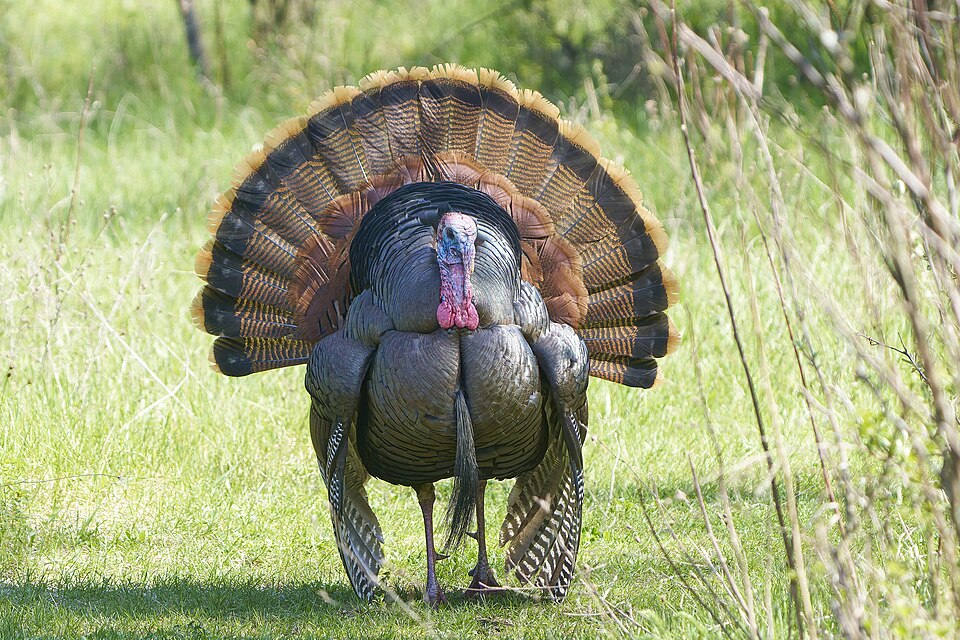
The Wild Turkey is one of North America's largest and most recognizable birds, a hefty, ground-dwelling member of the pheasant family that struts through woodlands, field edges, and increasingly suburban neighborhoods across the continent. A big tom can stand nearly waist-high to an adult and weigh more than 20 pounds, making it one of the heaviest birds most people will ever see in the wild. Despite that bulk, turkeys are surprisingly agile: they run quickly, fly powerfully over short distances, and roost high in trees every night.
This is a genuine conservation success story. By the early 1900s, overhunting and habitat loss had wiped Wild Turkeys out of much of their former range, leaving perhaps a few hundred thousand birds. Decades of trap-and-transfer restoration and habitat recovery brought them roaring back, and today they thrive in all 49 mainland states. The bird is also a cultural icon, tied to American Thanksgiving and famously praised by Benjamin Franklin, and it remains the wild ancestor of the domestic turkey on dinner tables worldwide.
There is little to confuse a Wild Turkey with once you get a clear look. It is enormous, dark, and long-legged, with a small, bare head on a long neck and a broad, fan-shaped tail. The body plumage looks dull brown or black from a distance but flashes coppery, bronze, and green iridescence in good light. The naked head and the way these birds walk in flocks across open ground are unmistakable field marks.
| Size & shape | Very large, plump body on long pinkish legs; small bare head, long neck, broad rounded tail |
| Plumage | Dark overall with strong bronze-green iridescence; pale-tipped tail and wing bars visible up close |
| Head | Featherless and warty; red, blue, and white tones, more vivid and swollen in displaying males |
| Beard | A tuft of stiff, hair-like bristles on the chest, present on most males and some females |
| Tail | Fanned into a broad semicircle during display; banded with a pale or chestnut terminal band by subspecies |
| Flight | Strong, noisy bursts on broad wings; usually runs from danger but can fly fast over short distances |
Male vs. female
Males and females are easy to separate with a decent view. The male (a "tom" or "gobbler") is noticeably larger and glossier, with bold iridescence, a featherless head that flushes bright red, white, and blue, fleshy growths including the dangling snood over the bill and the wattles at the throat, and usually a prominent beard hanging from the chest. Most toms also have spurs on the backs of their legs. The female (a "hen") is smaller, duller, and browner with a grayish, less ornamented head; she typically lacks a beard, though a minority of hens grow a thin one. In spring, a strutting tom with tail fanned and head glowing is the picture most people imagine, while hens go about feeding quietly nearby.
Juveniles
Young turkeys, called poults, hatch as buff-and-brown striped chicks that can walk and feed within a day. They follow the hen in a tight brood, roosting on the ground until they are strong enough to fly up into trees at a couple of weeks old. By late summer the juveniles are nearly hen-sized but look scruffier, with incompletely developed tail feathers and duller, less iridescent plumage. Young males (called jakes) begin to show a short beard and slightly brighter head by fall, and their central tail feathers often stick up above the rest of the fan, a handy way to age them.
The classic sound is the male's gobble, a loud, rapid, descending rattle, gobble-obble-obble, that carries a mile or more on a still spring morning and is used to attract hens and challenge rival toms. Turkeys are noisy and have a surprisingly varied vocabulary beyond the gobble.
The most familiar contact call is the hen's yelp, a series of clear, evenly spaced notes used to keep the flock together. Soft clucks and purrs signal contentment among feeding birds, sharp putts are alarm notes, and a rapid cutting sequence indicates an excited or assembling bird. Lost poults and flock members give a plaintive kee-kee whistle, especially in fall. Hunters imitate all of these with calls.
Wild Turkeys are year-round residents across most of the United States, southern Canada, and into northern and central Mexico. Five subspecies divide up the continent, including the widespread Eastern in the East and Midwest, the Rio Grande through the south-central plains, Merriam's in the western mountains, the Osceola restricted to peninsular Florida, and Gould's in the Southwest borderlands and Mexico. They have also been introduced well outside their native range, including parts of the West Coast and even Hawaii.
These birds do not truly migrate. Instead they make local seasonal movements between roosting and feeding areas, sometimes shifting a few miles to find food in winter, when flocks concentrate around reliable mast crops, waste grain, or fields kept open by feeding livestock. In deep snow, turkeys may stay near forested slopes and spring seeps where the ground stays workable.
Wild Turkeys are opportunistic omnivores that feed mostly on the ground, scratching through leaf litter much like an oversized chicken. The bulk of the diet is plant matter: acorns and other nuts (mast) are critical in fall and winter, along with seeds, grains, berries, grapes, and green forage such as grasses, ferns, and clover. They will readily exploit agricultural fields, eating waste corn, soybeans, and grain.
Animal foods round out the menu, especially in the warmer months. Adults take insects, spiders, snails, and the occasional small amphibian or reptile, and protein-rich insects are essential for fast-growing poults. Turkeys typically feed heavily in early morning and again in late afternoon, moving in loose flocks and using those strong feet to expose food beneath the litter.
Wild Turkeys are ground nesters. The hen scrapes a shallow depression in dead leaves, usually well concealed against a log, at the base of a tree, or in dense brush or tall grass near the edge of woods. She lines it sparingly and lays a sizable clutch over a couple of weeks, then incubates alone while the tom plays no part in raising young.
Incubation runs about 26 to 28 days, and the precocial poults leave the nest within a day of hatching to follow the hen and feed themselves. Turkeys raise a single brood per year, though a hen may attempt a replacement clutch if the first nest is destroyed by a predator, which is common given the long list of egg and chick predators from raccoons and foxes to snakes and hawks. Several hens and their broods often merge into larger flocks by late summer.
Wild Turkeys are not a typical feeder bird, but in rural and wooded suburban areas they readily visit yards, especially in fall and winter. Attracting them is more about habitat and spilled grain than hanging feeders, and a word of caution: turkeys that get too comfortable around people, particularly bold toms in spring, can become aggressive, so it is often best to enjoy them from a respectful distance rather than hand-feeding.
- Offer the right food. Cracked corn and mixed grain scattered on the ground, or seed that falls beneath your feeders, draws turkeys far better than any hanging feeder.
- Plant for mast and berries. Oaks, beeches, dogwoods, and other nut- and fruit-bearing native trees and shrubs provide the acorns and berries turkeys depend on.
- Keep some open ground near cover. Turkeys like to forage in open lawns and field edges but bolt to nearby trees and brush when alarmed, so a mix of open and wooded habitat helps.
- Provide water and tall roost trees. A reliable water source and mature trees for nightly roosting make a property far more attractive.
- Avoid taming them. Do not let turkeys associate you with food by hand-feeding; habituated birds can become a nuisance or even aggressive, especially gobblers in the breeding season.
- Ring-necked Pheasant: Much smaller and slimmer with a very long pointed tail; cock pheasants are richly colored with a white neck ring, unlike the turkey's bare head and broad fan tail.
- Ruffed Grouse: A chicken-sized woodland bird, far smaller than a turkey, with a feathered head and a banded tail fanned in display; usually solitary and explosive when flushed.
- Sandhill Crane: Also large and gray-brown on open ground, but stands much taller on very long legs, flies with neck outstretched, and gives a loud bugling call rather than a gobble.
What is the difference between a male and female turkey?
Males (toms) are larger and glossier with iridescent plumage, a bare head that flushes red, white, and blue, fleshy wattles and a snood, usually a beard on the chest, and leg spurs. Females (hens) are smaller, browner, and duller with plainer gray heads and typically no beard, though a few hens grow a thin one.
Can Wild Turkeys fly?
Yes. Despite their size, turkeys are strong fliers over short distances, bursting up into trees to roost every night and flying fast to escape danger. They cannot sustain long-distance flight and prefer to run or walk when feeding.
Why do turkeys gobble?
Gobbling is mainly a spring breeding behavior of males. Toms gobble to advertise their presence to hens and to challenge or intimidate rival males. The loud, rattling call can carry a mile or more and is most frequent at dawn during the mating season.
Where do Wild Turkeys sleep at night?
They roost in trees, flying up to sturdy branches at dusk and staying there until morning. Roosting off the ground helps them avoid nighttime predators. Hens with very young poults are the exception, staying on the ground until the chicks can fly up.
Are Wild Turkeys dangerous to people?
Wild turkeys are not generally dangerous, but bold males that have lost their fear of humans, often because they were fed, can become aggressive and chase or peck people during the spring breeding season. The best policy is to avoid feeding them by hand and to discourage tame behavior.