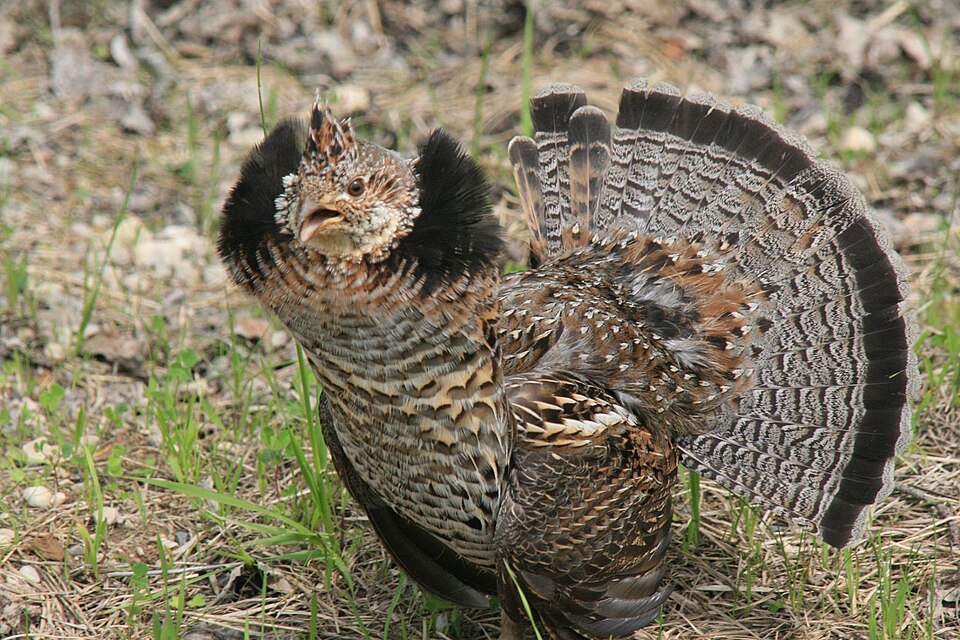
The Ruffed Grouse is a chunky, chicken-sized bird of young, brushy woodlands across the northern and mountain forests of North America. Most people hear it long before they ever see it. In spring, males perch on a favorite log and beat their wings against the air to produce a deep, accelerating thump... thump... thump-thump-thumpthumpthump that rolls through the woods like a distant engine struggling to start. You feel it in your chest as much as hear it. That sound, called drumming, is one of the signature voices of the eastern and boreal forest.
Despite being one of the most widespread gamebirds on the continent, the Ruffed Grouse is a master of staying hidden. Its dead-leaf camouflage lets it sit tight until you nearly step on it, then explode into flight in a heart-stopping roar of wingbeats. It is a non-migratory, year-round resident wherever it occurs, and it depends heavily on dense, regenerating forest, the kind of tangled second-growth that follows logging, fire, or beaver flooding. Where forests grow old and open underneath, grouse numbers tend to fade.
Look for a plump, rounded gamebird about the size of a small chicken, with a short crest it can raise or flatten, a fan-shaped tail, and intricately patterned brown or gray plumage that blends perfectly with leaf litter and bark. The most reliable field marks are on the tail and neck rather than overall color.
| Tail band | Broad, dark subterminal band across the fanned tail - the single best mark. Complete in most males, often broken in the center on females. |
| Neck ruffs | Black or dark-chocolate feather tufts on the sides of the neck, raised into a showy ruff when displaying. |
| Crest | A short, peaked crest on the crown, raised when alert and flattened when relaxed. |
| Color morphs | Two main color types: a rufous (red-brown) morph and a gray morph. Gray birds dominate in the north and west, red birds in the warmer, more humid parts of the range. |
| Underparts | Pale, barred with dark crescents and chevrons on a buffy or whitish ground. |
| Legs and feet | Feathered partway down the leg; in winter, comb-like scales (pectinations) grow along the toes to act as snowshoes. |
Male vs. female
The sexes look very similar, and telling them apart in the field is genuinely tricky. The most useful clue is the dark band near the tail tip: in males it is usually a complete, unbroken band across the whole fanned tail, while in females the band is often broken or faint in the central feathers. Males also tend to have larger, glossier neck ruffs and are slightly bigger overall. Behavior helps too - the drumming bird on a log in spring is virtually always a male. Outside of close, in-hand examination, plumage alone leaves many birds best left as "unidentified to sex."
Juveniles
Chicks are precocial, hatching covered in downy buff-and-brown plumage and able to walk, feed themselves, and even make short flutter-flights within a couple of weeks. By late summer, juveniles closely resemble adults but look slightly scruffier, with less developed tail patterning and shorter neck ruffs. Young birds disperse from the brood in fall during a period known as the "fall shuffle" or "crazy flight," when inexperienced grouse sometimes turn up in odd places, including crashing into windows.
Ruffed Grouse are nearly silent as songbirds go - they do not sing. Their famous sound is mechanical, not vocal. A displaying male stands on a log, fallen trunk, rock, or earthen mound and rapidly beats his wings forward and back, compressing air to create a hollow, drumming thump. The rhythm starts slow and deliberate, then accelerates into a soft blur: bup......bup......bup..bup.bup.bup-bup-burrrrr. The whole performance lasts about ten seconds and carries a surprising distance through the woods. Peak drumming is in spring, but you may hear it on calm fall days as well.
Actual vocalizations are quiet and easy to miss. Alarmed birds give soft, nervous pit-pit or clucking notes, and a hen with chicks uses low whines and clucks to keep her brood together. A flushed grouse usually says nothing at all - the startling sound is simply the thunderous whir of its wings.
The Ruffed Grouse ranges widely across the cooler forests of North America: throughout much of Canada and Alaska, south through the Great Lakes and New England, down the Appalachian Mountains, and through the northern Rockies and parts of the Pacific Northwest. It favors mixed and deciduous woodlands with plenty of young trees, especially aspen, birch, and alder, along with brushy edges and old logging cuts.
It is a permanent, non-migratory resident across its entire range. Individual birds spend their lives within a small home range, often just a few dozen acres, and do not undertake seasonal migrations. In deep snow, grouse may roost by diving into soft powder, which insulates them through frigid nights - a behavior called snow roosting. Populations in the Great Lakes and parts of the Northeast also famously cycle, rising and falling roughly every ten years.
Ruffed Grouse are primarily vegetarian, and their diet shifts dramatically with the seasons. In spring and summer they eat fresh leaves, clover, ferns, and a wide variety of soft fruits and berries, while chicks rely heavily on protein-rich insects in their first weeks of life. In fall they gorge on acorns, beechnuts, wild fruits, and seeds, building reserves for winter.
Their winter survival strategy is remarkable: when snow blankets the ground, grouse climb into trees and feed on the dormant flower buds and catkins of aspen, birch, and similar trees. A bird can quickly fill its crop with buds at dawn and dusk, then retreat to cover to digest. This bud-feeding habit is why healthy aspen stands are so closely tied to good grouse country.
The female does all the nesting work. She scrapes a shallow, leaf-lined bowl on the forest floor, usually tucked against the base of a tree, a log, or a clump of brush that gives her a clear view while keeping her hidden. She typically lays around 9 to 14 buff-colored eggs, sometimes more, and incubates them alone for roughly 23 to 24 days.
The downy chicks leave the nest within hours of hatching, following the hen as she leads them to feeding areas and broods them under her wings for warmth. The male takes no part in incubation or raising young. There is a single brood per year, though a hen may re-nest if her first clutch is destroyed early. Nests and chicks face heavy predation, so a female that brings even a handful of young to independence has had a successful season.
The Ruffed Grouse is not a backyard or feeder bird, so do not expect to lure one to a seed feeder. It is a shy forest specialist that needs large blocks of young, brushy woodland. That said, there are real things you can do if you own woodland and want to support them.
- Manage for young forest. Grouse thrive in dense, regenerating stands. Selective timber cuts, brush patches, and a mosaic of forest ages create far better habitat than mature, open woods.
- Favor aspen, birch, and alder. These provide the catkins and buds that carry grouse through winter, plus the thick early-growth cover broods need.
- Leave drumming logs and brush piles. Fallen logs and dense tangles give males display sites and give all birds escape cover from hawks and owls.
- Protect soft-mast plants. Wild grape, dogwood, hawthorn, blackberry, and similar fruiting shrubs feed grouse in late summer and fall.
- Walk quietly to see one. Your best odds of an encounter are slow, quiet walks along brushy woodland edges and old logging roads at dawn, especially in spring when males are drumming.
- Spruce Grouse: A darker, tamer boreal-forest grouse. Males have a black breast and red eye combs; it lacks the bold neck ruffs and the broad, fan-tail band of the Ruffed Grouse and prefers dense conifers rather than brushy deciduous woods.
- Sharp-tailed Grouse: A bird of open grasslands and brush prairie, not forest. It has a short, pointed (not fan-shaped) tail and a paler, spotted look, and males display communally on open leks rather than drumming on logs.
- Dusky Grouse: A larger, plainer western mountain grouse with a long, dark tail and no neck ruffs. It hoots softly rather than drumming and lives in higher-elevation conifer and aspen forests.
- Northern Bobwhite: Much smaller, a true quail of open farmland and grassy edges. It has a clear whistled bob-WHITE call and lacks the grouse's fan tail, crest, and neck ruffs.
What is the drumming sound made by a Ruffed Grouse?
The drumming is not a call but a mechanical sound. A male stands on a log and beats his wings rapidly forward and back, compressing the air to make a deep, accelerating thumping that rolls through the woods. It starts slow and speeds into a near-blur over about ten seconds. He does it to claim territory and attract females, mainly in spring.
How can I tell a male Ruffed Grouse from a female?
It is difficult, because the sexes look alike. The best clue is the dark band near the tail tip: in males it is usually complete and unbroken across the fanned tail, while in females it is often broken or faint in the central feathers. Males also tend to have larger neck ruffs and are slightly bigger. A bird drumming on a log in spring is almost always a male.
Do Ruffed Grouse migrate?
No. Ruffed Grouse are permanent, year-round residents throughout their range. Individual birds live their whole lives within a small home range of just a few dozen acres and do not migrate seasonally. In deep snow they survive by diving into powder to roost, which insulates them on cold nights.
Will Ruffed Grouse come to a backyard feeder?
Generally no. They are shy forest birds that feed on leaves, fruit, nuts, insects, and especially the buds and catkins of aspen and birch in winter. They do not visit seed feeders. To support them you need young, brushy woodland habitat. The best way to see one is a quiet walk through brushy woods, not waiting at a feeder.
Why did a Ruffed Grouse fly into my window or act tame?
This often happens in fall during the so-called crazy flight or fall shuffle, when inexperienced young birds disperse and turn up in unexpected places, sometimes colliding with windows or buildings. Occasionally, lone males become bold and even approach people, a quirky behavior that wildlife biologists have long noted but do not fully understand.