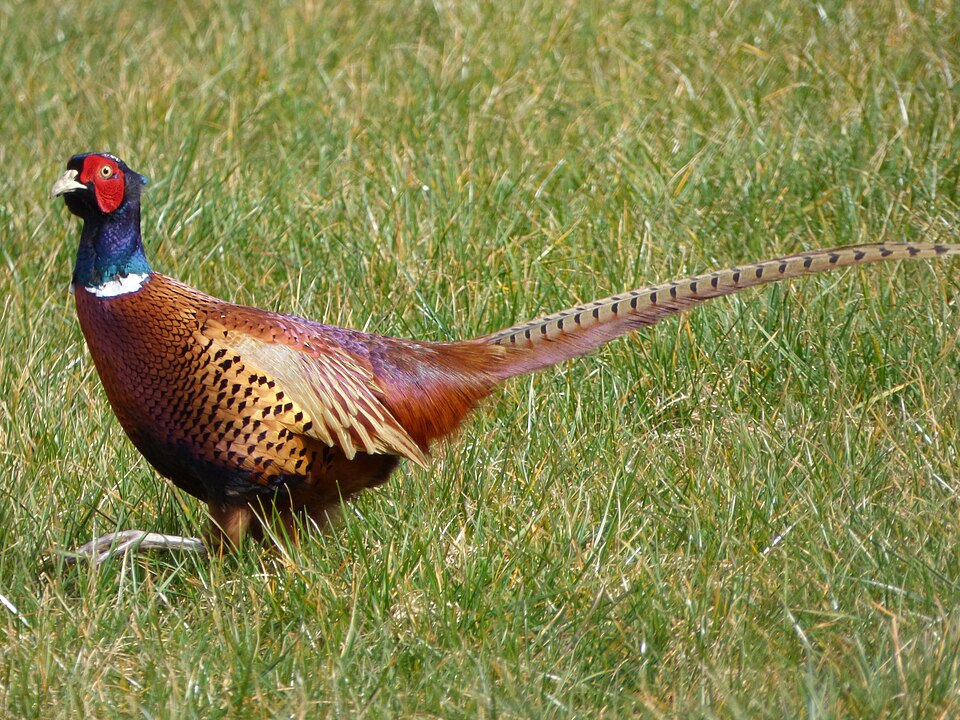
The Ring-necked Pheasant is one of those birds almost everyone in farm country has seen, even people who would never call themselves birders. A rooster bursting out of a roadside ditch in a clatter of wings and a metallic crow is hard to forget. Big, long-tailed, and brilliantly colored, the male looks like he wandered in from a different continent, and in a sense, he did. This is an Old World game bird, native to Asia, that was introduced to North America in the late 1800s as a hunting quarry and has been a fixture of the rural landscape ever since.
Pheasants thrive in the edges between things: where a corn field meets a weedy fencerow, where a marsh grades into grassland, where a hayfield borders a brushy slough. They are ground birds through and through, spending nearly all their time walking and running rather than flying, and relying on dense cover for survival. Though they are not a true backyard species, anyone living near agricultural land or grassland may find them turning up at the edge of a property, especially in winter when they range farther in search of waste grain.
The Ring-necked Pheasant has an unmistakable silhouette: a plump, chicken-sized body, a small head, and a remarkably long, pointed tail that can make up nearly half the bird's total length. On the ground it runs with the tail held low and level; in flight it explodes upward steeply before leveling into fast, whirring wingbeats interspersed with glides, tail streaming behind.
| Size & shape | Bulky, ground-dwelling game bird with a small head, plump body, and a very long, tapering, pointed tail. |
| Male head | Iridescent dark green head with fleshy red facial skin (wattles) and small ear tufts; a bold white neck ring on most birds. |
| Male body | Coppery, golden, and chestnut plumage intricately spotted and barred with black; rump often grayish or greenish. |
| Female | Mottled sandy brown and buff overall with dark spotting, paler below; long pointed tail but no ring or color. |
| Tail | Long and pointed in both sexes, finely barred; far longer and showier in males. |
| Legs & feet | Strong, bare legs built for running; males have a spur on the back of each leg. |
Male vs. female
The sexes look completely different, which makes telling them apart easy once you know the bird. The male (rooster or cock) is the showstopper: a glossy green-black head set off by a scarlet wattled face, often a clean white collar around the neck, and a body of glowing copper, gold, and chestnut speckled with black, ending in that long barred tail. The female (hen) is far plainer, a cryptic mosaic of sandy brown, buff, and black that blends perfectly with dead grass and stubble. She keeps the long pointed tail but lacks any ring, red face, or color, and she is noticeably smaller. That camouflage is no accident: she does all the incubating on the ground and needs to disappear.
Juveniles
Chicks are precocial, leaving the nest within hours of hatching as tiny striped, fast-running balls of down that can flutter short distances surprisingly early. Juveniles resemble dull, scaled-down hens, heavily mottled brown with a shorter tail. Young males begin showing their adult colors gradually through late summer and fall, often looking patchy as green feathering creeps over the head and copper tones bleed into the body before they reach full splendor by their first winter.
Pheasants don't sing so much as announce. The signature sound is the male's territorial crow: a loud, harsh, far-carrying two-note kok-KOK or aaa-AAK, almost mechanical and oddly metallic, delivered most often at dawn and dusk in spring. The crow is frequently followed immediately by a brief, rapid burst of whirring wingbeats as the rooster beats his wings against his body, you may hear that muffled drumming even when you can't see the bird.
When flushed, a pheasant erupts with an explosive cackling alarm, a rattling series of harsh kut-kut-kut-ket-ket notes, combined with a startling roar of wings. Hens and birds in cover give quieter clucks and contact calls. The springtime dawn chorus of crowing roosters is one of the classic sounds of open farm country.
Native to Asia, the Ring-necked Pheasant is now widely established across North America wherever there is suitable farmland and grassland habitat. In the United States its stronghold is the agricultural belt of the upper Midwest and northern Great Plains, the Dakotas, Nebraska, Kansas, Iowa, Minnesota, Montana, and similar grain-growing regions, with scattered populations in the Pacific Northwest, parts of the Northeast, the intermountain West, and southern Canada. It is also widespread across Europe, where it was introduced even earlier.
Pheasants are essentially non-migratory. A bird may live its whole life within a square mile or two of where it hatched. Seasonal movement is local: in harsh winters birds shift toward heavier cover such as cattail marshes, shelterbelts, and brushy draws, and concentrate near reliable food like waste grain. Populations rise and fall with farming practices and weather, and severe winters with deep snow and ice can cause heavy local die-offs.
Ring-necked Pheasants are omnivores that feed almost entirely on the ground, scratching and pecking much like chickens. The bulk of the adult diet is plant matter: seeds, waste grain (corn, wheat, sorghum, and other crops are favorites), grasses, weed seeds, berries, buds, and roots. They will dig and scratch through snow and leaf litter to reach buried food in winter, which is why they cluster around picked grain fields and feedlots in cold months.
Animal food becomes important in the warm season, especially for growing chicks, which depend heavily on protein-rich insects, grasshoppers, beetles, caterpillars, ants, and other invertebrates, during their first weeks of life. Adults also take insects, snails, and the occasional small vertebrate when available. Like other gallinaceous birds, pheasants swallow grit and small stones to help grind hard seeds in the gizzard.
Pheasants nest on the ground, and the hen does essentially all the work. She scrapes a shallow depression hidden in dense grass, hayfields, fencerows, weedy ditches, or wetland edges, lining it sparsely with grass and leaves. A typical clutch is large, often around 10 to 12 olive-brown eggs, sometimes more, and she incubates them alone for roughly 23 to 28 days while the polygynous male tends his harem and territory but takes no part in nesting.
The chicks hatch all at once, ready to follow the hen and feed themselves almost immediately. Pheasants normally raise a single brood per year, though a hen will re-nest if an early clutch is destroyed, a common occurrence, since ground nests are heavily exposed to predators, flooding, and especially the mowing of hayfields, which is a major source of nest loss across the species' range.
The Ring-necked Pheasant is not a true backyard or feeder bird, so don't expect one at a hanging tube feeder. That said, if you live near farmland, grassland, or brushy edges, you can absolutely make your property more pheasant-friendly, and in winter, scattered grain at the edge of cover may draw birds in to feed on the ground.
- Scatter cracked corn, milo, or whole grains directly on the ground near brushy cover rather than in feeders, pheasants are ground feeders and won't perch.
- Provide dense, undisturbed cover: native bunch grasses, shrub thickets, brush piles, and weedy field edges give them food, nesting sites, and shelter from predators and weather.
- Leave a corner of the property unmowed and a little messy, and delay mowing grassy areas until after the nesting season to protect ground nests.
- Plant or preserve shelterbelts and food plots (grain or seed-bearing plants) if you have acreage, these are exactly the features that pheasant conservation programs promote.
- Keep cats indoors and minimize disturbance near cover, since pheasants are wary and ground-nesting birds are very vulnerable to predation.
- Provide access to grit, such as a patch of bare gravelly soil, which they need to digest hard seeds and grain.
- Greater Sage-Grouse: Another large western grassland game bird, but chunkier with a fan-shaped (not long pointed) tail, no white neck ring, and tied strictly to sagebrush country.
- Sharp-tailed Grouse: Mottled brown like a hen pheasant but smaller, rounder, with a short pointed tail and no long streaming tail or colorful male plumage.
- Wild Turkey: Much larger and darker with a bare head and broad fan tail; shares open-edge habitat but is unmistakably bulkier and not long-tailed.
- Gray Partridge: A smaller introduced game bird of the same farmland habitat, with a short rusty tail, gray breast, and chestnut face, lacks the pheasant's long tail entirely.
Are Ring-necked Pheasants native to North America?
No. They are native to Asia and were introduced to North America in the late 1800s, primarily as a game bird for hunting. They have since become established across much of the continent's farmland and grassland and are now a familiar part of the rural landscape.
What is the difference between a male and female pheasant?
Males are large and brilliantly colored, iridescent green head, red wattled face, usually a white neck ring, and coppery, black-spotted body with a very long tail. Females are smaller and a plain mottled sandy brown for camouflage, with a long pointed tail but no ring or bright color.
What does a Ring-necked Pheasant sound like?
The male gives a loud, harsh, two-note crow, something like a metallic kok-KOK, usually followed by a quick whir of beating wings, most often at dawn and dusk in spring. When flushed, both sexes erupt with a rattling cackle and a loud roar of wingbeats.
Will pheasants come to a backyard bird feeder?
Not in the usual sense. They are ground-feeding birds and won't use hanging feeders, but if you live near farmland or grassland you may attract them by scattering corn or grain on the ground near dense cover, especially in winter.
Why do pheasants explode into flight so suddenly?
Pheasants prefer to walk or run from danger and stay hidden in cover. When a predator gets too close, they flush as a last resort with a powerful, near-vertical burst of wingbeats, the loud, startling takeoff is meant to surprise and confuse the threat before the bird levels off and glides to safety.