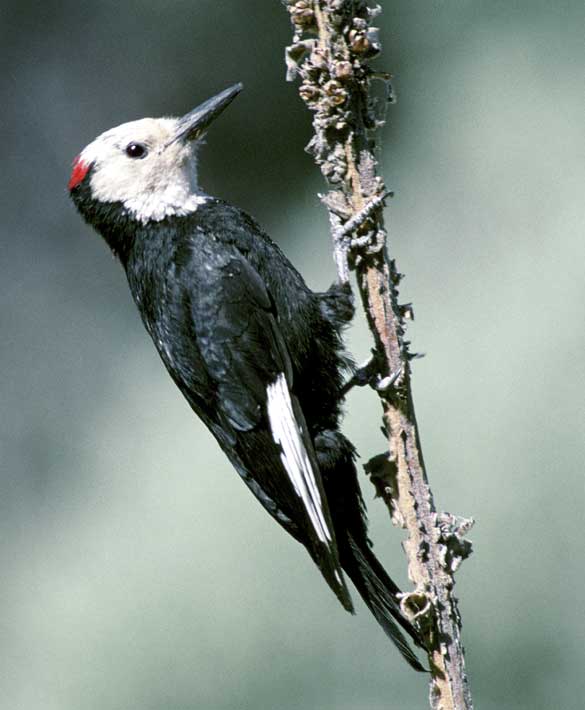
The White-headed Woodpecker is one of the most distinctive woodpeckers in North America, and also one of the most narrowly tied to a single habitat. Its body is glossy black, but the head and throat are a clean, snowy white, an instantly recognizable combination that no other woodpecker on the continent shares. Add a white patch on the wing that flashes in flight, and you have a bird that is hard to mistake once you finally lay eyes on one. It lives in the mountain pine forests of the western United States, where it makes a quiet, unhurried living among the big cones of ponderosa, sugar, and other large-seeded pines.
Unlike the rattling, conspicuous woodpeckers of suburban yards, the White-headed Woodpecker tends to go about its business calmly and almost silently, working over bark and probing into pine cones rather than hammering loudly on dead snags. Because it depends so heavily on mature, open pine forest with a steady supply of cone crops, it is a good barometer of forest health in the Sierra Nevada, Cascades, and other western ranges. Birders often travel specifically to find it, and the search usually means slowing down and listening for its sharp little calls drifting through the pines.
This is a medium-sized woodpecker, roughly robin-sized in length but stockier, with the upright posture and stiff propping tail typical of the family. The silhouette is unremarkable; it is the color pattern that makes identification almost instant.
| Head | Entirely white face, crown, and throat, contrasting sharply with the black body |
| Body | Glossy black on the back, breast, belly, and tail with no barring or spotting |
| Wing patch | Bold white patch on the primaries (the outer flight feathers), most obvious in flight |
| Bill | Straight, chisel-tipped, and dark; medium length for a woodpecker |
| Red mark (male) | Small red patch on the back of the crown, often hidden unless the bird raises its feathers |
| Size | About 8.5-9 in long, between a Downy and a Hairy Woodpecker in bulk |
Male vs. female
Males and females look nearly identical, both showing the white head and black body. The only reliable difference is a small red patch on the back of the crown (the nape) of the male. Females lack any red and have an all-white head. The red is easy to overlook because it is small and often concealed by the surrounding white feathers, so a good look at the back of the head is usually needed to be sure.
Juveniles
Juveniles resemble adults but tend to look slightly duller and less crisply patterned, with the black areas a bit browner and the white of the head sometimes flecked with gray. Interestingly, both young males and young females often show some red on the crown when they first fledge; females lose this red as they molt into adult plumage, while males retain a red nape patch. So a White-headed Woodpecker with red on the top of the head in late summer is not necessarily a male.
White-headed Woodpeckers do not really sing; like other woodpeckers they communicate with calls and drumming. The most common call is a sharp, slightly nasal note often given in a quick series, frequently written as a rattling pee-deet or chick-it, and a longer scolding rattle when birds are agitated or interacting. The notes are crisp and a little squeaky, less harsh than the loud calls of a Hairy Woodpecker.
The drum is a fairly even, rapid roll on a resonant branch or snag, used to advertise territory and attract mates in spring. Drumming is not as loud or as constant as in some other species, which fits this bird's generally low-key demeanor. Much of the time it forages in near silence, and birders often locate it first by a soft tapping or a single sharp call note rather than by any sustained song.
The White-headed Woodpecker is a year-round resident of montane pine forests in the western United States, with a small extension into extreme southern British Columbia. Its core range runs through the Sierra Nevada and Cascade ranges and associated mountains of California, Oregon, and Washington, with populations also in parts of Idaho and western Nevada. It is closely tied to forests dominated by large-coned pines such as ponderosa, sugar, Jeffrey, and Coulter pine, typically at middle elevations in the mountains.
It is essentially non-migratory, holding the same territory through the year. In harsh winters or poor cone years, individuals may wander short distances or drop to slightly lower elevations in search of food, but there is no true seasonal migration. Because it is so habitat-specific, the bird can be common in the right stand of mature pine and entirely absent from seemingly similar forest nearby.
This woodpecker has an unusual diet for its family, leaning heavily on pine seeds, especially in fall and winter. It works methodically over large pine cones, prying out seeds with its bill, and will also flake and pry at bark rather than excavating deeply the way many woodpeckers do. The big seeds of ponderosa, sugar, and other large-coned pines are a staple, which is exactly why the bird is tied so tightly to those forests.
During the warmer months it adds a good deal of animal food, gleaning ants, beetle larvae, and other insects and spiders from bark crevices and the surfaces of trunks and branches. Rather than hammering hard into wood, it tends to probe, pry, and glean, often hanging at odd angles or working out along cone-laden limbs. It will also take sap on occasion. This mix of seeds and surface insects lets it stay put year-round in forests that other woodpeckers might abandon in winter.
White-headed Woodpeckers nest in cavities they excavate themselves, usually in a dead tree, a dead section of a living pine, or a stump. Nest holes are often placed fairly low compared with many woodpeckers, sometimes only a few feet off the ground in a rotting snag, though height varies. Both members of a pair help dig the cavity, which takes a couple of weeks.
The female typically lays a small clutch of white eggs, and both parents share incubation, with the male often taking the night shift, as is common in woodpeckers. The pair feeds the nestlings together, and after the young fledge they may stay near the adults for a time while they learn to forage on cones and bark. Pairs commonly remain on the same general territory year after year.
This is not a typical backyard or feeder bird. It is a specialist of mature mountain pine forest and rarely visits suburban yards, so most people will see one by going to it rather than waiting for it to come to them. That said, there are a few things that help if you live within its range.
- Visit the right habitat: open, mature stands of ponderosa, sugar, or Jeffrey pine at middle elevations in the Sierra Nevada, Cascades, or nearby ranges are your best bet.
- Go slow and listen for the sharp pee-deet call or soft tapping; the bird is quiet and easy to walk past.
- Check trees with large pine cones, where the bird often works the cones for seeds, and scan dead snags where it may be excavating or nesting.
- If you live in or near suitable pine forest, leave dead trees and snags standing where safe, since they provide nesting cavities and foraging sites.
- Suet feeders occasionally draw one in forested mountain properties within its range, but do not expect feeder visits the way you would with a Downy or Hairy Woodpecker.
- Early morning, when birds are most active and calling, gives you the best odds of spotting one.
- Hairy Woodpecker: Black-and-white but has a white back stripe and white-spotted wings, plus a black-and-white striped face, not a solid white head.
- Downy Woodpecker: Smaller, with a striped face and white back; never shows the clean all-white head of a White-headed Woodpecker.
- Acorn Woodpecker: Shares western pine and oak country and has a pale face, but shows a clown-like red, white, and black face pattern, white rump, and white wing patches, not a fully white head.
- Black-backed Woodpecker: Solid black back like the White-headed, but has a striped face, yellow crown patch (male), and lives in burned conifer forest rather than showing a white head.
How do I tell a male from a female White-headed Woodpecker?
Look at the back of the head. Males have a small red patch on the nape, while females have an entirely white head with no red. Both sexes otherwise look the same, with a white head and throat and a glossy black body.
Where is the best place to find a White-headed Woodpecker?
Mature, open pine forests in the western mountains, especially stands of ponderosa, sugar, or Jeffrey pine in the Sierra Nevada, Cascades, and nearby ranges of California, Oregon, and Washington. They stay year-round, so any season can work, with early morning being best for activity and calling.
What does a White-headed Woodpecker eat?
Pine seeds are a major part of the diet, especially in fall and winter, pried out of large cones. In warmer months it also gleans ants, beetle larvae, and other insects and spiders from bark, and it occasionally takes sap.
Will a White-headed Woodpecker come to a backyard feeder?
Usually not. It is a pine-forest specialist and rarely visits typical suburban yards. If you live in or next to mature mountain pine forest, a suet feeder may occasionally attract one, but it is not a reliable feeder bird like a Downy or Hairy Woodpecker.
What sound does a White-headed Woodpecker make?
It gives sharp, slightly squeaky call notes, often a quick rattling pee-deet or chick-it, and a longer scolding rattle when agitated. In spring it drums a fairly even, rapid roll on resonant branches. It does not have a true song and is generally quiet while foraging.