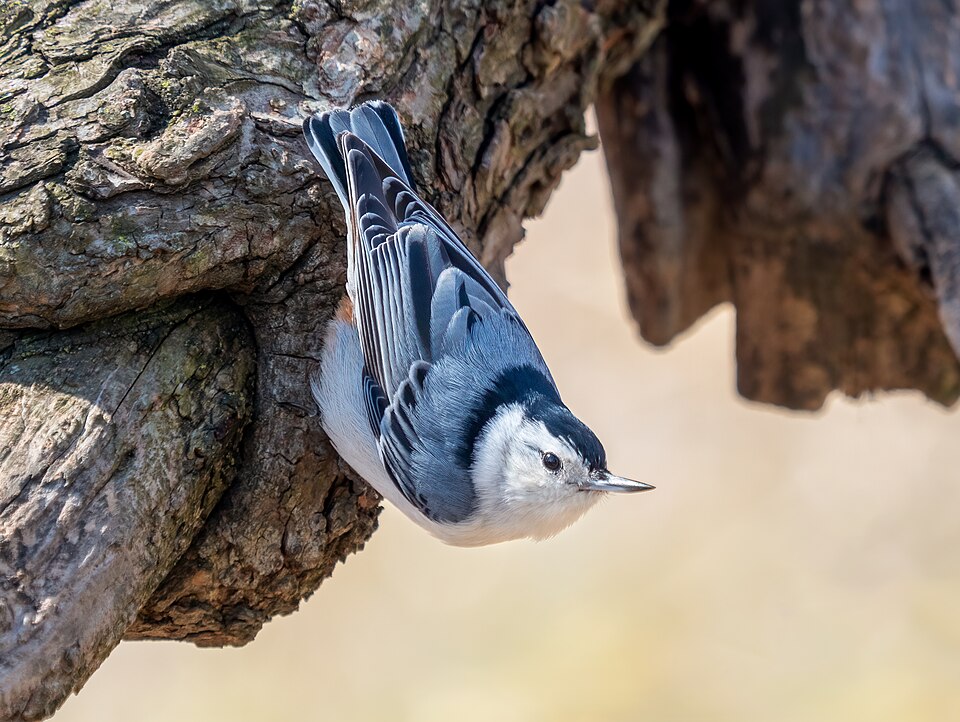
The White-breasted Nuthatch is one of North America's most endearing backyard birds, instantly recognizable as the small, compact songbird that walks head-first down tree trunks as casually as other birds walk up them. Stocky and short-tailed with a long, slightly upturned bill, it works over bark and branches in every direction, defying gravity in a way no woodpecker or creeper can match. Its blue-gray back, clean white face and underparts, and neat black cap give it a tidy, almost dapper appearance.
This is a familiar presence in mature deciduous and mixed woods, wooded suburbs, parks, and yards across most of the United States, southern Canada, and into the mountains of Mexico. It is a year-round resident wherever it lives, and a reliable, confiding visitor to feeders. Often you'll hear its low, nasal honking before you spot it, or notice it traveling at the edges of a winter chickadee flock. For many people, it's a gateway bird, the species that turns a casual feeder-watcher into a lifelong birder.
Look for a small, chunky bird with almost no neck, a stubby tail, and a long, straight, chisel-like bill that gives it a top-heavy, "front-loaded" silhouette. It rarely sits still, creeping and hitching along trunks and limbs at every angle, frequently hanging upside down.
| Upperparts | Clean blue-gray back, wings, and tail |
| Face & underparts | Bright white face and breast, with no eye line cutting through the white |
| Cap & nape | Black cap that extends down the back of the neck (glossy black in males) |
| Belly | White below with rusty or chestnut wash on the lower belly and under the tail |
| Bill | Long, straight, sharply pointed and slightly upturned at the tip |
| Shape | Stocky and neckless with a very short, square tail; often hangs head-down |
Male vs. female
The sexes look very similar and both show the white face and underparts, but they can often be told apart with a clear view of the head. Males have a glossy jet-black cap and nape. Females typically show a duller, grayer or slate-tinged cap that may not contrast as sharply with the blue-gray back. In poor light or at a glance the difference is subtle, so don't worry if you can't always be sure.
Juveniles
Juveniles look much like adults soon after fledging, since they grow into their adult-style plumage quickly. Young birds tend to look slightly duller and softer overall, with a less glossy cap and somewhat fluffier body feathering. By their first fall they are essentially indistinguishable from adults in the field, which is part of why this species can be tricky to age once autumn arrives.
The most familiar sound is the call: a low, nasal, slightly comical yank-yank-yank or wah-wah-wah, often repeated in a steady, honking series. It carries surprisingly far through the woods and is frequently the first clue that a nuthatch is nearby. Birds also give softer, conversational notes while foraging.
The song, heard mostly in late winter and early spring, is a rapid, even-pitched series of nasal whistled notes, a fast wer-wer-wer-wer-wer running together on one tone. It is less musical than a warbler's song but unmistakable once learned, and pairs will call back and forth to keep contact while they forage apart.
The White-breasted Nuthatch is widespread across North America, found from southern Canada through most of the Lower 48 states and into the highlands of Mexico. It favors mature deciduous and mixed forests, especially areas with large oaks, maples, hickories, and other broad-leaved trees, and readily uses wooded neighborhoods, parks, and orchards.
It is essentially non-migratory, holding the same territory year-round. In hard winters some northern birds may wander short distances or shift downslope in mountains, and the species occasionally takes part in modest irruptions, but for the most part the nuthatch you see in summer is the same one you'll see at your feeder in January. Regional populations differ subtly in voice and shade, so birds in the East, the interior West, and the Pacific states can sound and look slightly different from one another.
In the warmer months the diet is heavily insect-based: beetles, caterpillars, ants, spiders, and the eggs and larvae of various bark-dwelling bugs, all gleaned from crevices in trunks and limbs as the bird works methodically over the bark. This makes it a genuine help in controlling tree pests.
In fall and winter it relies more on seeds and nuts, especially acorns and other mast. The name "nuthatch" comes from its habit of wedging a large seed or nut into a bark crevice and hammering, or "hatching," it open with that strong bill. It's also a dedicated food-storer, caching seeds in bark cracks and covering them, sometimes with bits of bark or lichen, to retrieve later in lean weather.
White-breasted Nuthatches nest in cavities, usually a natural hole or an old woodpecker hole in a deciduous tree, and they will also accept nest boxes. The female does most of the nest building, lining the cavity with bark fibers, grasses, fur, and feathers to create a soft cup. They typically raise a single brood per year.
The female lays roughly five to nine eggs, white to creamy and spotted with reddish-brown, and does the incubating while the male brings her food. One of the species' odder behaviors is "bill-sweeping": an adult will grasp an insect (often a foul-tasting one) and wipe it around the entrance of the nest hole, possibly to deter squirrels or predators with the scent. Both parents feed the nestlings until they fledge.
Yes, this is an excellent backyard bird and a regular, confiding feeder visitor, especially in winter. With the right food and a few mature trees nearby, you have a good chance of hosting a resident pair year-round.
- Offer black-oil sunflower seeds, which are the single best draw, plus shelled peanuts and peanut pieces.
- Put out suet, especially in cold weather; nuthatches cling to suet cages with ease.
- Use tube, hopper, or platform feeders near trees so birds can dart back to bark to wedge and open seeds.
- Keep mature deciduous trees and, where safe, leave some dead limbs or snags for foraging and nesting cavities.
- Put up a nest box with a roughly 1.25-inch entrance hole mounted on a tree trunk to invite a breeding pair.
- Provide fresh water in a birdbath; nuthatches will drink and bathe readily, especially in dry spells.
- Red-breasted Nuthatch: Smaller, with a bold black eye line through the face and a rusty-orange wash across the entire underparts, not just the lower belly; prefers conifers and has a higher, tinny call.
- Brown-headed Nuthatch: Tiny, with a brown (not black) cap and a squeaky, rubber-duck call; restricted to southeastern pine forests.
- White-breasted Nuthatch's cousin the Brown Creeper: Streaky brown and camouflaged, with a thin decurved bill and a stiff tail; spirals up trunks and does not climb head-down.
- Black-capped Chickadee: Has a black bib (throat patch) and buffy flanks, a short bill, and never walks head-first down trunks the way a nuthatch does.
Why does the White-breasted Nuthatch walk upside down on trees?
Its strong legs and large, curved hind claw let it grip bark while moving head-first down a trunk. This downward angle gives it a different view into bark crevices than woodpeckers and creepers get climbing upward, so it finds insects and seeds that other birds miss.
What is the difference between a White-breasted and a Red-breasted Nuthatch?
The White-breasted is larger, has a clean white face with no dark eye line, and shows rusty color only on the lower belly. The Red-breasted is smaller, has a bold black line through the eye, a white eyebrow, and an orange wash across all of its underparts. Red-breasteds also favor conifers and have a higher, more nasal toot.
What do White-breasted Nuthatches eat at feeders?
They love black-oil sunflower seeds, peanuts, and suet. A nuthatch will often grab a single sunflower seed, fly to a nearby branch, wedge it into the bark, and hammer it open, then come right back for another.
Do White-breasted Nuthatches migrate?
No, they are essentially year-round residents that hold the same territory in all seasons. The bird at your feeder in summer is usually the same one you'll see in winter, though a few northern or mountain birds may wander short distances in harsh years.
Will White-breasted Nuthatches use a nest box?
Yes. They are cavity nesters and will use a nest box with about a 1.25-inch entrance hole mounted on a tree trunk in or near mature woods. They also readily use natural cavities and old woodpecker holes.