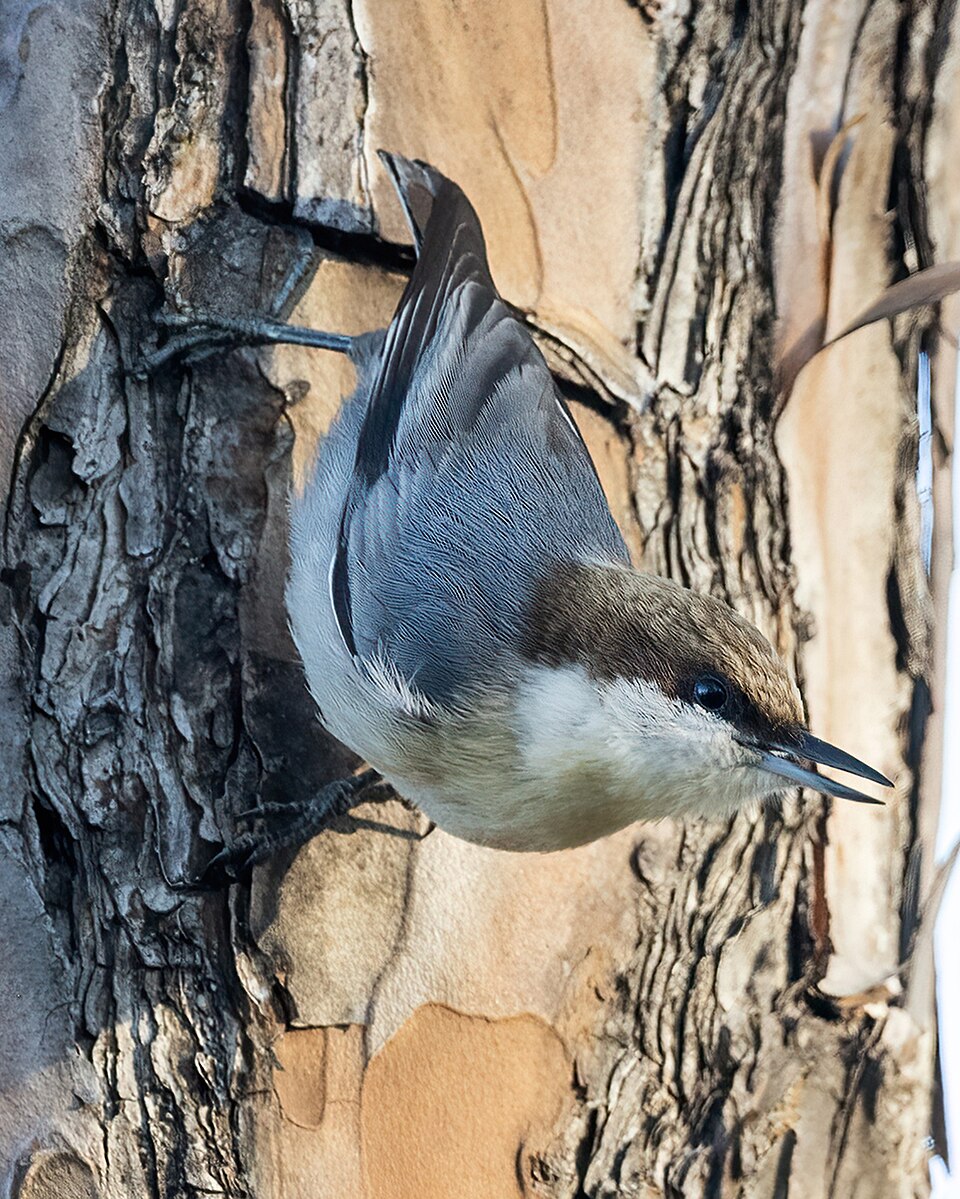
The Brown-headed Nuthatch is a pint-sized, restless bundle of energy that belongs body and soul to the pine forests of the American Southeast. Smaller and plainer than its more famous cousins, it makes up for any lack of flash with personality: it scuttles head-first down trunks, hangs upside down from cone clusters, and chatters constantly in a high, squeaky voice that birders almost universally compare to a rubber duck or a squeeze toy. Where you find tall southern pines, you usually find these little gray-and-brown acrobats working the bark in noisy family groups.
This is a bird with a few genuinely remarkable habits. It is one of the very few North American songbirds known to use a tool, prying up flakes of bark with a held bark scale to expose hidden insects. It is also a cooperative breeder, meaning young birds from earlier broods often stick around to help their parents raise the next batch of chicks. For backyard birders across the Southeast, it is a beloved year-round resident, a reliable feeder visitor, and one of the easiest cavity-nesters to attract to a small nest box.
Start with the shape and size. This is a tiny, big-headed, almost neckless bird with a stubby tail and a relatively long, sharp, slightly upturned bill, the classic compact nuthatch build. It is noticeably smaller than a chickadee and one of the smallest nuthatches in the world. Watch how it moves: nuthatches characteristically creep down tree trunks head-first, a posture no chickadee, titmouse, or warbler adopts.
| Crown | Dull grayish-brown cap that extends down to just above the eye, the source of the name |
| Nape spot | A small whitish or pale spot on the back of the neck, just below the brown cap |
| Upperparts | Soft blue-gray back, wings, and tail |
| Underparts | Plain whitish to buffy below, without strong markings |
| Face | Pale cheek and throat with a thin dark line through the eye separating the cap from the white face |
| Bill | Straight, slender, sharp-pointed, looking slightly upturned, ideal for probing bark and pine cones |
Male vs. female
Males and females look essentially identical in the field. Both sexes share the brown cap, gray back, and pale underparts, and there is no reliable plumage difference that a backyard birder can use to tell them apart. In the hand, researchers sometimes note subtle averages, but for practical purposes you simply cannot sex a Brown-headed Nuthatch by sight. Behavior during the breeding season, such as which bird incubates or feeds at the nest hole, is a better clue than appearance.
Juveniles
Juveniles look much like adults but a touch duller and softer overall. The cap tends to be paler and less cleanly defined, the bill is a bit shorter and may show pale or yellowish edges at the base (the last traces of the fleshy gape), and the underparts can appear washed with buff. Freshly fledged young often travel in noisy family groups with their parents and any helper birds, begging with fluttering wings, so a clump of squeaky nuthatches working one pine in midsummer is usually a family party.
The signature sound is the call, not a true song, and once you learn it you will hear these birds before you see them. The classic note is a high, sharp, two-syllabled pit-pit or ki-dah that sounds remarkably like a squeaky rubber duck or a dog's squeeze toy. Birds in a group keep up an almost constant, excited chatter, a rapid series of squeaky, piping, and rattling notes as they forage.
Beyond the rubber-duck call, listen for thin kew notes, twittering conversational chatter between flock members, and a faster rattle when birds are agitated or interacting. They are vocal year-round, which makes them easy to locate and a great bird for learning to bird by ear.
The Brown-headed Nuthatch is a bird of the southeastern United States, found across the coastal plain and piedmont from southeastern Virginia and the Carolinas south through Florida and west along the Gulf states to eastern Texas, with populations inland into parts of the Southeast wherever suitable pine forest persists. A separate, somewhat distinct population lives in the pinelands of the Bahamas.
It is a year-round resident throughout its range and does not migrate. Birds are largely sedentary, staying near their breeding territory through the seasons, so if you have them in your neighborhood in summer you very likely have them in winter too. The species is tightly tied to mature, open pine woodland, especially longleaf and loblolly pine, and its fortunes rise and fall with the health of those increasingly fragmented forests.
Brown-headed Nuthatches eat a mix of insects and pine seeds, and the balance shifts with the season. Through the warmer months they hunt small arthropods, beetles, caterpillars, spiders, and especially insects sheltering in bark crevices and at the tips of pine branches and cone clusters. In fall and winter pine seeds become a major food, and the birds also readily take seeds and suet at feeders.
Their foraging style is distinctive. They work the outer twigs, needle clusters, and trunks of pines far more than they probe deep bark, and they are famous for using tools: a bird will pick up a small flake of bark in its bill and use it as a lever or wedge to pry off other bark scales and uncover hidden prey. They also cache seeds, wedging them into bark to eat later, and they will hammer open seeds held against the bark, true to the nuthatch family habit of hatching nuts.
This is a cavity nester that, unlike woodpeckers, usually excavates its own hole in soft, decaying wood, often in a dead pine snag, a rotting stub, or a fence post, and it will readily use a nest box. Excavation can take a couple of weeks, and the cavity is typically lined with bark strips, plant down, pine seed wings, and other soft material. The female does most of the incubation.
A typical clutch is around five eggs, white and speckled with reddish-brown, and the species generally raises one brood per year, occasionally attempting a second. One of its most interesting traits is cooperative breeding: a meaningful share of nests have one or more helpers, usually a male offspring from a previous year, who assist in feeding the incubating female and the nestlings. These extra hands can boost how many young survive to fledge.
Good news for Southeast backyard birders: this is very much a feeder and nest-box bird if you live within its pine-country range. It is one of the more confiding small birds and will come to feeders close to wooded edges, and because it nests in cavities, a properly sized box gives you a real shot at hosting a family.
- Offer sunflower seeds (hulled or black-oil), suet, and peanut bits, which are top draws; they will also visit feeders for pine and other small seeds.
- Put up a small nest box with a 1 to 1.25 inch entrance hole mounted 5 to 10 feet up; the small hole keeps out competitors. Adding a few wood shavings can encourage interest.
- Leave dead pine snags and rotting stubs standing where it is safe to do so; they provide natural nest sites and insect-rich foraging.
- Plant or preserve native pines, especially longleaf and loblolly, since this bird is almost completely tied to pine habitat.
- Provide a shallow water source or birdbath, which can pull in groups during dry spells.
- Skip broad-spectrum insecticides, which remove the bark insects that make up so much of their diet, especially when feeding young.
- White-breasted Nuthatch: Much larger, with a clean black cap, bright white face and underparts, and no brown; lacks the squeaky rubber-duck call.
- Red-breasted Nuthatch: Has a bold black eyeline and white eyebrow with rusty underparts and a gray (not brown) cap; favors conifers farther north and is a winter wanderer.
- Pygmy Nuthatch: Nearly identical western counterpart in pine forests of the West; ranges do not overlap, so location alone usually separates them.
- Carolina Chickadee: Shares the pinewoods but has a black cap and black bib, climbs upright rather than head-down, and gives a clear chickadee-dee-dee.
What does a Brown-headed Nuthatch sound like?
Its most famous call is a high, sharp, squeaky note that sounds almost exactly like a rubber duck or a squeeze toy, often repeated as the bird forages. Groups keep up a constant excited chatter of squeaky and piping notes, so you usually hear them before you see them.
Where do Brown-headed Nuthatches live?
They are year-round residents of the southeastern United States, from Virginia and the Carolinas south through Florida and west to eastern Texas, plus a population in the Bahamas. They are tightly tied to mature, open pine forests, especially longleaf and loblolly pine.
How do I attract Brown-headed Nuthatches to my yard?
If you live in their pine-country range, offer sunflower seeds, suet, and peanuts at a feeder near wooded edges, and put up a small nest box with a 1 to 1.25 inch entrance hole. Keeping dead pine snags standing and avoiding insecticides also helps.
Do Brown-headed Nuthatches really use tools?
Yes. They are one of the few North American songbirds known to use tools. A bird will hold a flake of bark in its bill and use it as a lever to pry off other bark scales and uncover hidden insects, and it may also use the bark to cover a seed cache.
How is a Brown-headed Nuthatch different from a chickadee?
Although both live in southern pinewoods, the nuthatch has a brown cap, a longer pointed bill, and creeps head-first down tree trunks, while the Carolina Chickadee has a black cap and black bib, climbs upright, and gives the familiar chickadee-dee-dee call instead of the squeaky-toy note.