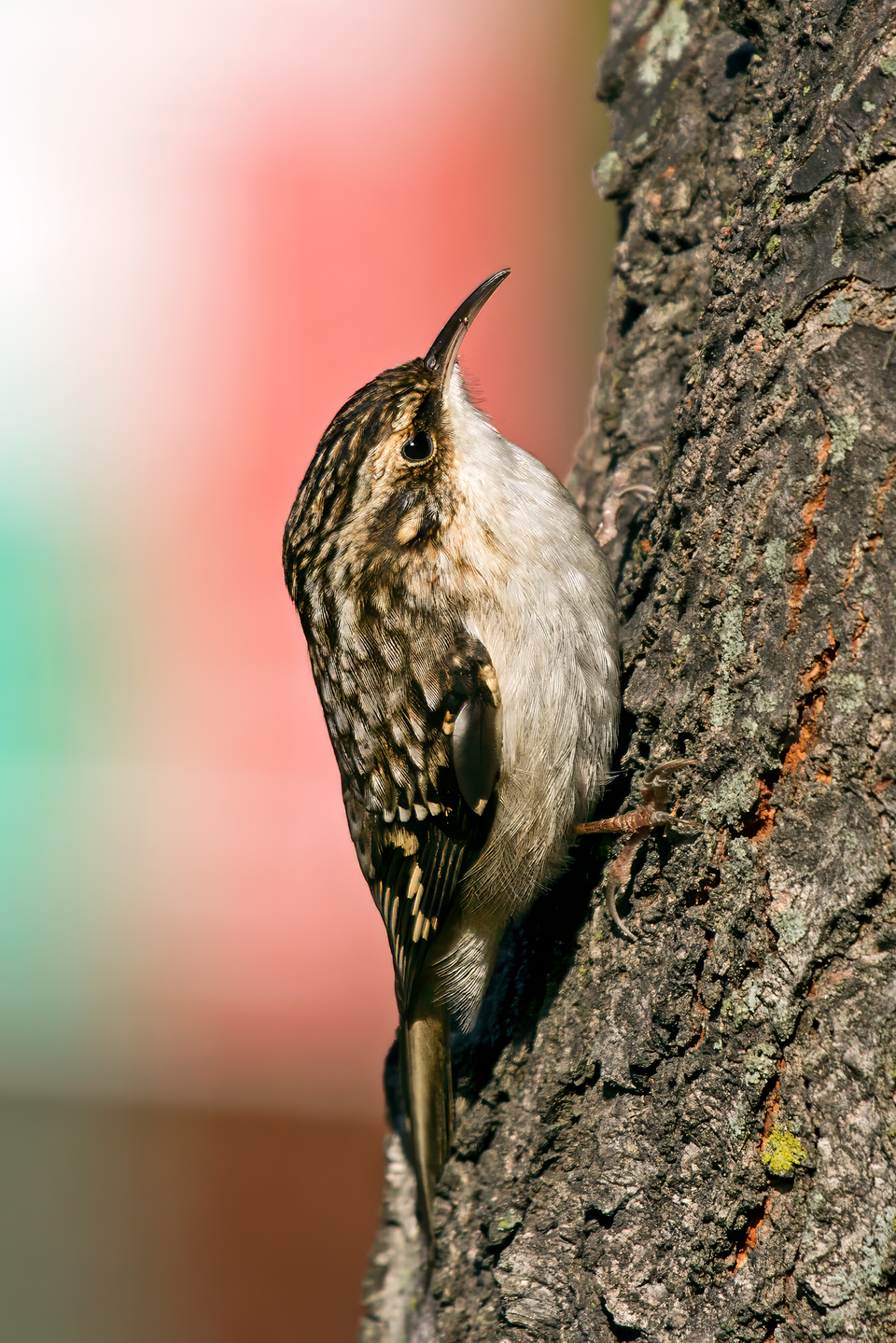
The Brown Creeper is one of those birds you almost certainly walk past every winter without noticing. Mottled brown above and bright white below, it presses itself flat against tree bark and creeps slowly upward in a spiral, looking for all the world like a small piece of the bark itself come loose. It is North America's only treecreeper, a member of the worldwide creeper family (Certhiidae), and it occupies a unique niche: while nuthatches walk headfirst down trunks and woodpeckers hitch up them in short bursts, the creeper works its way up a single tree, then flutters down to the base of the next one to start again.
Despite being widespread across forests from Alaska and Canada down through the mountains of Mexico, the Brown Creeper is genuinely easy to miss. It is tiny, quiet, supremely well camouflaged, and almost never sits still in the open. Most birders learn to find it by ear first, catching its thin, high call drifting through a winter woodlot, then scanning trunks until a fleck of brown begins to move. For backyard birders near woods, it can be a delightful and unexpected cold-weather visitor.
Shape and behavior identify this bird before color ever comes into play. It is a small, slender songbird with a slim, distinctly downcurved bill and a long, stiff, pointed tail that it braces against the bark like a woodpecker. Seen creeping upward in a spiral against a trunk, it is essentially unmistakable in North America.
| Upperparts | Streaked and mottled brown, buff, and black, superb tree-bark camouflage |
| Underparts | Clean bright white, often washed buffy toward the rear; the contrast is the best field mark |
| Bill | Thin and noticeably downcurved, used to probe bark crevices |
| Tail | Long, stiff, and pointed; used as a prop against the trunk |
| Face | Pale eyebrow stripe (supercilium) over a dark eyeline |
| Behavior | Spirals upward on trunks, then drops to the base of the next tree |
Male vs. female
Males and females look alike in the field, they share the same cryptic brown-and-white plumage and downcurved bill, and there is no reliable visible difference to separate the sexes. Males average very slightly larger with marginally longer bills, but this is not something you can judge on a bird flitting up a trunk. In the hand, banders sometimes use measurements, but for backyard and field observers, sexes are effectively identical.
Juveniles
Juveniles look much like adults and are often hard to age in the field. Freshly fledged young tend to look a touch more spotted or speckled below, with somewhat softer, less crisply streaked upperparts and a shorter bill than adults. By their first fall they are essentially adult-like, and most birders simply log them as Brown Creepers without attempting to age them.
The Brown Creeper's voice is famously high and thin, so high that some people, especially as hearing declines with age, simply cannot hear it at all. The common call is a single very high, sibilant see or tsee, easy to confuse with the calls of kinglets or a Golden-crowned Kinglet. Learning this note is often the key to finding the bird.
The song, given mostly in spring, is a sweet, tinkling, high-pitched warble, often written as see-see-see-titi-see or "trees, trees, beautiful trees." It rises and falls in a delicate cadence that sounds surprisingly musical coming from such a drab little bird. Because the whole performance sits at the top of the audible range, recordings and patient listening pay off when learning it.
Brown Creepers breed across a huge swath of North America: throughout the boreal forests of Canada and Alaska, down through the western mountains into Mexico and Central America, and across the northern and montane forests of the eastern United States, including the Appalachians. They favor mature woods with large trees and standing dead snags.
In winter, northern and high-elevation breeders move south and downslope, spreading into a much broader range of wooded habitats across most of the lower 48 states, including suburban parks, woodlots, and wooded neighborhoods where they don't nest. This seasonal shift is why many people in the central and southern U.S. only encounter creepers from fall through early spring. Birds in milder parts of the range are largely resident year-round.
Brown Creepers feed almost entirely on small insects, spiders, and other arthropods, plus their eggs, larvae, and pupae, gleaned from the bark of trees. That downcurved bill is perfectly shaped for probing into the cracks and furrows of bark, and the bird's slow, methodical spiraling lets it work over a trunk inch by inch, finding hidden prey that faster-moving birds miss.
In winter, when insects are scarce, creepers will also take some seeds and will occasionally visit feeders for suet, peanut butter, or finely chopped nuts smeared into bark crevices. Their feeding niche, working trunks from the bottom up, neatly complements that of nuthatches and woodpeckers, so the same tree may host several bark-foraging species at once without much competition.
The Brown Creeper has one of the most distinctive nests of any North American songbird: a crescent- or hammock-shaped cup tucked behind a loose flap of bark on a dead or dying tree. The female does most of the building, weaving together bark strips, twigs, moss, and spider silk into a structure that conforms to the narrow space behind the bark, then lining it with finer material.
She lays a clutch of typically 5 to 6 eggs (sometimes 4 to 8), white with fine reddish-brown speckling, and incubates them for around two weeks while the male brings her food. Both parents then feed the nestlings, which fledge in roughly 15 to 17 days. Because the species depends on large dead and dying trees for nest sites, it is a good indicator of healthy, mature forest with plenty of standing deadwood.
Brown Creepers are not classic feeder birds, but if you live near woods you can absolutely improve your odds of hosting one, especially in winter. They respond to food offered the way they naturally forage, on bark, and to habitat that includes the big, rough-barked, and dead trees they depend on.
- Offer suet, or smear peanut butter or finely chopped nuts directly into the furrows of tree bark, creepers forage on trunks, not at open feeders.
- Leave dead and dying trees standing where it's safe to do so; loose bark provides both food (insects) and nest sites.
- Plant or preserve large, mature, rough-barked trees, the more bark surface, the more foraging habitat.
- Listen for the thin, high see call in winter to know one is working your trees, then watch the trunks.
- Reduce pesticide use so bark-dwelling insects and spiders remain available as natural food.
- Provide a water source; creepers will drink and bathe at shallow, ground-level baths near cover.
- White-breasted Nuthatch: Also climbs trunks but is blue-gray above with a black cap, has a straight bill, and characteristically walks headfirst DOWN trees rather than spiraling up.
- Red-breasted Nuthatch: Climbs bark too, but is blue-gray above with rusty underparts, a bold black eyeline and white eyebrow, a straight bill, and a nasal yank-yank call.
- Golden-crowned Kinglet: Tiny and active in foliage rather than on bark; greenish with a bright yellow/orange crown stripe, and gives a similar high thin call that creepers are often confused with by ear.
- Carolina Wren: Warm rufous-brown with a bold white eyebrow and downcurved bill, but larger, plumper, cocks its tail upward, and forages low in tangles rather than spiraling up trunks.
What is the little brown bird that climbs up tree trunks in a spiral?
That's almost certainly a Brown Creeper. It's North America's only treecreeper, mottled brown above, white below, with a thin downcurved bill. It works its way up a trunk in a spiral, then flies down to the base of the next tree to start over, which is a behavior unique to creepers.
How is a Brown Creeper different from a nuthatch?
Both climb bark, but nuthatches are blue-gray above with straight bills and famously walk headfirst DOWN trunks, while Brown Creepers are camouflaged brown with a curved bill and only creep UPWARD in a spiral. The brown back and white belly contrast, plus the spiraling habit, are the giveaways.
Why can't I hear the Brown Creeper's call?
Its calls and song are extremely high-pitched, among the highest of any North American songbird. Many people, particularly as high-frequency hearing fades with age, genuinely cannot hear them. If you struggle, focus on visually scanning tree trunks instead, or use a recording to learn the thin 'see' note.
Do Brown Creepers come to bird feeders?
Not to typical seed feeders, but they will take suet and will eat peanut butter or finely chopped nuts smeared into bark crevices, since they forage on trunks rather than at open platforms. They're most likely to appear in winter if you live near mature woods.
Where do Brown Creepers build their nests?
They build a distinctive hammock-shaped nest tucked behind a loose flap of bark on a dead or dying tree, woven from bark strips, twigs, and spider silk. This reliance on standing deadwood makes them a good sign of healthy, mature forest.