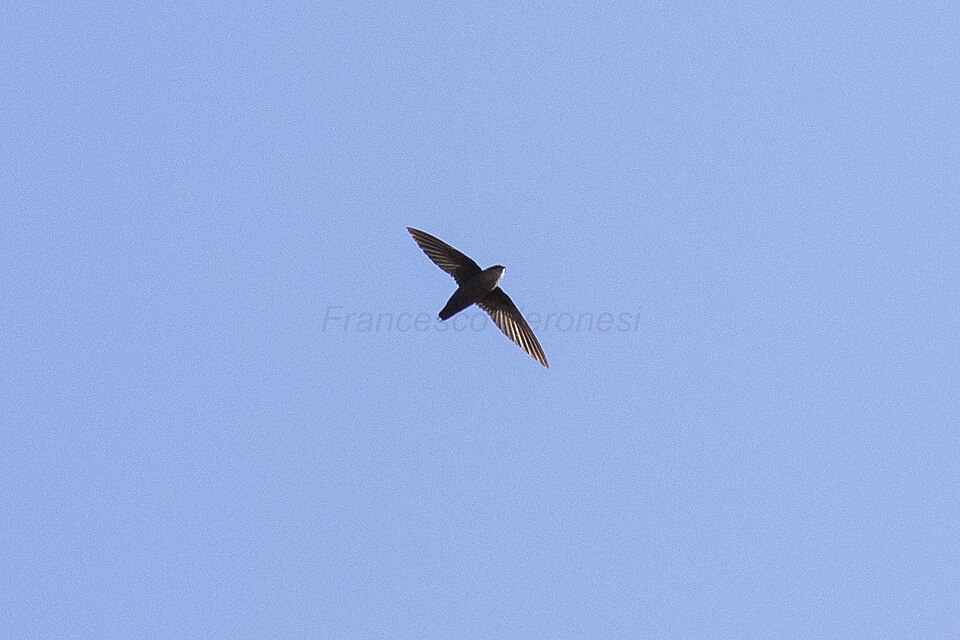
Vaux's Swift (pronounced "vawks") is the smallest swift in North America, a sooty little speed-demon that spends almost its entire life on the wing. Look up over a western river, a stand of old conifers, or a city skyline at dusk and you may catch a cluster of these birds twinkling across the sky on stiff, fluttering wings. They feed, drink, bathe, and even gather nesting material in flight, only stopping to cling to vertical surfaces inside hollow trees and chimneys. They never perch on branches or wires the way swallows do.
Named for Pennsylvania scientist William Sansom Vaux, this swift is the western cousin of the better-known Chimney Swift of the East. It breeds in the moist forests of the Pacific Coast and Pacific Northwest, where it historically nested almost exclusively in the hollowed trunks of large old trees. The loss of old-growth forest has pushed many birds to nest and roost in chimneys instead, and some of the most spectacular wildlife spectacles in the West are the swirling autumn roosts where thousands of Vaux's Swifts funnel down a single chimney at sunset.
Think of Vaux's Swift as a "flying cigar" - a compact, torpedo-shaped body with no obvious neck and a tiny, stubby tail. In flight it shows long, narrow, scimitar-shaped wings that beat in quick, shallow, almost fluttery bursts between short glides. It is noticeably smaller and paler than a swallow, and its silhouette never shows the forked tail or relaxed flap-and-glide of swallows.
| Size | Tiny - North America's smallest swift, smaller than any swallow |
| Shape | Cigar-shaped body, no visible neck, very short squared tail; long narrow curved wings |
| Color | Sooty grayish-brown overall, slightly paler and grayer on the throat, rump, and upper breast |
| Flight | Rapid, stiff, fluttering wingbeats alternating with brief flat-winged glides; bat-like and erratic |
| Tail | Short and stubby with spine-tipped feathers (hard to see) used to brace against vertical walls |
| Behavior | Always airborne; clings to vertical surfaces and never perches on branches or wires |
Male vs. female
Males and females look identical in the field. There is no difference in plumage, size, or color between the sexes, so you cannot reliably tell them apart by sight. Both share the same sooty-brown body and pale throat. Behavior at the nest is the only practical clue, and even that is unreliable since both sexes share incubation and feeding duties.
Juveniles
Juvenile Vaux's Swifts look very much like adults and are difficult to distinguish in the air. Freshly fledged birds may show slightly paler, fresher feather edges and a marginally fluffier appearance, but these differences fade quickly and are nearly impossible to judge against the fast-moving backdrop of a feeding flock. By the time young birds join the swirling roost flights of late summer and fall, they are essentially indistinguishable from adults.
Vaux's Swift has no true song. Instead it gives a high, thin, insect-like chittering - a rapid series of dry, buzzy chip and tsip notes that often run together into a fast, twittering trill. The overall effect is a soft, sputtering chi-chi-chi-chip-chip that fades in and out as birds wheel overhead.
The calls are noticeably softer, higher, and more "insect-like" than the louder, harder chattering of the Chimney Swift. You will most often hear them from feeding flocks high overhead or, dramatically, as a rising chorus of chitters when hundreds of birds circle a roost chimney at dusk.
Vaux's Swift breeds along the Pacific Coast and through the Pacific Northwest, from southeastern Alaska and British Columbia south through Washington, Oregon, and into northern and central California, reaching inland to parts of Idaho, Montana, and Nevada. Separate resident populations occur in the mountains of Mexico and Central America, where some birds stay year-round.
The northern breeders are long-distance migrants, wintering in Mexico and Central America. Migration is when this bird is most visible to people, because birds gather into enormous communal roosts at traditional chimneys, where flocks numbering in the hundreds or thousands pour down into a single shaft at sunset. Famous staging sites - such as a well-known schoolhouse chimney in Portland, Oregon - draw both swifts and crowds of human spectators every September.
Vaux's Swift is a pure aerial insectivore. It feeds entirely on the wing, snapping up flying insects and ballooning spiders from the air with its wide gape. Its diet is dominated by small, soft-bodied flying insects - flies, flying ants and other small wasps and bees, beetles, true bugs, aphids, mayflies, and tiny moths - whatever is drifting in the aerial plankton at the moment.
These swifts often feed in loose flocks, frequently over rivers, lakes, forest clearings, and wetlands where insects concentrate. They tend to forage higher in fair weather and drop lower over water when insects sink toward the surface ahead of storms. Because they catch all their food in flight, they are entirely dependent on a steady supply of airborne insects and can be hit hard by cold, wet spells that ground their prey.
Vaux's Swift is a cavity nester that needs a hollow vertical shaft. Historically it nested almost exclusively inside large hollow trees - especially the broken-topped, fire-hollowed trunks of old-growth conifers and snags. As old growth has declined, many birds now use chimneys, and they will occasionally use specially built towers or large hollow structures.
The nest is a small, shallow half-cup of tiny twigs that the bird snaps off in flight, glued together and to the inner wall of the cavity with the swift's sticky saliva. Both members of the pair build, incubate, and feed the young. The female typically lays about 3 to 6 white eggs, and pairs usually raise a single brood per season. Nestlings cling to the vertical nest and cavity walls using their sharp claws and stiff, spine-tipped tail feathers long before they can fly.
Vaux's Swift is not a feeder or birdhouse bird in any conventional sense - it eats only flying insects and will never visit a seed feeder, suet cage, or standard nest box. You cannot lure it into a typical backyard. What you can do is protect and provide the tall, open vertical cavities it depends on, and create the insect-rich airspace it hunts over.
- Keep large chimneys open and uncapped during the breeding and migration seasons if swifts already use them - an active roost or nest chimney is a regional treasure worth preserving.
- Time chimney cleaning and capping carefully - inspect for swifts and schedule any work for late fall or winter when birds are gone, never during nesting (roughly May through August).
- Preserve large dead trees and snags where it is safe to do so; hollow old conifers are the natural nest sites these swifts evolved to use.
- Support insect populations by avoiding broad-spectrum insecticides and keeping nearby ponds, wetlands, and native plantings healthy - more flying insects means better foraging.
- Consider a swift tower - a tall, open-topped chimney-like structure built to swift specifications can provide nesting and roosting habitat where natural cavities are scarce.
- Watch the skies, not the yard - the best way to enjoy these birds is to learn local roost sites and watch the evening fly-in during fall migration.
- Chimney Swift: Eastern counterpart with very little range overlap; slightly larger and darker, with louder, harder chattering calls. Range is the most reliable separator.
- Black Swift: Much larger and all-dark, with a slower, more soaring flight and slightly notched tail; flies higher and breeds near waterfalls and cliffs.
- Northern Rough-winged Swallow: A swallow, not a swift - browner, with broader wings, a longer tail, and relaxed flap-and-glide flight; perches on wires, which swifts never do.
- Bank Swallow: Small brown-and-white swallow with a clean breast band; has fluttery flight but shows white underparts, a longer notched tail, and perches readily.
How do I tell a Vaux's Swift from a swallow?
Watch the shape and flight. A Vaux's Swift is a tiny, cigar-shaped bird with no visible neck, a stubby tail, and long curved wings that beat in fast, stiff, fluttery bursts. Swallows are larger, have broader wings, longer and often forked tails, and a relaxed flap-and-glide flight - and crucially, swallows perch on wires and branches while swifts never do.
Why do Vaux's Swifts gather in chimneys?
Chimneys mimic the hollow tree trunks these swifts evolved to nest and roost in. During fall migration, large numbers gather at traditional roost chimneys to spend the night together, packing onto the inner walls. Roosting communally helps them conserve heat and may offer safety in numbers. The sunset fly-in at a big roost can involve hundreds or thousands of birds and is a popular wildlife spectacle in the West.
When and where can I see the big swift roosts?
The largest gatherings happen during fall migration, roughly from late August through September, at traditional roost chimneys in the Pacific Northwest and California. One of the most famous is a schoolhouse chimney in Portland, Oregon. Arrive about half an hour before sunset and watch for the swirling tornado of birds that funnels down into the chimney as darkness falls.
Do Vaux's Swifts ever land?
They never perch on branches or wires the way swallows do. Their feet are built for clinging to vertical surfaces, so they only stop flying to cling inside hollow trees, chimneys, or similar shafts. Everything else - feeding, drinking, bathing, even collecting nest twigs - happens in the air.
Will Vaux's Swifts use a nest box or visit my feeder?
No. They eat only flying insects, so they will never come to a seed, suet, or nectar feeder, and they won't use a standard nest box. The best way to help them is to keep large chimneys open during nesting and migration, preserve big hollow trees, avoid pesticides, and protect the insect-rich airspace they hunt over.