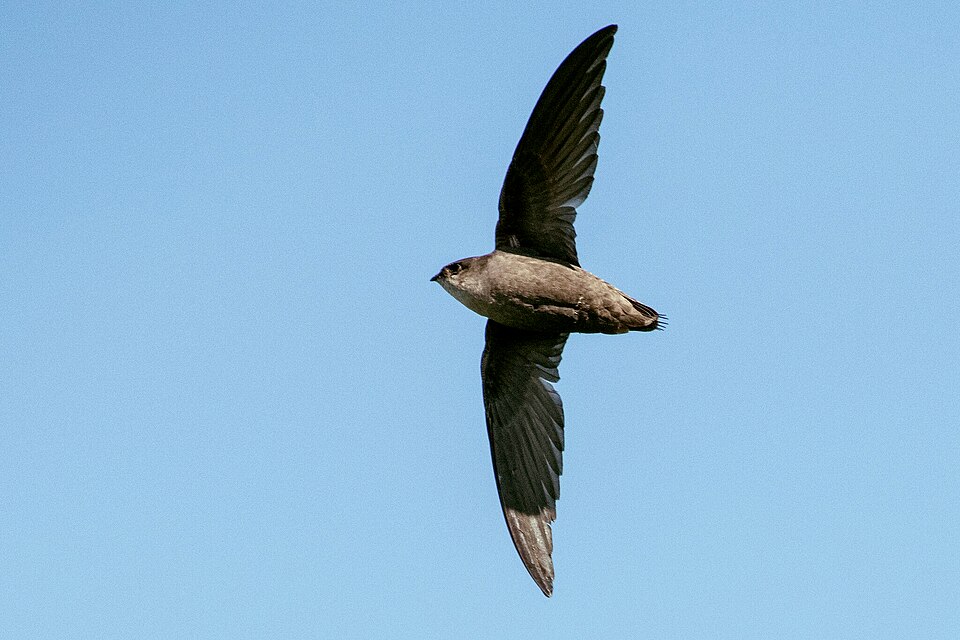
The Chimney Swift is one of the most familiar birds of eastern towns and cities that almost nobody actually sees up close. It spends nearly its entire waking life on the wing, twittering high overhead in loose, swirling flocks that look like animated commas against a summer sky. Birders often describe it as a "flying cigar", a stiff-winged, dark gray-brown body with no obvious neck, a short tapered tail, and long curved wings that beat in quick, almost fluttery bursts between glides. If you have ever looked up on a warm evening and watched birds spiraling down into a smokestack like water draining away, you have met this species.
Swifts are not closely related to the swallows they superficially resemble; their nearest cousins are actually the hummingbirds. Chimney Swifts cannot perch like a normal songbird. Their tiny feet are built only for clinging to vertical surfaces, so when they are not flying they are clinging to the inside walls of chimneys, hollow trees, and air shafts, propped up by stiff spine-tipped tail feathers. Once abundant in old-growth hollow trees, they shifted almost wholesale to masonry chimneys as North America was settled, a happy accommodation that is now working against them as old chimneys are capped, demolished, or replaced with narrow metal flues.
Chimney Swifts are best identified by shape and flight style rather than fine plumage detail, because they are almost always seen at a distance in silhouette. Look for a small, uniformly dark bird with a stubby torpedo of a body, long swept-back wings, and a short tail that often looks pointed or nearly absent. The flight is the giveaway: fast, twinkling wingbeats interspersed with stiff-winged glides, the bird constantly changing direction as it hawks insects.
| Shape | Cigar- or torpedo-shaped body with no visible neck; long, curved, swept-back wings |
| Tail | Very short and stubby, often looking pointed; spine-tipped feathers help it cling (not visible in flight) |
| Color | Uniform dark sooty gray-brown all over, slightly paler grayish on the throat and upper breast |
| Flight | Rapid, fluttering, stiff wingbeats alternating with short glides; constant erratic turns |
| Size | Small, between a sparrow and a robin; clearly smaller and stubbier than a swallow |
| Voice in flight | Hard, dry, mechanical chattering and ticking given almost constantly overhead |
Male vs. female
Males and females look identical in the field. The sexes share the same sooty plumage, the same proportions, and the same size, and there is no seasonal change in appearance. There is simply no reliable way to separate a male from a female Chimney Swift by sight, even in the hand. Behavior at the nest does not help much either, since both members of a pair build, incubate, and feed the young together.
Juveniles
Juvenile Chimney Swifts look much like adults, the same dark, neckless, short-tailed shape, and are essentially impossible to age in flight. Recently fledged birds may show very faint pale edging on some feathers and a slightly fresher, cleaner look to the plumage, but these marks are subtle and not visible at the distances swifts are usually seen. In late summer, family groups and gathering flocks often include young of the year, but you will know them by season and behavior rather than by any obvious field mark.
Chimney Swifts do not have a musical song. Their voice is a rapid, dry, mechanical chatter, a hard series of high chip and tick notes run together into a twittering or sputtering rattle, often written as chitter-chitter-chitter or a sharp tik-tik-tik-tik. They are remarkably vocal in flight, and that insistent chattering raining down from the sky is frequently how birders detect them before they spot the birds themselves.
The calls speed up and intensify during chases and social interactions, especially as flocks swirl around a roost site at dusk. Near a nest inside a chimney, you may also hear the loud, raspy begging of nestlings, a rolling, mechanical rattle that echoes down the flue and can puzzle homeowners who do not realize birds are living in their chimney.
The Chimney Swift is a long-distance migrant that breeds across most of the eastern United States and southern Canada, from the Great Plains east to the Atlantic and from the Gulf Coast north into the southern reaches of Canada. It is a bird of summer almost everywhere in that range, arriving in spring (generally March in the south, April into May farther north) and departing in fall.
It is absent in winter from North America entirely. The whole population funnels south through Central America to spend the non-breeding season in the upper Amazon basin of western South America, Peru, Ecuador, Chile, and adjacent areas. In the West, Chimney Swifts are scarce and mostly replaced by the closely related Vaux's Swift, though they have expanded into scattered western towns. During migration, especially in fall, huge numbers gather at communal roost chimneys, where hundreds or even thousands may pour in at dusk.
Chimney Swifts are pure aerial insectivores, they catch and eat virtually all of their food in flight. Their diet is made up of flying insects and ballooning spiders: flies, beetles, flying ants, mayflies, true bugs, small wasps and bees, and clouds of tiny midges and gnats. They forage by flying steadily through the air with their mouths open, snapping up whatever they encounter, often at considerable height but dropping lower in cool or overcast weather when insects fly nearer the ground.
Because they feed entirely on the wing, swifts are tireless flyers, covering many miles a day and even drinking and bathing without landing, skimming the surface of a pond to scoop water or wet their bellies. A single Chimney Swift consumes an enormous number of insects over a season, making the species a genuinely valuable, free pest-control service for the towns it lives in.
The nest is one of the species' most remarkable features. Chimney Swifts build a shallow half-saucer of short dead twigs, which they snap off tree branches in flight with their feet. They glue these twigs together, and cement the whole nest to a vertical surface inside a chimney, air shaft, or hollow tree, using their own saliva, which hardens like glue. The finished nest looks like a small bracket of sticks fixed to the wall, holding the eggs over open air.
A typical clutch is about 4 to 5 white eggs, and most pairs raise a single brood per season, occasionally attempting a second. Both parents share building, incubation (roughly 19-21 days), and feeding of the young, and unmated "helper" birds sometimes assist a breeding pair at the nest. The nestlings cling to the chimney wall with their sharp claws, growing rapidly on a diet of insects delivered by the adults, and fledge after about a month. Only one nesting pair uses a given chimney, even though dozens of non-breeding birds may roost in other chimneys nearby.
The Chimney Swift is not a feeder bird, it eats only flying insects and will never visit a seed feeder, suet cage, or birdbath in the usual sense. But it is one of the few birds you can genuinely "host," because it nests and roosts inside structures. If you have an old-fashioned masonry or clay-tile chimney, you can welcome swifts and help a declining species at the same time.
- Leave a traditional masonry or clay-flue-tile chimney uncapped from spring through fall so swifts can enter and nest; metal and slick flues are unusable and dangerous to them.
- Have the chimney cleaned in early spring (before swifts arrive) or late fall (after they leave), never during the May-August nesting season, to avoid destroying an active nest.
- Keep the damper closed while swifts are present so birds (or a fallen nest) cannot drop into the firebox or living space.
- Consider building a freestanding Chimney Swift tower, a tall wooden nesting structure designed for them, if you lack a suitable chimney; plans are available from conservation groups.
- Skip insecticide fogging of your yard; a healthy population of flying insects is exactly what these birds need to feed themselves and their young.
- Enjoy the fall roost spectacle by visiting large old chimneys (often on schools or churches) at dusk during migration to watch hundreds funnel in.
- Vaux's Swift: The western counterpart; very similar cigar shape but slightly smaller and paler, with a different chattering call. Ranges barely overlap, Vaux's is the swift you see in the Pacific states and Northwest.
- Barn Swallow: A true swallow, not a swift; has a long deeply forked tail, glides far more, shows rusty underparts and a blue back, and perches readily on wires, something swifts never do.
- Purple Martin: Larger and broader-winged with a forked tail; males are glossy dark blue-purple. Martins glide much more, soar in wide circles, and perch on houses and wires, unlike the stiff-winged, constantly flapping swift.
- Tree Swallow: Smaller swallow with clean white underparts and iridescent blue-green above; smoother, more buoyant flight and willingly perches, separating it from the uniformly dark, never-perching swift.
Are Chimney Swifts in my chimney a problem?
Usually not. Only a single pair nests in a chimney, they are quiet apart from some chattering and the begging of young, and they cause no structural damage. They are also federally protected, so it is illegal to remove an active nest. The main inconvenience is the rattling sound of nestlings for a few weeks in summer, which ends when the young fledge.
How do I get Chimney Swifts out of my chimney safely?
Wait. By law you cannot disturb an active nest, and the birds leave on their own once the young fledge, typically by late summer. After they have gone south in fall, you can have the chimney cleaned and, if you wish, capped. Never light a fire or run an insert while swifts are present, as it will kill them.
What is the difference between a Chimney Swift and a swallow?
Swifts and swallows are not closely related. A Chimney Swift has stiff, fluttering wingbeats, a stubby pointed tail, a cigar-shaped body, and never perches on wires. Swallows like Barn or Tree Swallows glide more smoothly, have forked tails and paler or colorful underparts, and frequently sit on wires and fences.
Why are Chimney Swifts declining?
Their numbers have dropped substantially in recent decades. The leading factors are the loss of suitable nesting and roosting sites as old open chimneys are capped or torn down, and a broad decline in flying insects, their only food. They are now listed as Near Threatened, which is why leaving a safe chimney open matters.
What does it mean when hundreds of swifts pour into a chimney at dusk?
That is a communal roost, most dramatic during fall migration. Large numbers of swifts gather to spend the night clinging together inside a big chimney for warmth and safety, circling overhead before funneling down in a spiraling tornado of birds. These roost events are a beloved birding spectacle worth seeking out.