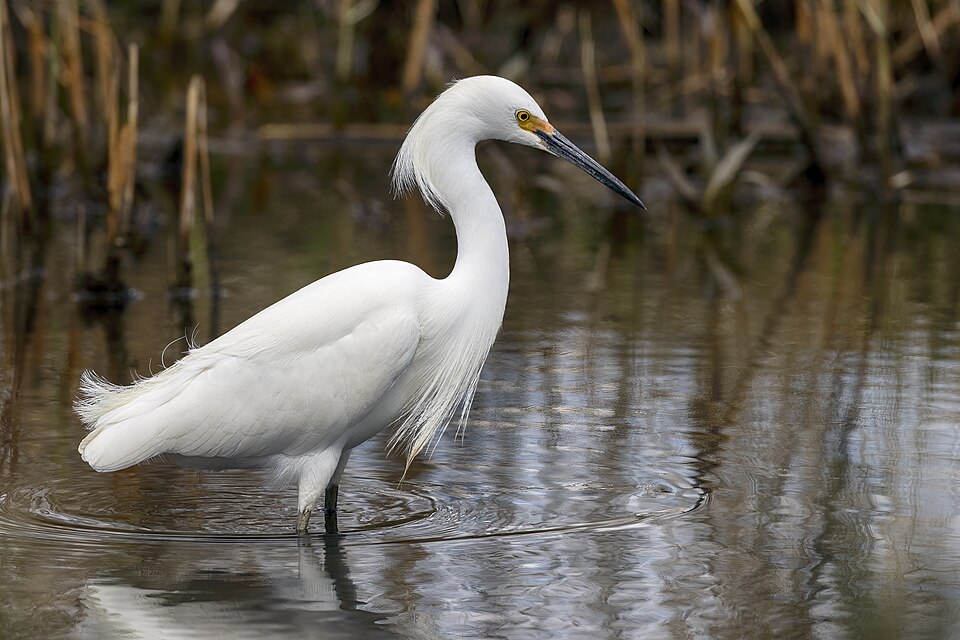
The Snowy Egret is one of North America's most elegant wading birds, a medium-sized heron clothed entirely in brilliant white. It is a bird of marshes, mudflats, tidal creeks, and shallow pond edges, where it stalks small fish and invertebrates with a restless, almost theatrical energy. Where many herons stand motionless and wait, the Snowy Egret often runs, shuffles, and lunges, putting on a show that makes it one of the more entertaining birds to watch at the water's edge.
This species has a remarkable history. In the late 1800s and early 1900s, Snowy Egrets were slaughtered in enormous numbers for their fine breeding plumes, called "aigrettes," which decorated fashionable women's hats. The outcry over this trade helped launch the modern bird conservation movement and the founding of the Audubon societies. Protected since, the Snowy Egret has rebounded strongly and is now a familiar sight across much of the southern and coastal United States, as well as throughout Central and South America.
A Snowy Egret is a slim, graceful, all-white heron, smaller and daintier than the Great Egret but considerably bigger than the Cattle Egret. The classic clinching feature is the combination of a thin black bill, jet-black legs, and startlingly bright yellow feet, the famous "golden slippers." In breeding season it sprouts lacy, recurved plumes on its head, neck, and back.
| Plumage | Entirely white at all ages and seasons |
| Bill | Slender and black, with yellow skin (lores) at the base in front of the eye |
| Legs & feet | Black legs ending in bright yellow feet, the diagnostic golden slippers |
| Size | Medium heron, about 24 in long with a roughly 3.3 ft wingspan |
| Breeding plumes | Lacy, upturned aigrettes on head, neck, and back; lores flush reddish or orange |
| Posture | Slim and active, often running and shuffling rather than standing still |
Male vs. female
Male and female Snowy Egrets look alike, with identical white plumage, black bills, black legs, and yellow feet. Males average slightly larger and may grow somewhat longer breeding plumes, but this is not reliable in the field. There is no plumage difference you can use to sex an individual bird at a distance, so the sexes are best told apart only by behavior at the nest.
Juveniles
Juvenile Snowy Egrets are white like adults but lack the showy breeding plumes. The best way to age them is by the legs: young birds show a yellowish or greenish stripe running up the back of the leg rather than the clean all-black leg of an adult, and the bill base and lores are duller. Immatures still show pale feet, though the contrast is often less vivid than in a crisp breeding adult.
The Snowy Egret is not a songbird, and it is usually silent away from the colony. When disturbed it gives a harsh, low, rasping aaahr or a nasal croak. Around breeding colonies it becomes much noisier, producing a bubbling, raspy chatter and a variety of squawks and grating notes during courtship and squabbles over nest sites.
A common contact and alarm call is a guttural wulla-wulla-wulla or a sharp squawk given as the bird flushes. These rough, unmusical sounds are typical of herons and contrast sharply with the bird's delicate appearance.
Snowy Egrets breed widely across the United States, especially along the Atlantic, Gulf, and Pacific coasts, throughout much of the interior West and Great Plains wetlands, and south through Mexico, Central America, the Caribbean, and into much of South America. They favor coastal salt marshes, mangroves, freshwater marshes, flooded fields, and the muddy margins of lakes and rivers.
Northern breeders are migratory, withdrawing from inland and northern areas in fall to winter along the southern coasts and farther south into the tropics. Birds in the southern United States and the tropics are largely year-round residents. After the breeding season, Snowy Egrets are well known for dispersing widely, sometimes wandering well north of their normal range.
Snowy Egrets eat a varied diet of small aquatic animals, including fish, shrimp, crayfish, crabs, aquatic insects, frogs, snails, and worms. They hunt in shallow water and along soft margins, taking prey with a quick thrust of the bill.
Their feeding style is famously animated. A Snowy Egret may dash through the shallows with wings half-raised, stir the bottom with one bright yellow foot to flush hidden prey, hover briefly and drop to snatch food, or simply stand and wait like other herons. This foot-stirring and active pursuit set it apart from the more patient Great Egret, and it often joins mixed feeding flocks with other herons and ibises.
Snowy Egrets are colonial nesters, often breeding alongside other herons, egrets, and ibises in noisy mixed rookeries set in trees, shrubs, or marsh vegetation, frequently on islands safe from ground predators. The male establishes a display site and attracts a mate with plume displays and calls, then the pair builds a loose, shallow platform of sticks, twigs, and reeds, with the male typically gathering material and the female arranging it.
The female lays about 3 to 4 pale blue-green eggs, and both parents share incubation for roughly three weeks. The young are fed by both adults and clamber actively around the nest branches well before they can fly. Pairs usually raise one brood per year.
The Snowy Egret is not a backyard or feeder bird and cannot be drawn to seed, suet, or nectar. It is a wetland specialist, so the way to enjoy one is to go where it hunts, or to make larger waterside properties friendly to wading birds.
- Look for them at shallow water: tidal flats, salt marshes, freshwater marsh edges, flooded fields, and pond margins, especially in the southern and coastal U.S.
- Visit at low tide or early morning, when egrets actively feed along exposed mud and shallow channels.
- If you own a large pond or wetland, keeping natural shallow edges with healthy fish and invertebrate life is far more useful than any feeder.
- Watch for their foot-stirring dance in the shallows, a giveaway that separates a Snowy from a calmer Great Egret even at a distance.
- Avoid disturbing nesting colonies; view rookeries from a respectful distance with binoculars or a spotting scope.
- Protect and avoid draining marshes and wetlands, the single most important thing for keeping egrets in any region.
- Great Egret: Much larger, with an all-yellow bill and black feet, the reverse of the Snowy's black bill and yellow feet. Hunts more patiently.
- Cattle Egret: Smaller and stockier with a short yellow bill; often in dry fields with livestock rather than in water. Shows buffy tones when breeding.
- Little Blue Heron: Immatures are white and easily confused, but show a two-toned blue-gray and pale bill, dull greenish legs, and no bright yellow feet.
- Reddish Egret: A white morph exists, but it is larger with a pink-and-black bill and blue-gray legs, and it has an even wilder, lurching foraging dance.
How do you tell a Snowy Egret from a Great Egret?
Look at the bill and feet. A Snowy Egret has a slender black bill and bright yellow feet on black legs. A Great Egret is noticeably larger, with a heavy yellow bill and all-black feet. The Snowy is also slimmer and far more active when feeding.
Why does the Snowy Egret have yellow feet?
The bright yellow feet, often called golden slippers, are thought to help in feeding. Snowy Egrets shuffle and stir the bottom with a foot to startle hidden fish and invertebrates into moving, and the flash of color may help flush prey into the open where the bird can snatch it.
Are Snowy Egrets endangered?
No. Snowy Egrets were once nearly wiped out by the plume trade for the millinery (hat) industry around 1900, but legal protection allowed them to recover. Today they are common and listed as Least Concern, though local populations still depend on healthy wetlands.
What does a Snowy Egret eat?
They eat small aquatic prey including fish, shrimp, crayfish, crabs, aquatic insects, frogs, snails, and worms, caught with a quick stab of the bill in shallow water.
Where do Snowy Egrets nest?
They nest in colonies, usually with other herons and egrets, building stick platforms in trees, shrubs, or marsh growth, often on predator-free islands. Both parents incubate the 3 to 4 eggs and feed the young.