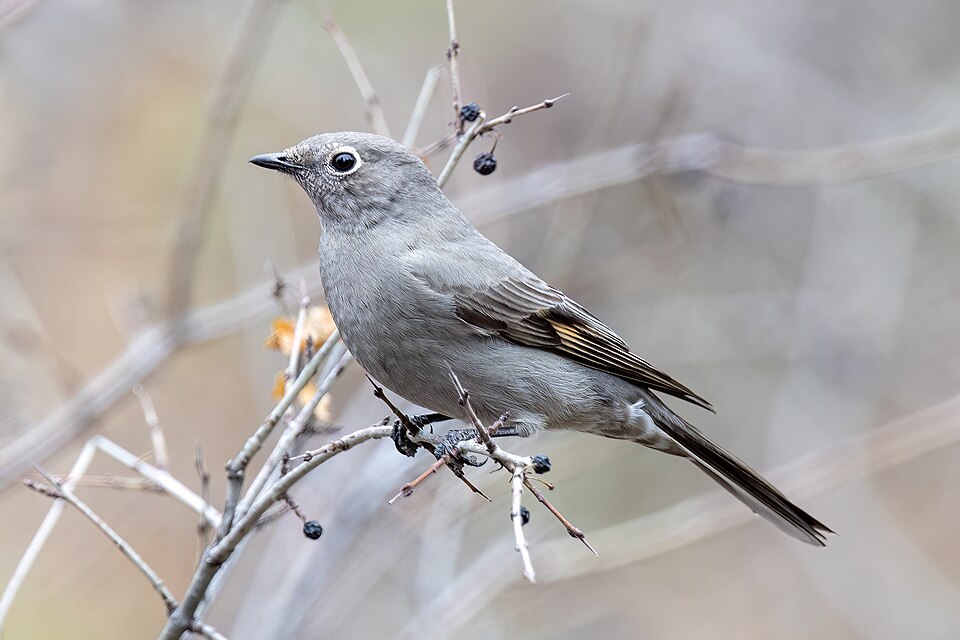
Townsend's Solitaire is one of the West's quietly distinctive birds: a slim, plain-gray thrush that perches bolt upright on the tip of a dead snag, often well above timberline or out on a windswept ridge, looking far more like a slender flycatcher than a robin relative. At a glance it can seem drab, but a closer look reveals a clean white eye-ring, a buffy patch in the wing, and white outer tail feathers that flash when it flies. It is a member of the thrush family (Turdidae), and the only solitaire that breeds widely in North America.
What makes this bird genuinely memorable is its winter life. While most thrushes fall silent and drift south in autumn, the solitaire often stays put in mountain foothills and canyons, where it sets up and fiercely defends a winter feeding territory centered on a single resource: juniper berries. A male will sing his long, warbling, finch-like song on bright, frigid January mornings, a sound that surprises birders expecting silence. Because so much of its winter survival hinges on juniper crops, the solitaire's local numbers swing dramatically from year to year as berry harvests boom and bust.
Shape is the first thing to learn. Townsend's Solitaire is a long, slender, small-headed thrush that sits very upright, often on an exposed perch, with a long tail and a short, thin bill. That elongated, almost mockingbird-like silhouette plus the overall uniform gray color is usually enough to clinch an ID before you even see the finer marks.
| Overall color | Uniform soft gray, slightly paler below; no bold streaks or strong contrast. |
| Eye-ring | Crisp, complete white eye-ring that stands out on the plain gray face. |
| Wing patch | Buffy-orange patch across the base of the flight feathers, obvious in flight and often visible at rest. |
| Tail | Long tail with white outer feathers that flash conspicuously when it flies or fans the tail. |
| Shape | Slim, upright, small-headed, long-tailed; perches on the very tips of snags. |
| Bill | Short, thin, dark; not robin-like and heavy. |
Male vs. female
Males and females look essentially identical in the field. Both sexes share the gray plumage, white eye-ring, buffy wing patch, and white-edged tail, and there is no reliable plumage difference a birder can use. Behavior is the better clue: it is almost always the male doing the loud, sustained singing, especially while defending a winter juniper territory, while quieter birds feeding nearby may be either sex.
Juveniles
Juveniles look strikingly different from adults and confuse many observers. Fresh juveniles are heavily spotted and scaled, with pale buff spots edged in dark gray covering the head, back, breast, and belly, giving them a speckled, almost scaly appearance. They still show the buffy wing patch and white outer tail feathers, which are the best clues to their identity. This spotted plumage is molted out during the first summer and fall, after which young birds resemble plain gray adults.
The song is a long, rapid, rising-and-falling warble, rich and slightly jumbled, often compared to a finch or a more musical, sustained version of a House Finch tumbling on and on. It can run for many seconds without an obvious pause, energetic and ringing, and it carries well across open mountain slopes. Remarkably, males sing through fall and winter to defend feeding territories, so a complex warble pouring out over a snowy juniper hillside is a classic giveaway.
The most useful call is a clear, single whistled note, often written as eek or heeh, a short, slightly squeaky tew or peek that the bird repeats from a high perch. This thin, plaintive note is frequently the first sign a solitaire is present before you spot the gray shape on a distant snag.
Townsend's Solitaire is a bird of the mountainous West, breeding from Alaska and western Canada south through the Rockies, the Cascades and Sierra Nevada, and the interior ranges of the United States into the mountains of northern Mexico. In the breeding season it favors open coniferous forest, burns, and steep slopes, often near treeline, where banks and road cuts provide nest sites.
Its movements are best described as altitudinal and irruptive rather than a tidy long-distance migration. In fall many birds simply drop downslope into foothills, canyons, and pinyon-juniper woodlands, where they spend winter wherever juniper berries are abundant. In poor berry years they wander much farther, and individuals turn up well east of the Rockies and across the Great Plains, occasionally surprising birders far outside the normal range.
Diet shifts dramatically with the seasons. In the breeding season Townsend's Solitaire is largely insectivorous, sallying out from a perch to snatch flying insects in mid-air like a flycatcher, or dropping to the ground for beetles, ants, caterpillars, and other invertebrates. This aerial flycatching habit, unusual among thrushes, is one reason the bird is so often seen perched conspicuously in the open.
In fall and winter it becomes overwhelmingly frugivorous, and one fruit dominates: juniper berries (the small blue cones of junipers). A solitaire's winter survival can hinge almost entirely on the local juniper crop, which is why birds set up and aggressively defend berry-rich territories against other solitaires and fruit-eating birds. It also takes other small fruits when available, including mistletoe and various wild berries.
Townsend's Solitaire is a ground-and-bank nester, an unusual choice for a thrush. The female typically builds a bulky, somewhat loose cup of pine needles, grass stems, twigs, and rootlets, tucked into a sheltered niche: an overhung dirt bank, the base of a rock or stump, a road cut, or a cavity among tree roots, where it is protected from above. These hidden, low sites can make active nests genuinely hard to find.
A clutch is usually 3 to 4 eggs, pale and dull-colored with darker speckling, and a pair commonly raises two broods in a season where conditions allow. Incubation and care follow the typical thrush pattern, with the female doing most or all incubation and both parents feeding the young, which leave the nest as active, scaly-plumaged juveniles.
Townsend's Solitaire is not a typical feeder bird and rarely visits seed or suet stations, so you won't lure it with the usual backyard setup. If you live within its range, the way to host one is to make your property attractive to a winter berry specialist and to give it the open perches it loves.
- Plant native junipers. A berry-bearing juniper or two is the single best thing you can do; in winter, fruit-laden junipers are exactly what a roaming solitaire is hunting for.
- Offer other native fruit. Mistletoe-bearing trees, wild rose hips, and other small native berries can hold a wandering bird, especially in a poor juniper year.
- Leave high, open perches. Dead snags, fence tops, and bare upper branches give the solitaire the exposed lookouts it uses to perch upright and watch its territory.
- Watch foothills and canyons in winter. If you're in the interior West, scan pinyon-juniper edges and lower mountain slopes from late fall onward rather than waiting for one at the feeder.
- Listen on cold mornings. A long warbling song or a thin, repeated eek note in winter is often your first clue that a solitaire has claimed nearby junipers.
- Northern Mockingbird: Similar slim gray shape and white outer tail, but the mockingbird shows bold white wing patches (not a buffy patch), lacks the white eye-ring, and has a longer bill and very different mimicking song.
- Mountain Bluebird: Shares open western perches and aerial feeding, but females are warmer gray-brown with blue in the wings and tail, and lack the white eye-ring and buffy wing patch of a solitaire.
- Gray Catbird: Also slim and gray, but the catbird is darker slate-gray with a black cap and rusty undertail, skulks in thickets rather than perching in the open, and gives a catlike mew.
- Townsend's Warbler: Shares the name but is a small, boldly black-and-yellow warbler; no real confusion in the field, though searches for the name sometimes mix the two.
How do I identify a Townsend's Solitaire?
Look for a slim, plain-gray, upright thrush perched on the tip of an exposed snag. Key marks are the crisp white eye-ring, a buffy-orange patch at the base of the wing, and white outer tail feathers that flash in flight. Its long, slender, small-headed shape sets it apart from rounder thrushes.
Why does Townsend's Solitaire sing in winter?
Unlike most thrushes, the solitaire defends a winter feeding territory built around juniper berries. Males sing their long warbling song through fall and winter to advertise and hold that berry-rich patch, so you can hear full song on cold, snowy mornings.
What does Townsend's Solitaire eat?
In summer it eats mostly insects, catching them in mid-air like a flycatcher or taking them off the ground. In fall and winter it switches almost entirely to fruit, especially juniper berries, which can determine whether a bird survives the winter in a given area.
Will Townsend's Solitaire come to a bird feeder?
Not usually. It rarely visits seed or suet feeders. To attract one within its range, plant native berry-bearing junipers and other native fruit and leave high, open perches, since the bird is a winter berry specialist rather than a feeder visitor.
Where does Townsend's Solitaire live?
It breeds in mountains across the western U.S. and Canada up to Alaska, favoring open conifer forest near treeline. In winter many birds move downslope into foothills, canyons, and pinyon-juniper woodlands, and in poor berry years they can wander east onto the plains.