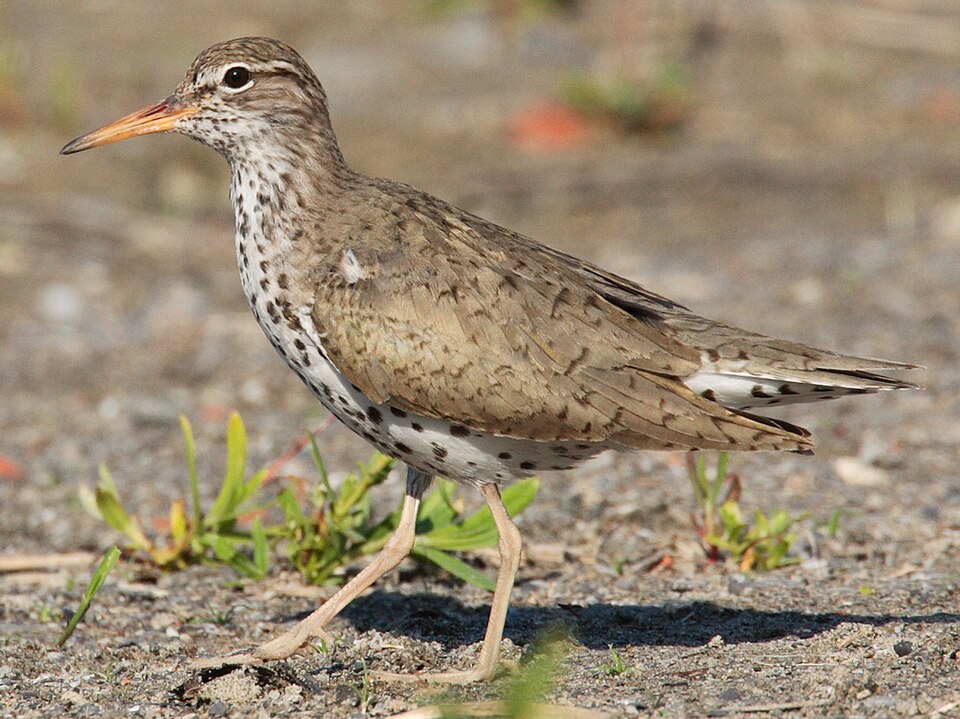
The Spotted Sandpiper is the most widespread breeding sandpiper in North America, and one of the easiest to recognize once you learn its quirks. Unlike most shorebirds, which crowd the coasts and mudflats in flocks, the Spotted Sandpiper turns up alone along just about any freshwater edge: the gravel bank of a mountain stream, the rim of a suburban pond, a lakeshore, a roadside ditch, even a city park fountain. If you see a small, solitary sandpiper bobbing its rear end up and down on a rock far inland, you have almost certainly found a "Spotty."
Two behaviors give it away instantly. The first is the constant teetering, a rhythmic seesaw motion of the tail and body that never seems to stop. The second is its distinctive flight: stiff, shallow, fluttering wingbeats held low over the water, with the wings barely rising above horizontal. Add the bold dark spots on a clean white breast in summer, and this is a bird you can name from a distance. It is also famous among ornithologists for an unusual breeding system in which the female, not the male, competes for and defends mates.
This is a small, trim sandpiper with a horizontal posture, a medium-length bill, and a habit of crouching forward as it walks. Size and silhouette aside, behavior is the fastest way to clinch the ID: the endless tail-bobbing and the low, stiff-winged flight are unique among small inland sandpipers.
| Breeding plumage | Bold round black spots scattered across a bright white breast and belly; warm olive-brown upperparts. |
| Nonbreeding plumage | Spots vanish entirely; plain clean white below, gray-brown above, with a brownish smudge on the side of the breast. |
| Bill | Medium length, straight; pinkish to orange with a dark tip in breeding birds, duller in winter. |
| Face | White eyebrow stripe over the eye and a dark line through it; gives a slightly capped look. |
| Legs | Yellowish to pinkish-tan, fairly short. |
| Behavior | Constant teetering/bobbing of the rear, and low stiff-winged, fluttering flight over water. |
Male vs. female
Males and females look essentially alike in plumage, and in the field you generally cannot separate them by eye. On average females are slightly larger and tend to be a bit more heavily and boldly spotted in breeding plumage, but this overlaps too much to rely on. The real difference is behavioral: the Spotted Sandpiper has a sex-role-reversed mating system in which females arrive on territory first, are the ones to compete aggressively for and defend territory, and may pair with several males in a season (polyandry). The males do most of the incubating and chick care.
Juveniles
Juveniles resemble nonbreeding adults: clean white underparts with no spotting, and gray-brown upperparts. Look closely and you'll see neat buff-and-dark barring or scaling on the wing coverts, giving the folded wing a finely patterned look that fresh adults lack. The brown patches on the sides of the breast and the white wedge in front of the wing are already present, and young birds teeter just like their parents.
The most familiar sound is a sharp, clear peet-weet or weet-weet-weet, often given as the bird flushes and flutters away low over the water. The notes are high, whistled, and slightly downslurred, with an urgent, slightly nervous quality.
On the breeding grounds birds also give an extended series, a rolling weet-weet-weet-weet-weet that runs together into a trill, used in display and around the territory. Alarm and contact calls are similar short pit or weet notes. Overall the voice is clean and whistled rather than harsh or buzzy.
Spotted Sandpipers breed across an enormous swath of North America, from Alaska and northern Canada south through nearly all of the lower 48 states, wherever there is suitable water with a vegetated or gravelly edge. Few other shorebirds nest so broadly across the continent.
They are long-distance migrants. In fall most birds move south to winter from the southern United States and coasts down through Mexico, Central America, the Caribbean, and well into South America. Migration is largely on a broad front, and during passage you can find single birds at almost any pond, river, or shoreline. They typically migrate and winter alone or loosely spaced rather than in tight flocks.
Spotted Sandpipers are generalist insect and invertebrate hunters. They feed by walking along the water's edge, pecking and snatching prey from the ground, the water surface, and low vegetation, often darting after things that move. They take aquatic and terrestrial insects, including flies, beetles, grasshoppers, caterpillars, and midges, along with small crustaceans, worms, snails, and even tiny fish or carrion when available.
Watch one feed and you'll notice it is more active and "darty" than a typical probing sandpiper. It frequently makes short rushes, lunges at flying insects, and continues teetering between grabs. The constant body-bobbing carries on even while it eats.
Nesting happens on the ground, usually within easy reach of water. The nest is a shallow scrape lined with grass and other plant material, tucked under a clump of vegetation, a log, or a shrub for cover. A typical clutch is four eggs, buff with dark blotches, arranged points-inward in the classic shorebird fashion.
The breeding system is unusual: many females are polyandrous, laying clutches for several different males in a season, and it is largely the males that incubate and raise the young. Incubation runs about three weeks. The chicks are precocial, leaving the nest within hours of hatching, already teetering and able to feed themselves while a parent (usually the male) shepherds and broods them.
The Spotted Sandpiper is not a feeder bird and won't visit a seed tray or suet cage, since it eats live insects and invertebrates along water's edge. But it is very much a "backyard" bird if your yard happens to include or border the right water, and it's one of the easier shorebirds to attract to a property with a pond or stream.
- If you have a pond, stream, or lakeshore, leave a section of natural gravelly or muddy edge rather than mowing or hardening it all the way to the water.
- Maintain low vegetation and a few rocks or logs near the shoreline, which provide both foraging spots and nesting cover.
- Avoid pesticides near the water so the insect and invertebrate prey base stays healthy.
- During migration, watch any nearby water, even a small ornamental pond or flooded field, since lone birds turn up almost anywhere.
- Keep dogs and foot traffic off the shoreline during the breeding season, as ground-nesting birds are easily disturbed.
- Look and listen at the water's edge, then watch for the telltale teetering and the sharp peet-weet call as a bird flushes.
- Solitary Sandpiper: Also an inland loner, but darker above with bold white eye-ring, dark (not yellow-pink) bill, and dark central tail; it bobs less mechanically and lacks breast spots.
- Spotted Sandpiper's Old World twin, the Common Sandpiper: Nearly identical Eurasian counterpart; never spotted below, slightly longer tail projection, and out of range for almost all of North America.
- Least Sandpiper: Tiny peep with yellow-green legs that feeds in flocks on mudflats; lacks the teetering walk and the stiff low flight.
- Killdeer: Larger, with two black breast bands and a rusty rump; runs in stops and starts on open ground rather than teetering at the water's edge.
Why does the Spotted Sandpiper bob its tail up and down?
It teeters almost constantly, even as a chick. Ornithologists aren't fully certain why, but leading ideas are that the rhythmic motion helps camouflage the bird against moving water and shifting light, or serves as a signal to other sandpipers. Whatever the reason, it's a reliable field mark: a small sandpiper bobbing its rear nonstop along a freshwater edge is almost always a Spotted.
Where do the spots go in winter?
The bold black breast spots are only present in breeding (summer) plumage. In fall and winter the bird molts to a plain plumage with clean white underparts and no spots at all, which surprises people who only know the summer look. Even then you can ID it by the brown breast-side patch, the white wedge in front of the wing, the teetering, and the stiff low flight.
Are Spotted Sandpipers found inland or only at the beach?
Very much inland. While many sandpipers stick to coasts and mudflats, the Spotted Sandpiper is the classic freshwater sandpiper, found along rivers, streams, ponds, and lakes across the continent, often far from any ocean. It will use coastlines too, especially in migration and winter, but you're just as likely to see one at a mountain creek or a park pond.
Do Spotted Sandpipers come to bird feeders?
No. They eat live insects, worms, small crustaceans, and other invertebrates gleaned from the ground and water's edge, so they won't visit seed or suet feeders. The way to attract them is to provide good shoreline habitat with natural edges and a healthy insect supply rather than feeder food.
Is it true the female mates with several males?
Often, yes. The Spotted Sandpiper is well known for sex-role reversal. Females arrive first, set up and defend territory, and many are polyandrous, pairing with several males in one season. The males then take on most of the incubation and chick-rearing, which is the opposite of the pattern in most birds.