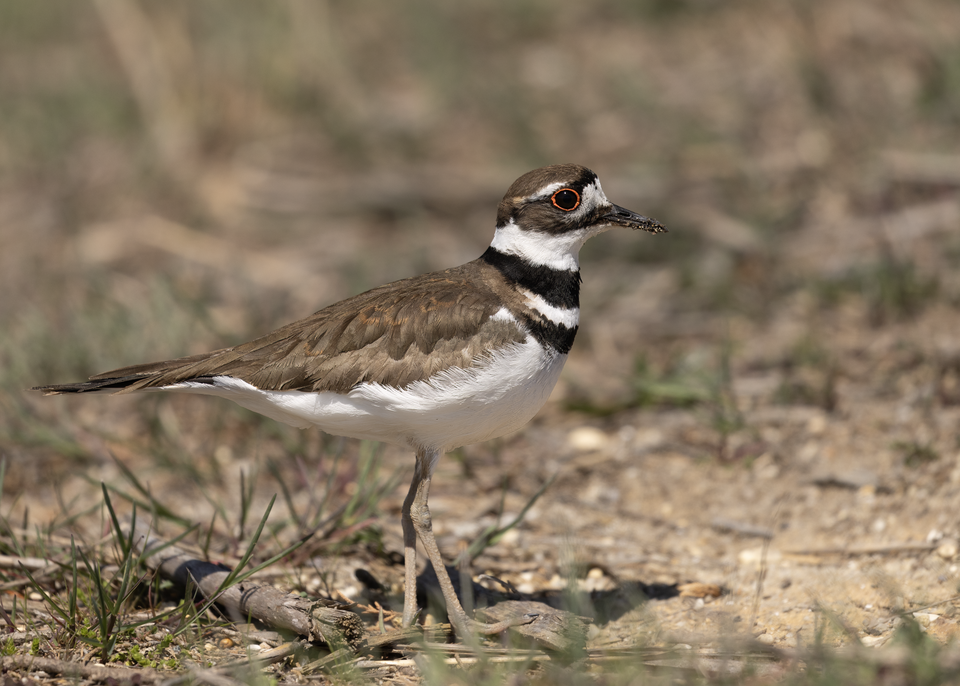
The Killdeer is the shorebird you are most likely to meet without ever going near the shore. A slender, long-legged plover with a sandy-brown back and two bold black bands across a white chest, it thrives in gravel lots, ballfields, pastures, driveways, and the flat gravel roofs of big-box stores. Many people hear it long before they see it: a piercing, repeated kill-deer that rings out across open ground, often at night, and gives the bird both its common and its scientific name (vociferus means "noisy").
What makes the Killdeer such a beloved character is its theatrics. When a predator (or a person) wanders too close to its nest, an adult will stagger away dragging a "broken" wing, tail fanned and pressed to the ground, crying loudly to lure the threat away from its eggs. Once the intruder has been led far enough, the bird makes a miraculous recovery and flies off. This combination of bold patterning, loud voice, and dramatic distraction display makes the Killdeer one of the easiest and most entertaining birds for a beginning birder to learn.
The Killdeer is a medium-sized plover with a rounded head, a short black bill, big dark eyes, and noticeably long, pale legs. It has a slender body and a long, pointed tail that extends well past the wingtips at rest, giving it a more elongated, "tail-heavy" look than smaller plovers. In flight it shows long, narrow wings with a white stripe and a bright orange-buff rump that is hard to mistake.
| Two breast bands | Two complete black bands across a white chest, the single most reliable field mark. Most similar small plovers have only one. |
| Brown above, white below | Warm sandy-brown back and crown, clean white belly and throat. |
| Orange-red rump & tail | A bright tawny-orange rump and tail base, especially obvious in flight and during displays. |
| Face pattern | White forehead and white eyebrow, black bands across the crown and through the eye, plus a red eye-ring. |
| Long tail | A relatively long, pointed tail projects past the folded wingtips, longer than on other North American plovers. |
| Pale, long legs | Long dull-pinkish to grayish legs suited to walking and running across open ground. |
Male vs. female
Males and females look essentially identical in the field, and you cannot reliably sex a Killdeer by plumage. Both sexes show the same two black breast bands, brown upperparts, and orange rump. On close study, some females average slightly more brown mixed into the black face and breast bands, but this is subtle, variable, and not dependable for everyday birding. Behavior at the nest is a better clue than appearance, since both sexes share incubation and both will perform the broken-wing distraction display.
Juveniles
Newly hatched Killdeer are precocial: downy, long-legged chicks that leave the nest within hours of hatching and run about feeding themselves, looking like tiny cotton balls on stilts. A key detail is that downy chicks show only a single breast band, not the adult's two, a frequent source of confusion for people who think they have found a different species. Juveniles soon resemble adults but can look slightly scalier or paler-fringed on the back, and the black bands may appear a touch duller or browner before they sharpen up with age.
The Killdeer is one of the most vocal birds in open country, and its calls are worth learning because you will hear them constantly. The signature call is a loud, high, ringing kill-DEER, kill-DEER or dee-dee-dee, repeated insistently and carrying a long way. Birds often call in flight, on the ground, and even on calm nights, which is why people sometimes hear them after dark.
When agitated or defending a nest, a Killdeer gives a rapid, rolling, trilled trrrr or a stuttering series of notes, often while running or performing its broken-wing act. There is also a softer, low dee used between mates and family members. Once the distinctive kill-deer phrase clicks for you, you will recognize this bird with your ears alone.
The Killdeer is widespread across North America, breeding from southern Canada through the United States and into Mexico, and it also occurs in parts of the Caribbean and along the western coast of South America. It is one of the few shorebirds equally at home in the continental interior as on the coast, since it nests on dry, open, gravelly ground rather than beaches.
Across much of the United States, Killdeer are year-round residents wherever winters are mild. Birds breeding in the northern states and Canada are migratory, withdrawing south in fall and returning very early in spring, often among the first migrants to arrive, sometimes while snow still lingers. In the southern U.S., Mexico, and along both coasts, you can find them in any month.
Killdeer are primarily insectivores that forage by sight on open ground. They use the classic plover style of feeding: run a few quick steps, stop abruptly, tilt forward to snatch prey, then run again. Their diet is dominated by insects and their larvae, beetles, grasshoppers, fly larvae, caterpillars, true bugs, and ants, supplemented with spiders, earthworms, snails, small crustaceans, and other invertebrates.
They often feed in plowed fields and along muddy edges, sometimes following farm equipment to grab insects stirred up from the soil. A characteristic behavior is "foot-trembling," where the bird vibrates one foot against wet ground to flush or expose hidden prey. Because so much of their food is made up of crop and pasture pests, Killdeer are generally considered beneficial to farmers.
The Killdeer nest is famously minimal: a simple shallow scrape on bare, open ground, often gravel, sand, or short grass, sometimes lined with a few pebbles, bits of shell, or grass. Favored sites include gravel parking lots, driveways, railroad beds, golf courses, ballfields, and even flat gravel rooftops. The speckled, buff-and-dark eggs are superbly camouflaged against gravel, which is why people so often stumble onto a nest by accident.
A typical clutch is four eggs, arranged points-inward. Both the male and female take turns incubating for roughly 24 to 28 days. The chicks hatch covered in down and ready to run, leaving the scrape almost immediately while the attentive parents guard them and lead them to feeding areas. In warmer regions Killdeer frequently raise two broods in a season, and they readily re-nest if a clutch is lost. The broken-wing distraction display is their main defense against nest predators.
The Killdeer is not a feeder bird, it eats insects from the ground and will ignore seed or suet, but it is very much a "yard and neighborhood" bird if you have the right open habitat. Rather than baiting it with food, you attract Killdeer by offering the bare, gravelly, open spaces they love and by giving them room to forage and nest undisturbed.
- Provide open, short or bare ground, gravel patches, a graveled driveway, a flat unplanted area, or closely mown lawn edges mimic their natural habitat.
- Skip the insecticides; Killdeer feed on the beetles, grubs, and grasshoppers that pesticides eliminate, so a chemical-free yard supports them.
- Leave muddy or damp edges around puddles, ponds, or drainage areas where they can probe for invertebrates.
- If a pair nests in your gravel driveway or lot, rope off the area and keep pets and mowers away until the chicks have left, the eggs are nearly invisible.
- Be patient with the broken-wing act; a parent feigning injury means a nest is nearby, so back off rather than following the bird.
- Avoid tidying every gravel and dirt patch into lawn or pavement, a little open mess is exactly what they need.
- Semipalmated Plover: Much smaller and rounder with only ONE breast band, a stubby orange-and-black bill, and orange legs; favors mudflats and beaches, not lawns and fields.
- Wilson's Plover: A coastal single-banded plover with a heavy all-black bill; lacks the Killdeer's two bands, long tail, and bright orange rump.
- Piping Plover: Small, very pale sandy plover of beaches with a single (often incomplete) breast band; far paler and shorter-tailed than a Killdeer.
- Black-bellied Plover: Larger, chunkier, gray-toned coastal plover with no breast bands; shows black 'armpits' in flight, unlike the brown, orange-rumped Killdeer.
Why does the Killdeer pretend to have a broken wing?
It is a distraction display to protect the nest or chicks. By dragging a wing and crying loudly, the parent lures a predator away from the eggs, then flies off normally once the threat has followed it to a safe distance. Both parents do it, and seeing it is a sign a nest is nearby, so step back.
Is a Killdeer a shorebird if it lives away from water?
Yes. The Killdeer belongs to the plover family of shorebirds, but unlike most relatives it nests and feeds on dry open ground, gravel lots, fields, lawns, and rooftops, often far from any shoreline. It is one of the most terrestrial shorebirds in North America.
Why do Killdeer call so loudly, even at night?
Killdeer are naturally vocal and use their ringing kill-deer call to communicate, defend territory, and sound alarms. They commonly call in flight and on calm nights, especially during the breeding season, which is why you may hear one overhead in the dark.
What should I do if a Killdeer nested in my driveway or parking lot?
Leave the nest in place if you can, it is illegal to disturb the eggs of native birds in the U.S. Rope off or flag the area, keep pets, mowers, and vehicles away, and wait. Incubation lasts about 24 to 28 days, and the chicks leave within hours of hatching, so the disruption is short-lived.
How can I tell a Killdeer from other plovers?
Look for two black breast bands rather than one, a warm brown back, a long pointed tail, a bright orange rump in flight, and a red eye-ring. Most similar plovers have a single breast band, are smaller and rounder, and stick to beaches and mudflats rather than fields and lawns.