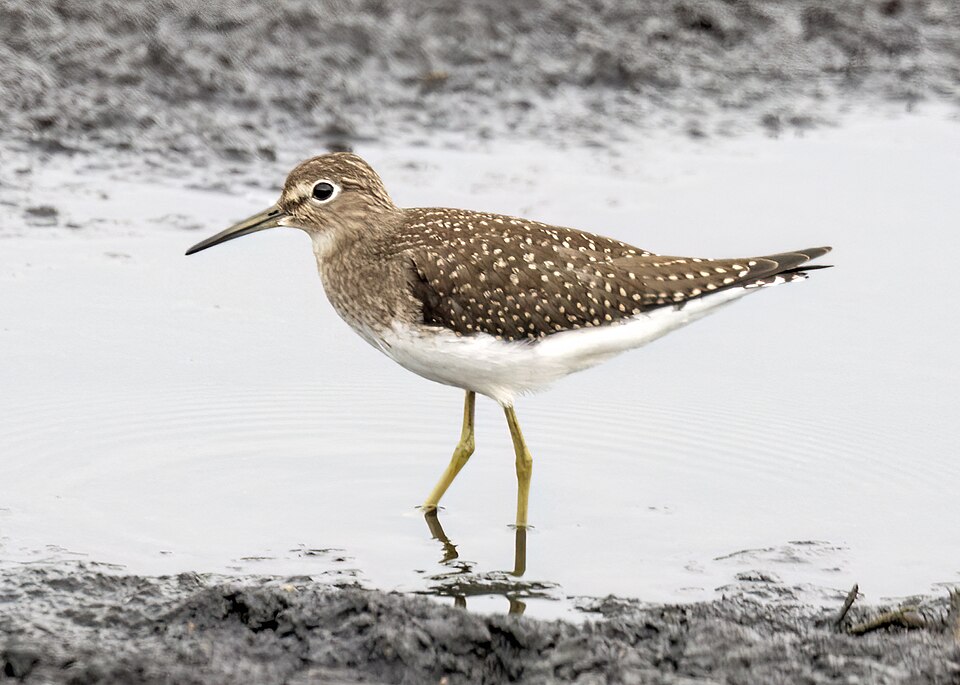
The Solitary Sandpiper lives up to its name. While most shorebirds gather in busy flocks on open mudflats and beaches, this slender, dark sandpiper turns up alone at the edge of a woodland pond, a flooded ditch, a quiet stream, or even a puddle in a gravel lane. During migration, seeing two or three together is about as crowded as it gets. That habit of haunting small freshwater pockets rather than the coast makes it one of the more accessible "shorebirds" for inland birders who rarely get to the ocean.
It is also one of North America's most surprising nesters. Instead of scraping a nest on the ground like nearly all of its relatives, the Solitary Sandpiper lays its eggs in the abandoned tree nests of songbirds, high in the spruce and tamarack bogs of the boreal forest. For a wading bird, that is genuinely odd behavior, and it went undocumented for a remarkably long time. Add in its bold white eye-ring, bobbing walk, and distinctive bouncing flight, and you have a bird that rewards a close, patient look.
This is a medium-small, trim sandpiper with a relatively long neck, a straight, fine bill, and noticeably long legs that give it an alert, upright posture. In profile it looks darker and daintier than the common yellowlegs, and it constantly bobs the front of its body up and down as it forages along a water's edge.
| Eye-ring | Bold, complete white ring around a dark eye, the most reliable quick mark, giving a wide-eyed, spectacled look. |
| Upperparts | Dark olive-brown to blackish back and wings, finely spotted with white, especially crisp in breeding adults. |
| Legs | Dull olive to greenish, never the bright yellow of a yellowlegs. Long enough to wade in shallow water. |
| Bill | Straight, thin, and fairly short, dark, sometimes with a paler greenish base. |
| Tail in flight | Dark central tail feathers with bold black-and-white barring on the outer tail, a striking pattern as it flushes. |
| Underwing | Dark underwings flash blackish in flight, separating it from the white-rumped, white-underwinged yellowlegs and Spotted Sandpiper. |
Male vs. female
Males and females look alike in the field. There is no difference in plumage color or pattern between the sexes, and the size difference is too slight and overlapping to judge on a lone bird. Don't try to sex a Solitary Sandpiper by sight, even in the hand it is difficult. What you can age, however, is breeding versus nonbreeding and adult versus juvenile plumage.
Juveniles
Juveniles, which make up many of the birds seen on fall migration, are warm-toned and neatly marked. Their dark brown upperparts are speckled with small buff or pale-cinnamon dots rather than the cleaner white spots of a breeding adult, giving them a slightly browner, more uniform look. The breast is washed with soft gray-brown streaking, and the eye-ring is just as bold. With wear into winter the spotting fades and the bird becomes plainer and grayer overall.
The sound you will most often hear is the flight call, given as the bird flushes and towers away: a sharp, high, ringing peet-weet or pit-pit-weet, thinner and higher-pitched than the similar call of a Spotted Sandpiper. It often rises at the end and carries well across a quiet pond. Birders frequently detect a Solitary Sandpiper by ear before they see it leave the water.
On the breeding grounds the male performs an aerial display with a more musical, repeated weet-weet-weet song, but few birders ever hear it given how remote the nesting bogs are. For most of us, the crisp two- or three-note alarm whistle is the signature sound of this bird.
The Solitary Sandpiper breeds across the boreal forest of Alaska and Canada, from the interior of Alaska east through the spruce-and-bog country to Labrador. It is a long-distance migrant, passing through nearly all of the Lower 48 states in spring and again in fall, when it can show up at almost any freshwater edge, including small ponds in cities and farm country far from any coast.
Winters are spent in the tropics, principally in Central and South America, with birds ranging widely from Mexico south to Argentina along streams, marsh edges, and wet woodland. Spring passage is brisk, often late April into May; fall movement is more drawn out, with adults moving south as early as July and juveniles trickling through into September and October.
Solitary Sandpipers are active, deliberate foragers in shallow fresh water and soft mud. They eat mostly aquatic and terrestrial invertebrates, insects and their larvae such as midges, beetles, dragonfly and damselfly nymphs, and water bugs, along with small crustaceans, spiders, worms, and the occasional tiny frog or tadpole. They pick prey from the surface and from just below it rather than probing deeply like a dowitcher.
A characteristic feeding move is to stir the bottom with one foot, trembling or shuffling it through the mud to flush hidden prey, then snatching whatever scurries out. Combined with the constant body-bobbing and a tendency to work methodically around the rim of a small pool, this gives the bird a busy, purposeful look as it feeds.
This is the headline trait of the species: the Solitary Sandpiper nests in trees. Rather than scraping a nest on the ground, it reuses the old nests of songbirds, commonly American Robin, Rusty Blackbird, Gray Jay, cedar waxwings, and other forest birds, set well up in conifers in boreal bogs and along quiet northern waterways. The female adds little or nothing to the structure, simply laying in the existing cup.
A typical clutch is 4 eggs, pale greenish or buff with dark blotches, and the species raises a single brood per year. Both parents incubate, and the downy chicks face a dramatic first challenge, leaving an elevated nest by tumbling or fluttering to the ground soon after hatching, then following the adults to water. Because the nesting range is so remote and the nests so well hidden, this behavior eluded naturalists until the early 1900s.
The Solitary Sandpiper is not a feeder bird and won't visit seed, suet, or a typical birdbath, it forages on living invertebrates at wet edges. But it is genuinely attractable in the broad sense: this is a shorebird that seeks out exactly the kind of small freshwater habitat that many backyards and rural properties can provide, especially during spring and fall migration.
- Offer shallow water with muddy margins. A pond edge, a flooded low spot, a livestock trough overflow, or even a large puddle that lingers after rain can draw a passing migrant.
- Keep some edges natural and muddy. Solitary Sandpipers feed on exposed mud and in shallow water, not on manicured lawn right up to the waterline. A soft, vegetated, sloping margin is ideal.
- Time your watching to migration. Late April through May and again July through October are your best windows away from the breeding range.
- Think small and quiet, not big and open. Unlike most shorebirds, this species prefers secluded woodland pools and ditches over wide-open shoreline, so a tucked-away wet corner is perfect.
- Don't crowd it. It is shy and quick to flush with its ringing call. Watch from a distance and let it settle and feed.
- Spotted Sandpiper: Also bobs and haunts freshwater edges, but in breeding plumage shows round black belly spots, has an orange-based bill, and flies low over water on stiff, fluttering wingbeats rather than towering up with a barred tail.
- Lesser Yellowlegs: Bigger, paler, and longer-legged with bright yellow legs and a white rump and tail. Lacks the bold white eye-ring and dark underwings of the Solitary Sandpiper.
- Greater Yellowlegs: Much larger with a long, slightly upturned bill, bright yellow legs, and a white rump. Loud ringing three-note calls differ from the Solitary's thinner peet-weet.
- Green Sandpiper: The Solitary's Old World counterpart and near-twin; told by its gleaming white rump and underwing in flight versus the Solitary's dark rump and dark underwings.
Why is it called the Solitary Sandpiper?
Because it is almost always seen alone. Unlike the flocking shorebirds of beaches and mudflats, this species spreads out and forages by itself at small freshwater pools, streams, and ditches. Even in migration you rarely see more than a few together, and they don't pack into tight flocks.
How do I tell a Solitary Sandpiper from a Spotted Sandpiper?
Both bob and like freshwater edges. Look at the eye-ring (bold and white on the Solitary), the flight (the Solitary towers up showing a black-and-white barred tail and dark underwings, while the Spotted flies low with stiff, fluttery wingbeats), and breeding plumage (Spotted shows round black belly spots that the Solitary never has).
Do Solitary Sandpipers really nest in trees?
Yes. They are one of very few shorebirds that nest off the ground, laying eggs in the abandoned tree nests of songbirds like robins and Rusty Blackbirds in boreal bogs. The chicks leave the elevated nest soon after hatching and make their way down to water.
Where and when am I most likely to see one?
Almost anywhere in North America during migration, spring (roughly late April to May) and fall (July into October), at quiet freshwater spots: woodland ponds, flooded fields, ditches, slow streams, and pond edges, usually inland rather than on the coast.
What does the Solitary Sandpiper sound like?
Its signature sound is a sharp, high, ringing peet-weet or pit-pit-weet given as it flushes, thinner and higher than the Spotted Sandpiper's call. Birders often hear it leave a pond before they get a good look.