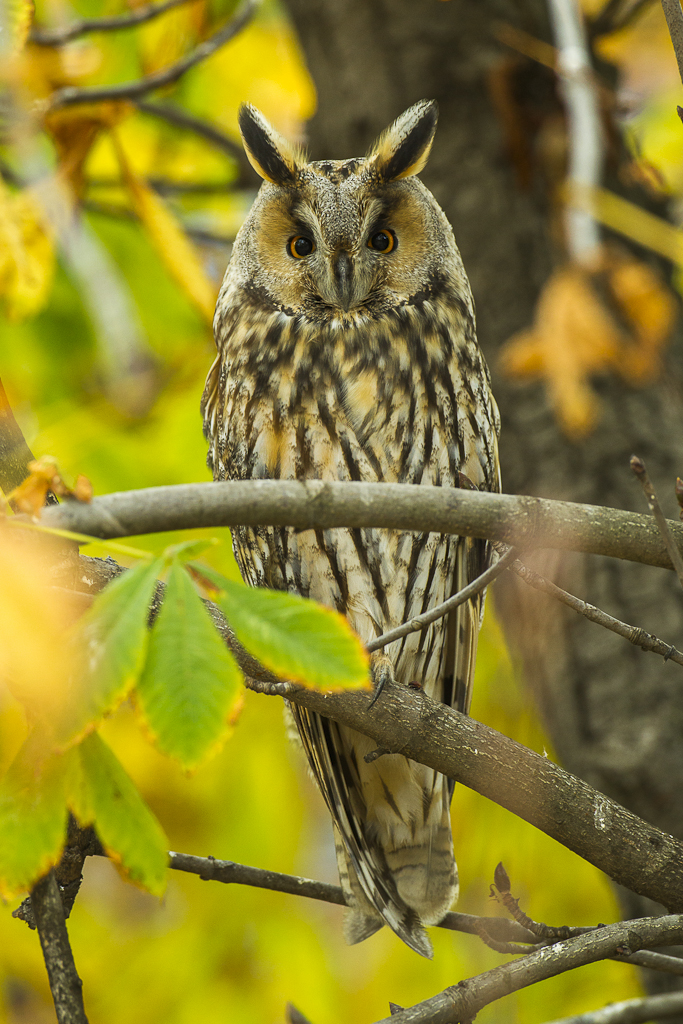
The Long-eared Owl is one of the most elusive owls in the Northern Hemisphere, a slim, upright bird that spends its days pressed tight against a tree trunk or hidden deep inside a dense conifer or thicket. Streaked in browns, buffs, and grays, it is built for concealment rather than confrontation, and when alarmed it will compress its body into a tall, thin, bark-colored stick that is astonishingly hard to spot. Most birders go years without seeing one, not because the species is rare, but because it is so good at not being found.
What makes this owl special is its double life. It is a creature of edges, hunting over open meadows, marshes, and grassland at night while roosting by day in nearby dense cover. In winter, Long-eared Owls do something unusual for owls: they gather in communal roosts, sometimes a dozen or more birds tucked into the same grove of evergreens or willows. Finding one of these winter roosts is a highlight of the birding year, and it explains why this quiet, nocturnal hunter has such a devoted following.
A medium-sized owl with a notably slender, elongated silhouette, especially when alert. The long ear tufts set close together near the center of the head, the rich orange facial disk, and the lengthwise streaking on a buffy, cryptic body are the key things to lock onto. In flight it looks long-winged and buoyant, lacking the bulk of a Great Horned Owl.
| Ear tufts | Long, close-set tufts rising near the center of the head; raised when alert, lowered in flight |
| Facial disk | Rich rusty-orange face with a pale buff X between the eyes and dark vertical patches near the bill |
| Eyes | Bright orange-yellow, giving an intense, surprised expression |
| Underparts | Buffy and heavily streaked lengthwise, with crosswise barring creating a herringbone pattern on the belly |
| Size and shape | Slimmer and smaller than a Great Horned Owl; tall and stick-thin when alarmed |
| Wings in flight | Long wings with a buffy patch at the base of the primaries and a dark wrist mark, like a Short-eared Owl |
Male vs. female
Males and females look very similar and cannot be reliably told apart in the field by plumage alone. As with most owls, females average slightly larger and heavier, and they often appear a bit darker and more richly colored, while males tend to be paler and grayer underneath. These differences are subtle and overlap broadly, so sexing a lone perched bird is rarely possible. Voice is a better clue during the breeding season, when the male gives the steady territorial hoot and the female answers with a higher, nasal call.
Juveniles
Young Long-eared Owls go through a fluffy downy stage and then a distinctive "branching" juvenile plumage with grayish-buff down still clinging to the body and a dark mask around the eyes that gives them a striking, almost masked-bandit look. At this stage the ear tufts are barely developed, so the silhouette is rounder and less elongated than an adult's. Fledglings give a memorable begging call, a squeaky, creaky note often compared to a rusty gate hinge or a squeaking gate, which is one of the most reliable ways to detect a breeding family in summer.
The male's territorial song is a low, soft, evenly spaced hoo... hoo... hoo..., a single mellow note repeated every two to four seconds, sometimes carrying surprisingly far on a still night. It is gentler and more measured than the deep hooting of a Great Horned Owl and lacks any rhythmic phrasing. Females give a higher, weaker, more nasal shoo-oogh or lamb-like bleat.
Away from the song, Long-eared Owls produce a remarkable range of barks, squeals, whines, and catlike wails, especially around the nest and during disputes. Displaying males also clap their wings together beneath the body in flight, producing a sharp whip-crack sound. The begging young add their unmistakable squeaky-gate calls through summer nights, often the first sign that owls have bred nearby.
The Long-eared Owl has a vast range across the Northern Hemisphere, breeding through much of North America, Europe, and Asia. In North America it nests across southern Canada and the northern and western United States, favoring a patchwork of dense woodlots, shelterbelts, riparian thickets, and conifer stands set beside open hunting grounds.
It is a partial and somewhat unpredictable migrant. Northern breeders move south in fall, and numbers in any given area can swing dramatically from year to year, tracking the boom-and-bust cycles of voles and other small mammals. In winter, birds concentrate in communal roosts farther south, sometimes appearing in regions where they do not breed. Because of this nomadic, irruptive behavior, a spot empty one winter may host a roost of several owls the next.
Long-eared Owls are specialist hunters of small mammals, above all voles, along with deer mice, pocket mice, shrews, and young rats. In good vole years they lean almost entirely on these rodents, and their breeding success rises and falls with rodent populations. They take birds and large insects far less often, mainly when mammals are scarce.
They hunt almost entirely at night, coursing low and silently over open fields, marsh edges, and grassland with slow, moth-like wingbeats, much like a harrier or a Short-eared Owl. Superb hearing, aided by an asymmetrical placement of the ear openings, lets them pinpoint prey rustling under grass or snow in near-total darkness, and their soft-fringed feathers let them drop on a target in silence. Indigestible fur and bone are coughed up as pellets, which collect in tidy piles beneath favored roosts and are a classic way to confirm a bird is using a site.
Long-eared Owls almost never build their own nests. Instead they take over old stick nests built by crows, magpies, ravens, or hawks, usually placed in a dense tree or tall shrub, and occasionally use squirrel dreys or even nest on the ground or in artificial baskets where natural sites are scarce. Pairs form in late winter, with the male singing and performing wing-clapping flights to claim a territory.
The female lays a clutch of roughly four to six white eggs, sometimes more in vole-rich years, and incubates them alone for about four weeks while the male delivers food. The chicks leave the nest before they can fly, clambering out onto nearby branches at around three weeks old (the "branchling" stage) and depending on their parents for several more weeks. There is typically one brood per year, though a failed early attempt may be replaced.
The Long-eared Owl is not a feeder or backyard bird in any conventional sense, and it will never come to seed, suet, or a birdbath. It is a shy, strictly nocturnal hunter that needs dense roosting cover next to open hunting ground. That said, if your property or local patch has the right habitat, you can genuinely make it more attractive and even help it breed.
- Preserve or plant dense conifers, hedgerows, and thickets next to open grassland or meadow, the exact roost-plus-hunting combination this owl needs.
- Keep rough, unmowed grassy areas that support healthy vole populations, the foundation of their diet.
- Leave old crow, magpie, and hawk nests standing rather than removing them, since Long-eared Owls reuse them to breed.
- In areas short on natural sites, some landowners install open wicker nest baskets in dense trees, which this species will readily adopt.
- Avoid rodenticides, which poison the small mammals owls eat and can kill the owls themselves.
- If you find a winter roost, keep your distance and stay quiet; repeated disturbance forces birds to abandon a site and burns energy they need to survive.
- Short-eared Owl: Very short, often invisible ear tufts, paler streaked body, pale yellow eyes set in black patches, and a habit of hunting in daylight over open country rather than roosting in dense trees.
- Great Horned Owl: Much larger and bulkier, with wide-set ear tufts, a white throat patch, and a deep, classic hooting series; lacks the slim, stick-like profile.
- Eastern Screech-Owl: Far smaller and stockier with short ear tufts and a whinnying or trilling call; about the size of a soda can next to the much taller Long-eared Owl.
- Barn Owl: Pale, heart-shaped white face with no ear tufts, golden-buff upperparts, and dark eyes; gives a harsh raspy scream rather than hoots.
How do I tell a Long-eared Owl from a Short-eared Owl?
Look at the ear tufts, eyes, and behavior. Long-eared Owls have long, close-set tufts they raise when alert, orange eyes, a rusty face, and they roost hidden in dense trees, hunting only at night. Short-eared Owls have tiny, usually invisible tufts, paler yellow eyes ringed in black, and famously hunt over open fields in daylight and at dusk.
Are Long-eared Owls rare?
Not really, but they are extremely easy to miss. They are widespread across North America, Europe, and Asia, yet their secretive daytime roosting and strictly nocturnal hunting mean most people never encounter one. They are considered Least Concern overall, though local numbers swing with rodent cycles.
When and where can I see a Long-eared Owl?
Winter is the best time, when birds gather in communal roosts tucked into dense conifers, willows, or shelterbelts near open fields. Scan the interior of evergreens for an upright, bark-colored shape, and look on the ground below for pellets and whitewash that betray a regular roost. Keep your distance to avoid flushing them.
What sound does a Long-eared Owl make?
The male gives a soft, low, evenly spaced single hoot, repeated every few seconds, much gentler than a Great Horned Owl. Around the nest they also produce barks, squeals, and catlike wails, and the begging young make an unforgettable squeaky-gate call on summer nights.
Do Long-eared Owls eat anything besides mice?
Small mammals are overwhelmingly their food, especially voles, along with deer mice, shrews, and young rats. They eat birds and large insects only occasionally, mostly when rodents are scarce. Their breeding success closely tracks vole abundance from year to year.