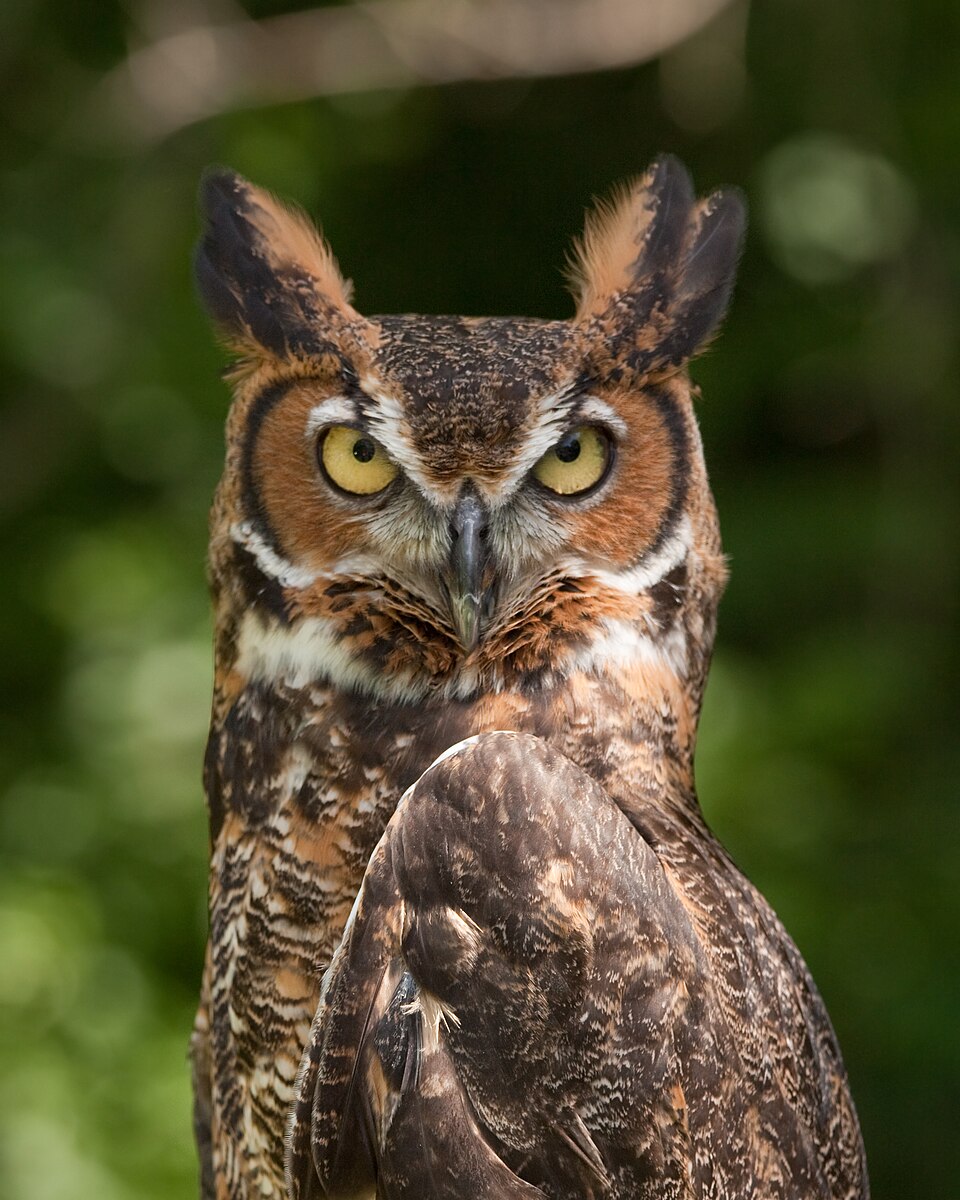
The Great Horned Owl is one of the most powerful and adaptable predators in the Americas, and for many people it is the owl they picture when they imagine an owl at all. Big, barrel-chested, and armed with thick feathered talons, it hunts almost anything it can overpower, from mice and rabbits to skunks, ducks, and even other owls. Its booming hoo-h'HOO-hoo-hoo drifting across a winter night is one of the classic sounds of the North American outdoors, and once you learn it you will hear this bird far more often than you ever see it.
Few birds are as flexible about where they live. Great Horned Owls thrive in deep forests, deserts, prairies, swamps, suburban parks, and even the edges of major cities, from the Arctic treeline south to the tip of South America. Because they are largely nocturnal and superbly camouflaged in mottled brown and gray, they often go unnoticed roosting against a tree trunk by day. They are early nesters too, frequently sitting on eggs while snow is still on the ground, which gives attentive birders a real chance to find them.
This is a large, bulky owl with a rounded head topped by two prominent feather tufts, the "horns" that give it its name. Perched, it looks heavy and upright with a thick body, broad wings, and no obvious neck. The combination of big size, ear tufts, a rusty or grayish facial disk, and a bright white throat patch is distinctive across most of its range.
| Ear tufts | Long, widely spaced feather "horns" on the head; often laid flat when alarmed or in flight |
| Facial disk | Rusty to grayish-brown face outlined by a dark border, with piercing yellow eyes |
| Throat patch | A clean white "bib" on the upper breast, very obvious when the bird is hooting |
| Underparts | Pale and finely barred with dark horizontal bars across the belly and chest |
| Size & shape | Bulky, big-headed owl roughly the size of a large hawk; broad rounded wings in flight |
| Color tone | Mottled brown overall; northern and desert birds run paler and grayer, eastern and Pacific birds darker and more rufous |
Male vs. female
Males and females look alike in plumage, so you cannot reliably tell them apart by sight in the field. As with most birds of prey, the female is noticeably larger and heavier than the male. The most useful clue is voice: the male's hoot is actually lower-pitched than the female's despite his smaller size, and when a pair duets you can often pick out the deeper male and the slightly higher, faster female calling back and forth.
Juveniles
Young Great Horned Owls leave the nest before they can fly, clambering onto nearby branches as fuzzy "branchlings." Juveniles are covered in pale buffy-gray down with faint barring and lack the full ear tufts of adults, giving them a rounder, almost earless look. They beg with a raspy, screechy shree call, often through the night, and depend on their parents for food for several months after fledging while they learn to hunt.
The signature sound is a deep, soft series of hoots, often written as hoo, hoo-hoo, hoo, hoo or who's awake? me too. The rhythm is steady and resonant, carrying a long way on calm nights, and it is most frequent in late fall and winter when pairs are establishing territories and courting. Listen for duets, with the lower male and higher female alternating or overlapping their hoots.
Beyond hooting, Great Horned Owls make a surprising range of sounds: sharp barks and screams during disputes, bill-snapping and hissing when threatened, and a catlike screech from begging young and sometimes from females near the nest. Agitated birds may give a low growl or a loud, descending shriek that can be startling in the dark.
The Great Horned Owl is a true year-round resident across nearly all of North America, plus much of Central and South America. It occupies an enormous variety of habitats, from boreal forest and rocky canyons to farmland, desert, and city parks, and it does not migrate in the usual sense. Once a pair claims a territory, they typically defend it for life and stay put through every season.
The main exception is at the far northern edge of the range. In years when prey such as snowshoe hares or voles crashes, owls from the subarctic may drift south in late fall and winter in search of food. Across most of the U.S. and southern Canada, though, the bird you hear hooting in January is very likely the same individual you will hear the following summer.
Great Horned Owls are formidable, opportunistic hunters with one of the broadest diets of any North American raptor. Mammals form the core of it: rabbits, hares, rats, mice, voles, gophers, squirrels, and even animals as large as skunks and young foxes. They are famously one of the few predators that routinely kill and eat skunks, seemingly untroubled by the spray. They also take birds up to the size of ducks, grouse, herons, and other raptors, along with reptiles, amphibians, large insects, and occasionally fish.
They hunt mostly at dusk and through the night, using exceptional hearing and large light-gathering eyes to locate prey, then dropping silently on broad wings edged with sound-muffling feathers. Their grip is extraordinarily strong, allowing them to dispatch prey heavier than themselves. Like other owls, they swallow smaller prey whole and later cough up pellets of bone and fur, which can pile up under a favored roost and are a great clue to an owl's presence.
Great Horned Owls are among the earliest nesting birds on the continent, often laying eggs in late winter, sometimes as early as January or February while snow is still on the ground. They do not build their own nests. Instead they take over the old stick nests of hawks, crows, ravens, herons, or eagles, and will also use tree cavities, broken-off snags, cliff ledges, and even artificial platforms or large nest boxes.
The female does almost all of the incubation while the male delivers food. Both parents fiercely defend the nest and will strike intruders, including people who venture too close. The young hatch helpless and grow quickly, climbing out onto branches weeks before they can truly fly, and the parents continue to feed them well into summer.
The Great Horned Owl is not a feeder bird, and you cannot lure one with seed or suet. It is a top predator that goes where the food and roosting cover are. That said, you can absolutely make your property and outings more owl-friendly and improve your odds of hosting or hearing one.
- Keep large trees and snags. Mature conifers and tall hardwoods give owls daytime roosts and nest sites; standing dead trees are especially valuable.
- Maintain a healthy prey base. Brushy edges, meadows, and unmowed corners support the rabbits and rodents owls hunt; avoid rodenticides, which poison owls that eat the prey.
- Install a large nest platform. In areas with suitable habitat, a sturdy open platform or oversized box in a tall tree can attract a nesting pair, especially where old hawk nests are scarce.
- Listen at dusk in late fall and winter. This is peak hooting season; step outside on calm evenings and learn the call to detect owls you would never spot by day.
- Look for sign. Whitewash, pellets of fur and bone, and mobbing crows during the day often reveal a roosting owl nearby.
- Protect pets at night. Small dogs and outdoor cats can be at risk; keeping them in is good for them and for the owl.
- Long-eared Owl: Much slimmer and smaller with close-set, vertical ear tufts and a rusty-orange face; lacks the bulky barrel chest and white throat bib of the Great Horned.
- Barred Owl: Round-headed with no ear tufts and dark eyes; gives a rhythmic "who-cooks-for-you" call rather than deep hoots.
- Great Gray Owl: Larger overall but lankier, with a huge round (tuftless) gray facial disk, dark eyes, and a white "bowtie" throat; a bird of northern forests.
- Snowy Owl: Similar bulk but mostly white plumage, a smoothly rounded tuftless head, and active by day; an Arctic species seen mainly in winter.
What does it mean when you hear a Great Horned Owl hooting at night?
Most often it simply means an owl is announcing and defending its territory or calling to a mate, which is most common from fall through winter. Duets between a lower male and higher female signal a bonded pair. Hooting is normal owl communication, not a sign of danger.
Are Great Horned Owls dangerous to pets?
They can be a risk to small pets at night. A Great Horned Owl is strong enough to take animals up to the size of a rabbit or small cat, so it is wise to keep small dogs and cats indoors after dark in areas where owls are present. Larger dogs are not realistic prey.
How can I tell a Great Horned Owl from a Barred Owl?
Look at the head and eyes. The Great Horned Owl has prominent ear tufts and bright yellow eyes, while the Barred Owl has a smooth round head with no tufts and dark eyes. Their calls also differ: deep, spaced hoots for the Great Horned versus the Barred Owl's rhythmic "who-cooks-for-you."
When do Great Horned Owls nest?
Remarkably early. They often lay eggs in late winter, sometimes January or February, and may be incubating while snow is still on the ground. They reuse old hawk, crow, or heron nests rather than building their own.
Do Great Horned Owls really eat skunks?
Yes. They are one of the few predators that regularly hunt skunks and appear largely unbothered by the spray, partly because their sense of smell is weak. A lingering skunk odor around a roost or nest is sometimes a clue that a Great Horned Owl is nearby.