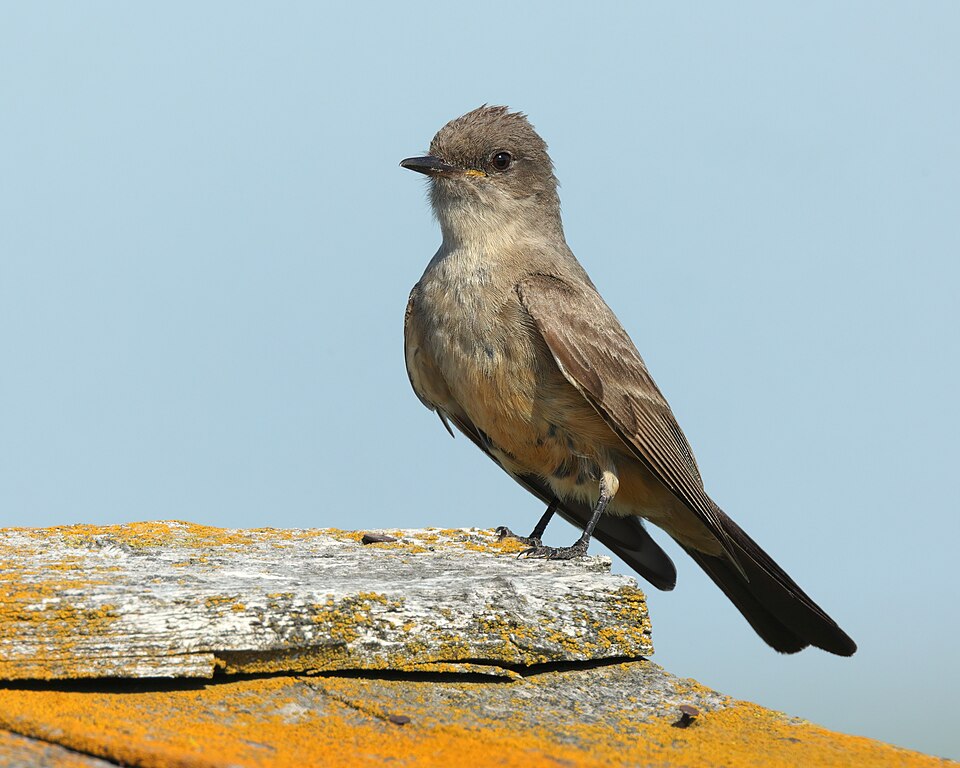
The Say's Phoebe is a quietly charming flycatcher of the wide-open West, a bird you're far more likely to meet on a sun-baked rangeland fence post than in a leafy backyard. Soft gray-brown above with a warm cinnamon belly, it perches low, pumps its long dark tail, and sallies out after passing insects before settling back almost exactly where it started. Where its cousin the Eastern Phoebe loves water and woodland edges, Say's Phoebe is a creature of dry country: prairie, desert scrub, badlands, sagebrush flats, ranchland, and the dusty margins of small towns.
Named for the naturalist Thomas Say, this is the most widespread phoebe in North America and the hardiest, breeding farther north than any other New World flycatcher, all the way to the Arctic slopes of Alaska. Tolerant of people and fond of buildings, it readily nests under eaves, on ledges, and in old sheds and culverts, which makes it a familiar and welcome presence around rural homesteads. Its plaintive, downslurred whistle is one of the signature sounds of open western landscapes.
Look for a medium-sized, slender flycatcher with an upright posture, a slightly peaked head, and a long, square-tipped tail that it habitually wags and spreads. The overall impression is soft and pastel: dusky gray-brown upperparts, a paler gray breast, and an unmistakable warm cinnamon-buff wash across the belly and undertail.
| Belly | Warm cinnamon to peachy-buff on the lower breast and belly - the key field mark |
| Upperparts | Soft brownish-gray, plain, without strong wing bars |
| Tail | Long and blackish, frequently pumped and fanned; contrasts with paler body |
| Head | Slightly peaked gray-brown crown, dark eye, no bold eyering or stripe |
| Bill | Thin, all-black, typical flycatcher shape |
| Posture | Upright on low, exposed perches; sallies out and returns |
Male vs. female
Males and females look essentially identical. There is no reliable plumage difference you can pick out in the field - both sexes show the same gray-brown upperparts and cinnamon belly. Behavior offers the only hints during breeding season, when the singing bird advertising a territory is typically the male, and the bird doing most of the incubating on the nest is the female.
Juveniles
Recently fledged juveniles closely resemble adults but look softer and slightly scruffier, often with two narrow cinnamon or buffy wing bars and pale buff feather edges that adults lack. Their belly color tends to be a touch duller and more washed-out. These youthful markings wear and fade through late summer, so by fall most young birds are difficult to separate from adults.
The most familiar call is a thin, mournful, downslurred whistle, often written as pdee-ur or phee-eur, delivered repeatedly from a perch and carrying surprisingly far across open ground. It has a soft, plaintive quality that fits the lonesome landscapes the bird favors.
In its dawn or flight song, given especially by males early in the season, Say's Phoebe strings together a fast, fluttering jumble that alternates a rising pit-tsee-ar with a quicker pidirEEP, sometimes while hovering. Unlike the Eastern Phoebe, it does not buzzily say its own name; the voice is whistled and wistful rather than raspy.
Say's Phoebe is a bird of western North America, breeding from the deserts and grasslands of Mexico north through the Great Basin, Rockies, and Great Plains, and remarkably far up into Canada and Alaska - it is the only flycatcher that regularly nests near the Arctic. Across much of the arid interior West it is a year-round or summer resident.
It is a partial migrant. Northern and high-elevation breeders pull south in fall, with many wintering across the southwestern U.S. and Mexico. Birds in the milder Southwest may stay put all year. In winter and migration, Say's Phoebes turn up well east and west of the core range as regular vagrants, and they are among the earliest spring migrants to return to northern breeding grounds, sometimes arriving while snow still lingers.
Like all phoebes, Say's is an insectivore and a sit-and-wait hunter. It perches low - on a fence, weed stalk, rock, or low shrub - scans the ground and air, then darts out to snatch prey before returning to a perch. It takes beetles, bees, wasps, flies, grasshoppers, crickets, and other insects, along with spiders, capturing food both in midair (hawking) and by dropping onto it on the ground.
One of its signature behaviors is hovering: Say's Phoebe will hang in the air over open ground or low vegetation, fluttering in place like a small kestrel, then drop to seize an insect. It hunts low to the ground more often than other phoebes, which suits its open, sparsely vegetated habitat.
Say's Phoebe builds a flat, open cup of grasses, plant fibers, moss, and spider silk, often lined with softer material and wool. Unlike the Eastern Phoebe, it does not require mud. It favors sheltered ledges with an overhang: cliff faces, stream banks, the mouths of caves and old burrows, abandoned buildings, and very commonly the eaves, beams, and ledges of human structures like sheds, porches, barns, and culverts.
The female lays a clutch of typically 4 to 5 white eggs, sometimes lightly speckled, and does most or all of the incubating for about two weeks. Both parents feed the nestlings, which leave the nest a couple of weeks after hatching. Pairs often raise two broods in a season and will reuse or build atop a successful old nest site year after year.
Say's Phoebe is not a feeder bird - it eats insects, not seed, so you won't lure it with a feeder. But it readily nests on buildings, which means you can absolutely make a rural or semi-open property attractive to a pair.
- Offer sheltered nesting ledges - mount a small open nest platform or shelf under an eave, porch overhang, carport, or shed beam.
- Keep open, low vegetation nearby; phoebes hunt over bare ground, short grass, and sparse fields rather than dense lawns or shrubbery.
- Avoid pesticides so a healthy supply of flying and ground insects remains available.
- Provide low perches - fences, posts, dead snags, or a single stake in an open area give them a hunting lookout.
- Leave outbuildings accessible; an open shed or barn door lets a pair scout interior ledges for nesting.
- Tolerate the same pair returning - they show strong site fidelity and often reuse a good spot for years.
- Eastern Phoebe: Lacks the cinnamon belly; dirty whitish underparts, browner head, and a raspy fee-bee song. Prefers wooded streamsides in the East.
- Black Phoebe: Sooty black head, breast, and back with a sharply contrasting white belly - no cinnamon. Tied to water.
- Mourning Dove: Far larger and plumper with a long pointed tail; sometimes confused at a glance on open ground but not a flycatcher and lacks tail-pumping behavior.
- Townsend's Solitaire: Gray and upright like a phoebe but shows a bold white eyering, buffy wing patch, and white tail edges; sits higher and sings a long warble.
How do I tell a Say's Phoebe from an Eastern Phoebe?
The belly is the giveaway. Say's Phoebe has a warm cinnamon-buff wash on its lower breast and belly, while the Eastern Phoebe is plain dirty-white below. Say's also lives in dry, open western country and gives a soft whistled pdee-ur, whereas the Eastern says a raspy fee-bee near water and woods.
Is the Say's Phoebe a backyard or feeder bird?
It won't come to seed or suet feeders because it eats only insects. However, it readily nests on buildings, so in rural and semi-open areas you can attract a pair by offering a sheltered nesting ledge under an eave and keeping open ground and low perches nearby.
Where do Say's Phoebes live?
They favor dry, open habitats across western North America - grasslands, deserts, sagebrush, badlands, ranchland, and the edges of towns. They breed from Mexico all the way to Arctic Alaska, the farthest north of any New World flycatcher.
Why does the Say's Phoebe wag its tail?
All phoebes habitually pump and spread their tails while perched. The exact reason isn't fully understood, but it likely signals alertness to predators and may help communicate with mates or rivals. It's a useful identification clue - a slim gray flycatcher persistently bobbing its tail on a low perch is very likely a phoebe.
Do Say's Phoebes migrate?
Partly. Birds breeding in the far north and at high elevation move south for winter, many to the southwestern U.S. and Mexico, while populations in the milder Southwest stay year-round. They are among the earliest spring migrants, sometimes returning north while snow is still on the ground.
What does a Say's Phoebe eat?
Insects and spiders - beetles, bees, wasps, flies, grasshoppers, and crickets. It hunts from a low perch, sallying out to grab prey in the air or on the ground, and frequently hovers in place before dropping onto an insect.