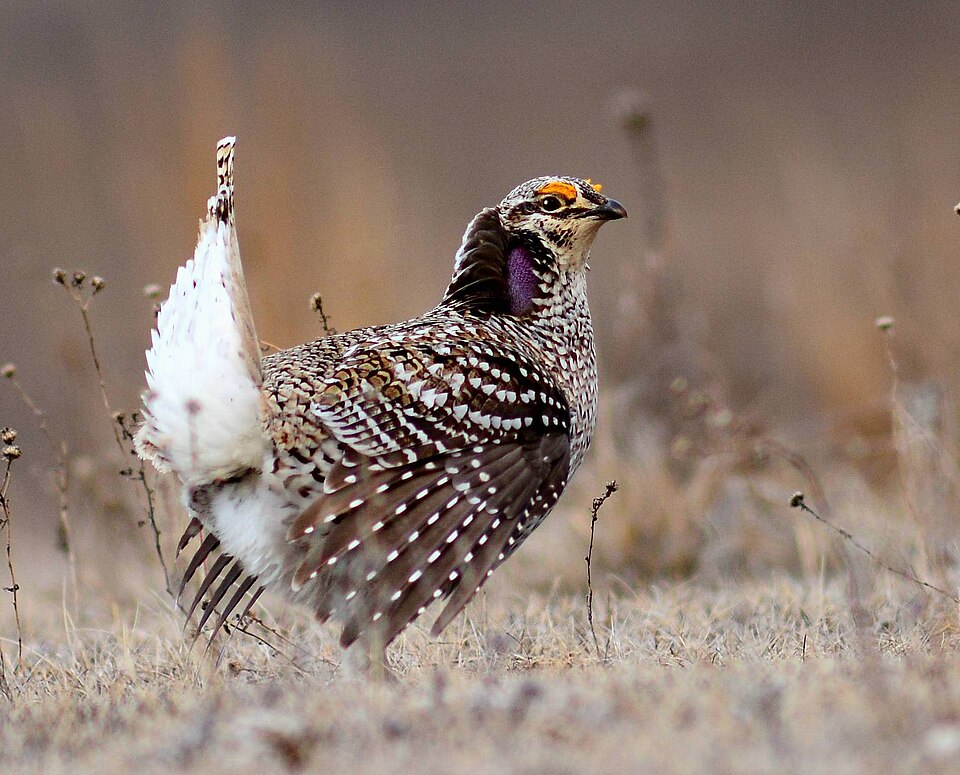
The Sharp-tailed Grouse is a chunky, mottled-brown grouse of open country across the northern Great Plains, intermountain West, and Canadian prairie-forest transition. Stand on a frosty April morning at the edge of a grassland and you may witness one of North America's great wildlife spectacles: dozens of males gathered on a communal "dancing ground," stamping their feet in a blur, rattling their tails, inflating violet neck sacs, and spinning like wind-up toys. The display is so distinctive that it inspired traditional dances among several Plains peoples.
Outside the breeding season the species is far more retiring, blending into stubble fields, sagebrush flats, and brushy draws where its cryptic plumage makes it almost invisible until it flushes with a startling whir of wings. It is a hardy, year-round resident that pushes farther north than almost any other North American grouse, surviving brutal winters by burrowing into snow and switching to a diet of buds and catkins. Where prairie and shrub habitats remain intact, "sharptails" persist as one of the signature game birds and indicator species of healthy open landscapes.
A medium-sized, rounded grouse with a relatively short neck, small head, and the namesake pointed tail that gives a distinctly different silhouette from the square-tailed prairie-chickens. In flight it looks pale-bellied and short-tailed, alternating rapid wingbeats with glides on stiff, downcurved wings.
| Overall color | Mottled and scaled brown, buff, and black above; underparts whitish with V-shaped or chevron-like brown markings, not solid barring |
| Tail | Short and sharply pointed, with the two central feathers projecting well beyond the rest; tail looks white-edged in flight |
| Head | Faint pale crest that can be raised; small yellow comb over the eye, brightest and most visible on displaying males |
| Belly | Pale whitish belly with scattered dark chevrons, a key separator from the heavily barred prairie-chickens |
| Legs | Feathered down to the toes, an adaptation to cold; legs appear pale and fuzzy |
| Neck sacs | Displaying males inflate purplish-pink to violet air sacs on the sides of the neck (not the orange-yellow of prairie-chickens) |
Male vs. female
The sexes look broadly similar in everyday plumage, and a flushed bird in fall is hard to sex in the field. Males average slightly larger and, in spring, show a brighter yellow-orange comb above the eye and the purplish neck sacs when displaying. On the dancing ground, males also hold the two central tail feathers more upright and crossed. Females are a touch smaller with a duller comb and shorter central tail feathers; they tend to have somewhat heavier dark markings on the central crown and tail. Away from the lek, telling a lone male from a female reliably usually requires a bird in the hand.
Juveniles
Newly hatched chicks are precocial, buffy, downy, and able to leave the nest within hours of hatching, feeding themselves under the hen's watch. By a few weeks old, juveniles resemble small, scruffier adults but with a shorter, less-pointed tail and softer, more spotted body feathers. Young birds can make short fluttering flights at one to two weeks and are nearly adult-sized and fully feathered by late summer, when families break up and birds gather into fall flocks.
Sharp-tailed Grouse are not "singers" in the songbird sense; their vocal repertoire centers on the dancing ground. Displaying males produce a low, hollow, cooing or gobbling sound and a soft single-note coo as they inflate the neck sacs, but the signature sound of a lek is mechanical, not vocal: a dry, rattling, castanet-like whirr made by the rapidly vibrating tail feathers as the bird stamps and spins. Birders often describe the overall lek soundscape as a low cooing punctuated by sharp rattles and odd, cork-popping pops.
Away from displays, alarmed or flushing birds give a clucking chuk-chuk-chuk or a sharp cackle, and hens use soft clucks to keep a brood together. Listen also for a wooden cooo carrying across the prairie at dawn during the March-to-May display season.
The Sharp-tailed Grouse ranges across the northern interior of the continent, from Alaska and the Yukon through much of central and western Canada, south into the Dakotas, Montana, Wyoming, Idaho, Nebraska, and locally into the upper Midwest and parts of the intermountain West. It favors a patchwork of native grassland, sagebrush, brushy draws, and the brushy edges of boreal and aspen woodland, generally more tolerant of shrubs and woody cover than the prairie-chickens, which prefer open grass.
It is essentially non-migratory, holding its range year-round, though birds may shift locally between summer grasslands and more sheltered, brushy, or wooded sites in winter where buds and catkins are available. Populations have contracted at the southern and eastern edges of the range as native prairie was converted to cropland, but the species remains widespread and locally common across the northern plains and Canadian prairie.
Sharp-tailed Grouse are omnivores with a strongly seasonal diet. In spring and summer they forage on the ground for green leaves, flowers, forbs, waste grain, seeds, berries, and a good deal of insects, grasshoppers, beetles, and ants are especially important protein for growing chicks. Late summer and fall bring a bounty of fruits such as rose hips, snowberries, chokecherries, and other prairie and shrub berries.
In winter, when snow blankets the ground, sharptails switch to browsing buds, catkins, and twigs of trees and shrubs, aspen, birch, willow, chokecherry, and serviceberry are favorites. They will fly up into trees and shrubs to feed, a behavior that lets them survive deep-snow conditions that would starve a strictly ground-feeding bird.
Breeding revolves around the lek, or dancing ground, a traditional open patch of short grass used year after year where males gather at dawn (and often dusk) through spring to display and compete. Dominant males hold the central, most-contested spots and win most of the matings. After breeding, the hen leaves the lek to nest entirely on her own.
The nest is a simple, grass-lined scrape on the ground, well hidden under a shrub, clump of grass, or other low cover. The hen typically lays around 10-14 buffy, finely speckled eggs and incubates them alone for roughly three to four weeks. Chicks are precocial and leave the nest soon after hatching, feeding themselves while the hen leads, broods, and defends them. There is a single brood per year, though a hen may re-nest if her first clutch is lost early.
This is not a backyard or feeder bird. The Sharp-tailed Grouse needs large, open landscapes, native grassland, sagebrush, and brushy edge, and will not visit suburban yards or seed feeders. You "attract" sharptails the way you attract any prairie wildlife: by conserving and managing habitat, and by going to where they live.
- If you own or manage rural land within their range, protect native grassland and shrubby draws and avoid converting them to row crops or dense tree plantings.
- Maintain a mix of grass, low shrubs, and scattered fruiting shrubs (chokecherry, serviceberry, snowberry, wild rose) for year-round food and winter browse.
- Use prescribed fire or rotational grazing where appropriate to keep grasslands open and prevent woody encroachment that degrades dancing grounds.
- To see them, visit a known lek at dawn in April, many state wildlife agencies and refuges offer viewing blinds; stay in the blind and arrive before first light so you don't disturb the display.
- Support prairie conservation groups and grassland easement programs, which do far more for grouse than anything you can do in a yard.
- Greater Prairie-Chicken: Square dark tail (not pointed), heavily barred underparts, and orange-yellow neck sacs with long neck 'pinnae' feathers raised in display, versus the sharptail's pale chevroned belly and purplish sacs.
- Lesser Prairie-Chicken: Smaller southern-plains relative with the same square tail and strong barring; reddish neck sacs. Sharptails are paler-bellied with a pointed white-edged tail and live farther north.
- Ruffed Grouse: A woodland grouse with a broad, fan-shaped, banded tail and a dark subterminal tail band; drums on logs rather than dancing on open leks. Sharptails are birds of open country with a pointed tail.
- Ring-necked Pheasant: Introduced and often shares prairie edges, but pheasants are much larger with a very long tapering tail; males are gaudy and unmistakable, females longer-tailed and warmer brown than a sharptail.
What is the difference between a Sharp-tailed Grouse and a prairie-chicken?
The quickest tells are the tail and the belly. Sharptails have a short, pointed, white-edged tail and a pale belly marked with V-shaped chevrons, while prairie-chickens have a short, square dark tail and heavily barred underparts. On the lek, displaying sharptails inflate purplish neck sacs and rattle their tails, whereas prairie-chickens inflate orange-yellow sacs and raise long ear-like pinnae feathers.
Why do Sharp-tailed Grouse dance?
The dancing is a courtship display. Each spring, males gather on a communal arena called a lek or dancing ground, where they stamp their feet rapidly, rattle their tails, inflate their neck sacs, and spin to compete for females. Dominant males claim the center spots and do most of the mating. It is one of the most-watched wildlife spectacles on the northern prairies.
Where can I see Sharp-tailed Grouse?
Look in open grassland, sagebrush, and brushy edge across the northern Great Plains, intermountain West, and Canadian prairie, states like Montana, the Dakotas, Wyoming, Idaho, and Nebraska, plus much of central and western Canada and into Alaska. The best viewing is at a known lek at dawn in April, often from a wildlife-agency or refuge viewing blind.
Are Sharp-tailed Grouse endangered?
As a species they are listed as Least Concern and remain locally common across the northern part of their range. However, they have disappeared from much of their former southern and eastern range as native prairie was plowed under, and some local populations and subspecies are of conservation concern. Habitat loss is the main long-term threat.
What do Sharp-tailed Grouse eat in winter?
In winter they switch from ground foraging to browsing the buds, catkins, and twigs of shrubs and trees such as aspen, birch, willow, chokecherry, and serviceberry. They will fly up into the branches to feed and often burrow into soft snow to roost and stay warm, which lets them survive deep-snow conditions year-round without migrating.