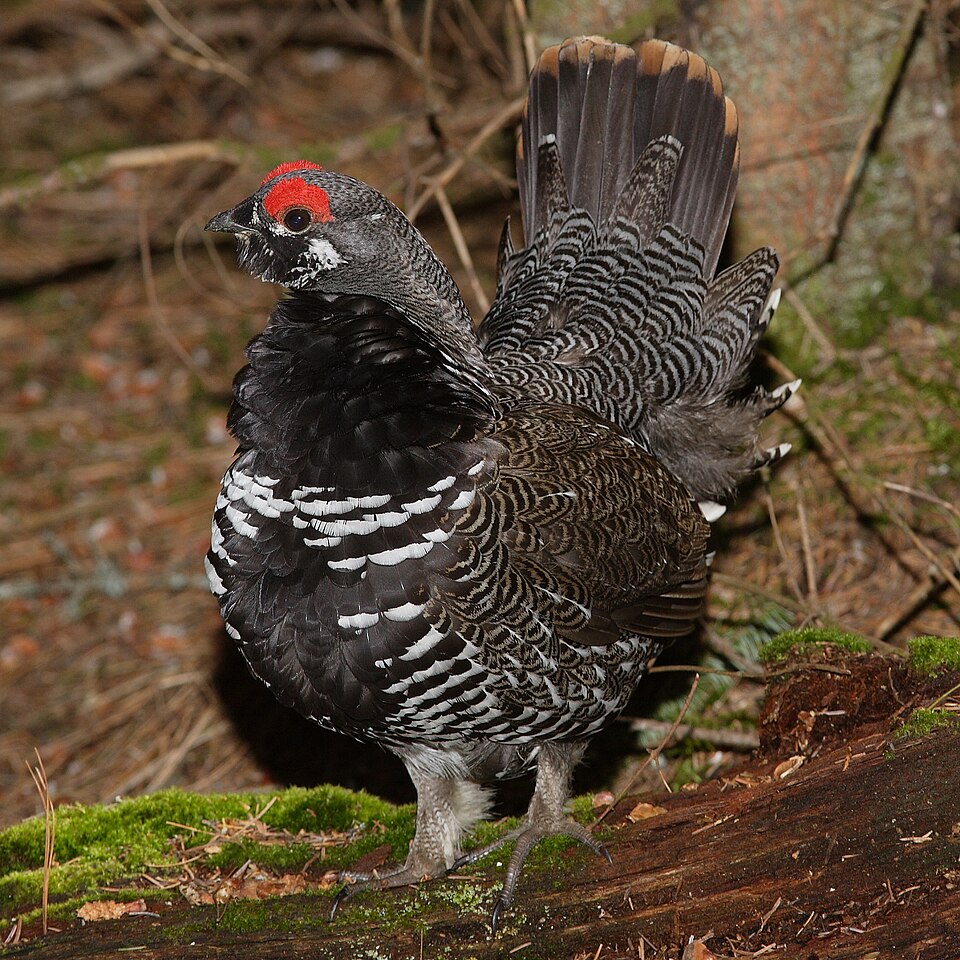
The Spruce Grouse is a stocky, chicken-sized bird of the great northern conifer forests, a creature so thoroughly at home among black spruce, jack pine, and tamarack that it barely seems to notice people at all. Birders who finally track one down are often startled by how close they can walk to it. This famous tameness earned the species its nickname, the "fool hen," because a grouse that sits quietly on a low branch and stares back at you was, in earlier centuries, an easy meal for a hungry traveler. What looks like foolishness is really an adaptation to a world with few ground predators that hunt by sight: the bird relies on stillness and cryptic plumage rather than flushing in a panic.
For many North American birders, the Spruce Grouse is a coveted "boreal specialty", a bird you go looking for on a trip to Maine, the Adirondacks, northern Minnesota, the Rockies, or the vast spruce country of Canada and Alaska. It spends most of the year quietly walking the forest floor and clambering through conifer branches, eating needles, and it can be maddeningly easy to walk right past. Learn its preferred habitat and its odd, low-volume displays, though, and it becomes one of the more rewarding finds in the deep woods.
Look for a plump, short-tailed, dark grouse roughly the size of a small chicken, usually seen walking on the forest floor or perched calmly on a low conifer limb. Both sexes have a stout body, a small head, and feathered legs. The two visible plumage types, a strikingly marked dark male and a barred brown female, both share a finely barred, intricate pattern that camouflages them beautifully against shaded conifer trunks and needle litter.
| Size & shape | Stocky, round-bodied grouse with a small head and relatively short tail; smaller and chunkier than a Ruffed Grouse. |
| Male body | Slaty gray above with a sharply defined black throat and breast bordered by white-tipped feathers; bright red comb over the eye. |
| Female | Cryptic, finely barred brown or gray-brown overall with pale spotting; no black bib, no red comb. |
| Tail | Dark with a chestnut or rusty band at the tip in most populations; the 'Franklin's' form of the Rockies lacks the rusty tip and shows white spots on the upper tail coverts. |
| Legs & feet | Feathered down to the toes, an adaptation to walking on snow in the boreal winter. |
| Overall impression | A dark, tame, slow-moving grouse of dense spruce and pine that often refuses to flush. |
Male vs. female
The sexes look quite different. The male is the showy one: slaty gray on the back and wings with a clean black throat and breast set off by a row of white-tipped feathers along the chest and flanks, plus a vivid scarlet comb of bare skin above each eye that swells during display. The female is far plainer, a finely barred, mottled brown (some birds grayer, some redder) with pale spotting below, no black bib, and no red comb. The female's camouflage is so effective that an incubating hen can be nearly invisible from a few feet away.
Juveniles
Chicks are precocial, leaving the nest within hours of hatching as buff-and-brown downy balls streaked for camouflage. Within a few weeks they grow a juvenile plumage that resembles the barred brown female, and young birds of both sexes look female-like through their first summer. By autumn, young males begin showing the black throat feathers and the first hints of the adult pattern, though they can still appear somewhat scruffy and intermediate into their first winter.
Spruce Grouse are remarkably quiet birds, and they do not "sing" in the way songbirds do. Most of what you'll hear are low, soft sounds that carry poorly through the forest. Hens give clucks and a hen-like kuk-kuk-kuk, along with soft purring and broody calls to chicks.
The male's displays are more about sound made with the body than the voice. Depending on the population, a displaying male may produce a low, hooting series, soft drumming-like notes, and, most famously in the Rocky Mountain "Franklin's" form, a sharp double wing-clap, a startling crack-crack made as he flutters between perches. Some males also perform a "flutter flight" with a loud, abrupt wing burst. These sounds are easy to miss; many birders find Spruce Grouse by sight long before they ever hear one.
The Spruce Grouse is a year-round resident of the boreal and montane conifer forests of North America. Its range stretches across virtually all of forested Canada and Alaska, dipping south into the northern United States: the northern Rockies (Montana, Idaho, northeastern Washington, northern Wyoming), the western Great Lakes (northern Minnesota, Wisconsin, Michigan's Upper Peninsula), northern New England, and the Adirondacks of New York.
It is essentially non-migratory. Birds may make short seasonal shifts between summer and winter habitats, for example, moving into denser stands of mature conifers in winter, where they feed almost entirely on needles, but they do not undertake long migrations. Because the species is so tied to specific conifer habitats and so quiet, it can be locally common in good habitat yet completely absent from seemingly similar woods nearby.
The Spruce Grouse is one of the most specialized herbivores among North American grouse. For roughly half the year, all through the long boreal winter, it eats almost nothing but conifer needles, especially those of spruce, pine, fir, and larch. It plucks needles directly from the branches, and a bird may spend hours in a single tree, working through the foliage. This needle diet is nutritionally poor and high in tough fiber, so the grouse has an unusually large gizzard and long intestinal ceca to process it, and it swallows grit to help grind the food.
In the snow-free months the diet broadens considerably. Spruce Grouse eat the fresh new growth of conifers, plus the leaves, flowers, berries, and seeds of ground plants, blueberries, cranberries, and other heath-family fruits are favorites. Chicks, like most young gamebirds, rely heavily on insects and other invertebrates in their first weeks of life for the protein needed to grow quickly.
Nesting is a solitary, ground-based affair. The female chooses a sheltered spot on the forest floor, usually beneath the low branches of a conifer or beside a log or low shrub, and scrapes out a shallow depression lined with needles, leaves, and a few of her own feathers. She does essentially all the parental work, the male takes no part in incubation or chick-rearing.
She lays a clutch of buff eggs blotched with brown and incubates them for roughly three weeks. The downy chicks leave the nest almost immediately and follow the hen, feeding themselves while she leads them to food and broods them when they're cold or wet. They can make short fluttering flights within a couple of weeks and grow quickly through the brief northern summer. There is a single brood per year.
This is not a backyard or feeder bird. The Spruce Grouse is a habitat specialist of remote conifer forests and will essentially never visit a suburban yard or seed feeder. "Attracting" it is really about knowing where and how to go find it.
- Go to the right forest. Search wet or boggy stands of black spruce, jack pine, tamarack, and fir in the boreal zone or high mountains, not open hardwoods or dry edge habitat.
- Walk slowly and watch the ground and low branches. These birds are quiet and cryptic; they're far more often seen than heard, and they sit tight rather than flush.
- Bird the early morning along quiet logging roads and trails. Grouse frequently come to road edges for grit and to dust, especially at dawn.
- Listen for the male's wing-claps in spring. In late April through May, displaying males (especially the western 'Franklin's' form) give sharp wing cracks that can lead you to a bird.
- Look in winter at the tops of conifers. When snow covers the ground, birds spend the day feeding high in spruces and pines and can be spotted as dark lumps against the sky.
- Respect the bird. Because they're so tame, it's tempting to crowd them, give them space and enjoy the rare chance to watch a wild grouse up close.
- Ruffed Grouse: More warmly brown and rufous with a prominent fan-shaped tail with a dark subterminal band; favors deciduous and mixed woods, and explodes into a loud flush rather than sitting tight.
- Dusky Grouse: Larger and grayer; males show yellow-to-reddish neck air sacs and lack the Spruce Grouse's sharp black-and-white breast pattern; favors more open mountain forest and edges.
- Sooty Grouse: A large, dark Pacific-coast forest grouse; males have bright yellow neck sacs and a long booming hoot, very different from the quiet Spruce Grouse.
- Sharp-tailed Grouse: Paler and spotted, with a short pointed tail and a clear preference for open grasslands and brushy prairie rather than dense conifers.
Why is the Spruce Grouse called the 'fool hen'?
Because it's astonishingly tame. Rather than flying off, a Spruce Grouse will often sit quietly on a low branch or the ground and let a person walk right up to it. This isn't stupidity, it's a defense strategy of holding still and relying on camouflage, which works against natural predators but made the bird an easy target for hungry travelers, hence the unflattering nickname.
Where can I see a Spruce Grouse?
Look in dense northern conifer forests of spruce, jack pine, fir, and tamarack. In the U.S. that means northern Maine and New England, the Adirondacks, the northern Great Lakes states, and the northern Rockies; across Canada and Alaska it's widespread in the boreal forest. Quiet logging roads at dawn in good habitat are a classic place to find one picking up grit.
What does a Spruce Grouse eat in winter?
Almost entirely conifer needles, spruce, pine, fir, and larch. It plucks needles right off the branches and can spend much of the short winter day feeding in a single tree. Its oversized gizzard and long digestive ceca let it survive on this tough, low-nutrition diet that few birds could handle.
How do you tell a Spruce Grouse from a Ruffed Grouse?
The Spruce Grouse is darker, stockier, and shorter-tailed, and the male has a black throat and breast with a red eye comb. The Ruffed Grouse is warmer brown with a long, banded, fan-shaped tail and lives in deciduous and mixed woods. Behavior helps too: a Ruffed Grouse usually flushes loudly, while a Spruce Grouse tends to sit tight.
Is the Spruce Grouse endangered?
Globally it's listed as Least Concern and remains fairly common across the vast boreal forest. However, it's tied to specific conifer habitats, so at the southern edge of its range, such as parts of the northeastern U.S., local populations are small, declining, and of conservation concern where logging and forest change reduce suitable habitat.
What is a 'Franklin's' Spruce Grouse?
It's the Rocky Mountain form of the species. Males of the Franklin's type lack the rusty tail tip seen in eastern and northern birds, show white spots on the upper tail coverts, and perform a distinctive display that includes a sharp double wing-clap. It's the same species, just a regionally distinct subspecies group.