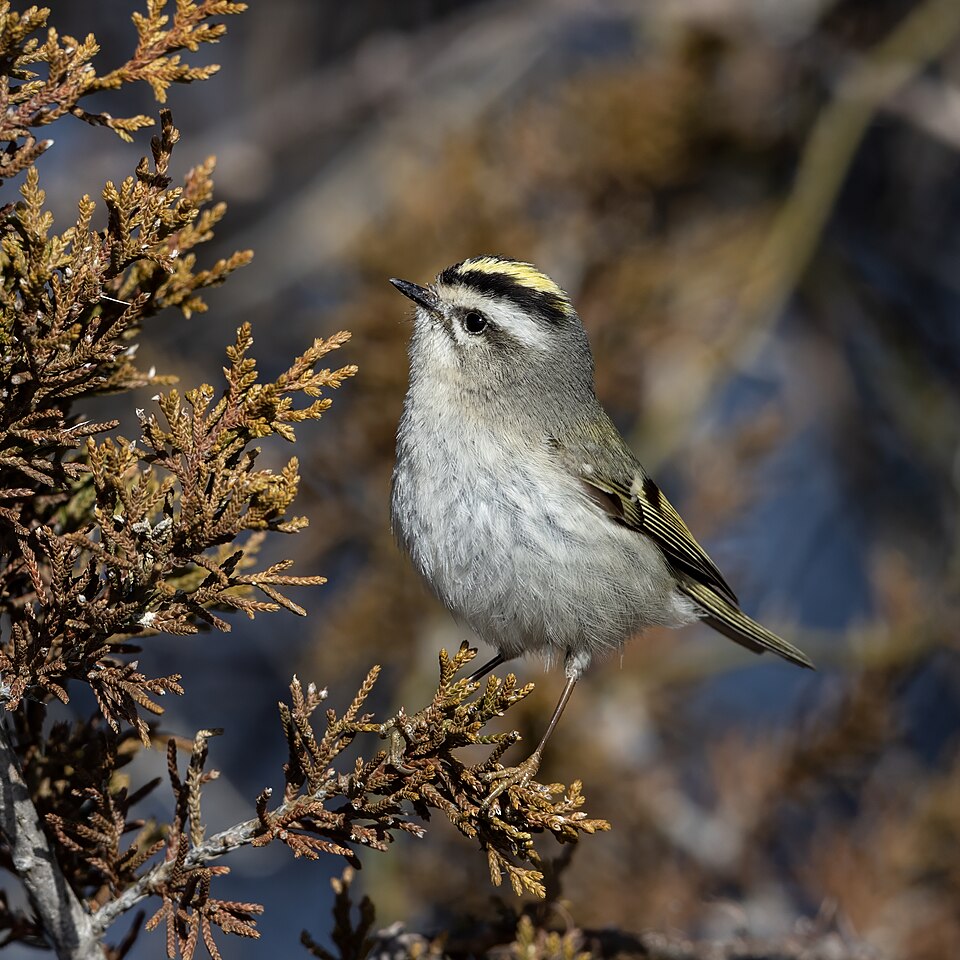
The Golden-crowned Kinglet is one of the smallest birds in North America, a round-bodied scrap of olive and gray that weighs about as much as two pennies. Despite its size, it is astonishingly tough: this is a bird that spends winter nights in northern forests where temperatures plunge well below zero, surviving by feeding almost nonstop through the short days and huddling together against the cold. Its name comes from the brilliant crown stripe it flashes when excited or displaying, a band of yellow (in females) or yellow framing fiery orange (in males) bordered by bold black.
Most birders meet this kinglet not by its looks but by its voice: a series of impossibly high, thin notes drifting down from the top of a spruce or pine. It rarely sits still, flitting and hovering through the foliage in a near-constant search for tiny insects and their eggs. In summer it nests in the dense conifer forests of Canada, the northern U.S., and western mountains; in winter it spreads across much of the continent, joining roving flocks of chickadees and creepers in woodlots and even suburban evergreens.
Look for a tiny, almost neckless bird with a plump body, short tail, and a relatively large head that gives it a perpetually round-shouldered look. It is smaller and stubbier than any warbler, and its habit of nervously flicking its wings while moving through dense foliage is a quick giveaway.
| Crown stripe | Bold yellow (female) or orange-centered yellow (male) crown bordered by heavy black lines |
| Face | Pale eyebrow stripe above a dark line through the eye, giving a striped, masked look |
| Body | Olive-gray above, paler grayish below with no strong streaking |
| Wings | Two whitish wingbars with a dark bar just below, and a yellow-edged flight feathers |
| Size & shape | Tiny and round with a short tail and proportionally large head; smaller than a chickadee |
| Behavior | Constant nervous wing-flicking and hovering at the tips of conifer branches |
Male vs. female
Males and females look nearly identical at a glance, both showing the striped face and black-bordered crown. The reliable difference is in the crown center: males have a glowing orange patch nestled inside the yellow band, while females show clean yellow only. The orange is often hidden and shows best when a male is agitated or displaying, so you may need a clear, close look (or a lucky photo) to be certain. Size and overall plumage are otherwise the same between the sexes.
Juveniles
Recently fledged Golden-crowned Kinglets are duller and grayer than adults and, importantly, lack the colorful crown entirely, showing a plain grayish head for their first weeks. They still have the dark eyeline and pale eyebrow, plus the wingbars, which help separate them from young Ruby-crowned Kinglets. By their first fall, after molting, young birds acquire the adult-style crown pattern and become difficult to tell from full adults in the field.
The song is a thin, very high-pitched series that rises and then tumbles into a faster, lower jumble at the end, often written as see-see-see-see, why-do-you-shilly-shally. The opening notes sit at the very top of human hearing, and many people, especially as they age, simply cannot hear them, so a quiet kinglet flock can pass overhead unnoticed.
The most useful field clue is the call: a thin, high tsee-tsee-tsee given in threes, sharper and higher than a Brown Creeper's single note. These contact calls keep flock members in touch as they forage and are often the first sign that kinglets are moving through the treetops.
Golden-crowned Kinglets breed across the boreal forest of Canada and Alaska, southward through the conifer belts of the northern U.S., the Appalachians, the Rockies, and the mountains of the West Coast. They favor dense stands of spruce, fir, and hemlock for nesting, and their breeding range has expanded in places where planted spruce groves have matured.
In fall, most northern and high-elevation birds move south and downslope, spreading across nearly the entire Lower 48 and into northern Mexico for the winter. During this season they turn up far from any breeding forest, foraging in suburban conifers, mixed woodlots, and brushy edges, frequently as members of mixed-species flocks. Birds in milder coastal and mountain regions may be present year-round.
This kinglet is almost entirely insectivorous, gleaning tiny arthropods, springtails, aphids, scale insects, caterpillars, and especially insect and spider eggs from needles, twigs, and bark. It often hovers briefly at the tip of a branch to pick prey from the undersides of needles, and it works methodically through the outer foliage of conifers where larger birds cannot easily forage.
Its winter survival is a small marvel of metabolism. To fuel itself through frigid nights, it must feed almost constantly during daylight, and it can find dormant insects and frozen eggs even in deep cold. On the harshest nights, several kinglets may roost pressed together to conserve body heat. In winter they will occasionally take small amounts of fat or suet, though they are not dependent on feeders.
Golden-crowned Kinglets build a deep, cup-shaped nest high in a conifer, usually well out toward the end of a branch and hidden among dense foliage. The female does most of the building, weaving moss, lichen, fine bark strips, and spider silk into a thick-walled, hanging cup lined with feathers and soft plant down, well insulated against the cold of northern springs.
Clutches are unusually large for such a tiny bird, often holding many eggs stacked in two layers within the deep cup. The female incubates while the male feeds her, and pairs frequently raise two broods in a season, sometimes overlapping so the male tends fledglings from the first brood while the female begins the second. The eggs are whitish to pale buff with fine darker speckling.
Golden-crowned Kinglets are insect-eaters that do not come to seed feeders, but you can still draw them to a yard, especially in winter when roving flocks wander widely in search of food.
- Plant and keep conifers. Spruce, fir, pine, and hemlock are magnets; mature evergreens offer both foraging and shelter, and are the single best way to attract kinglets.
- Offer suet or bark butter. While not feeder regulars, wintering kinglets will sometimes sample suet, peanut butter blends, or bark butter smeared on tree trunks.
- Leave insects alone. Skip broad-spectrum pesticides so dormant insects, eggs, and spiders remain available, this is what kinglets are actually after.
- Watch the mixed flocks. Kinglets travel with chickadees, nuthatches, and creepers in winter, so anything that draws those birds raises your odds.
- Provide a water source. A heated birdbath in winter can attract kinglets that otherwise ignore feeders.
- Listen, don't just look. Learn the high tsee-tsee-tsee call; you will detect far more kinglets by ear than by sight.
- Ruby-crowned Kinglet: Lacks the striped face and black-bordered crown; shows a bold white eyering and a broken wingbar, with only males flashing a usually hidden red crown patch.
- Brown Creeper: Often in the same winter flocks but spirals up tree trunks; streaky brown above with a decurved bill and stiff tail, never showing a colored crown.
- Hutton's Vireo: Resembles a Ruby-crowned Kinglet but is larger and slower-moving with a thicker, hooked bill; lacks the bold facial stripes of the Golden-crowned.
- Yellow-rumped Warbler: Bigger and longer-tailed with a bright yellow rump patch; more active in open foliage and lacks the kinglet's striped crown.
How do you tell a Golden-crowned Kinglet from a Ruby-crowned Kinglet?
The Golden-crowned has a bold black-and-yellow (or orange) crown stripe and a strongly striped face with a pale eyebrow over a dark eyeline. The Ruby-crowned has a plain face with a conspicuous white eyering and only a hidden red crown patch in males. The two also sound different: Golden-crowned calls are higher and thinner.
Why are Golden-crowned Kinglets so hard to hear?
Their songs and calls are pitched at the very top of human hearing, around 8-10 kHz and higher. Many people, especially with age-related high-frequency hearing loss, genuinely cannot hear them, so the birds often pass by undetected even when calling steadily.
How does such a tiny bird survive freezing winters?
It feeds almost nonstop during daylight to fuel a fast metabolism, finding dormant insects and eggs in conifers even in deep cold. On the coldest nights, kinglets may huddle together in sheltered spots to share body heat, and their thick, well-insulated plumage helps trap warmth.
Will Golden-crowned Kinglets come to my bird feeder?
Not to seed feeders, since they eat insects. In winter they will occasionally visit suet, peanut butter, or bark butter, but the best way to attract them is to have mature conifers and avoid pesticides that kill the small insects they depend on.
What is the difference between male and female Golden-crowned Kinglets?
Both sexes share the striped face and black-bordered crown. Males have an orange center within the yellow crown, while females show clean yellow only. The orange is often concealed and shows best when a male is excited, so a close look or photo may be needed to confirm the sex.