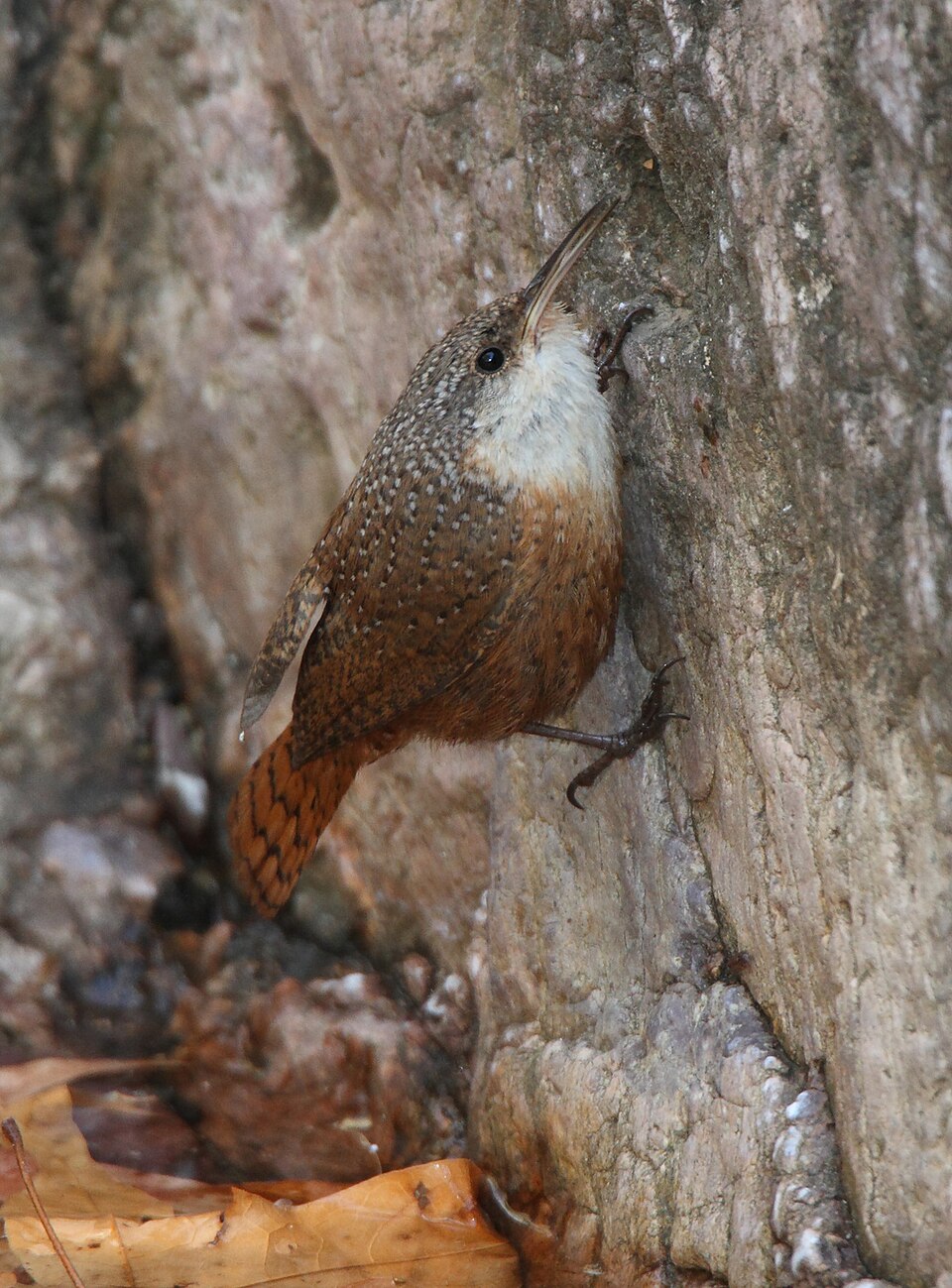
If you have ever stood at the bottom of a desert canyon and heard a silvery waterfall of notes tumbling down the rock walls, you have met the Canyon Wren. This small, rust-colored bird is one of the most distinctive voices of the arid West, and its song is so striking that people often remember hearing it long before they ever manage to see the singer. The Canyon Wren lives its entire life among rock, cliffs, boulder piles, slot canyons, talus slopes, road cuts, and even stone buildings, and it is exquisitely adapted to probing the cracks and crevices that other birds cannot reach.
What makes this wren special is not flashy plumage but the way it fits its world. Its flattened skull and long, slender, slightly downcurved bill let it poke deep into fissures after spiders and insects, and its strong feet grip vertical stone with ease. It rarely visits feeders or backyards unless your yard happens to be wrapped in rock, so for most birders the Canyon Wren is a reward earned on a hike, a flash of cinnamon and a snowy white throat bobbing over the boulders, followed by that cascading song echoing off the walls.
The Canyon Wren is a small, compact wren with a noticeably long, thin bill and a relatively short, often-cocked tail. Its silhouette and behavior, creeping over rock faces, frequently bobbing its whole body up and down on flexed legs, are as good a clue as any field mark. The combination of a bright white throat and breast against a rich rusty-brown body is unmistakable once you see it.
| White throat & breast | A clean, gleaming white throat and upper breast that contrast sharply with the rest of the body, the single best field mark. |
| Rusty body | Warm cinnamon to chestnut-brown on the back, belly, and especially the rump and tail, deepening toward the rear. |
| Fine speckling | Delicate white spots and dark speckles dust the back and crown, with fine barring on the tail and wings. |
| Long downcurved bill | A strikingly long, slim, slightly decurved bill, proportionally longer than most wrens', built for probing crevices. |
| Bobbing behavior | Constantly bobs its body up and down on bent legs while creeping over rocks, like doing tiny knee-bends. |
| Reddish tail with black bars | Bright rufous tail crossed by narrow black bars, often held cocked or flicked. |
Male vs. female
Male and female Canyon Wrens look alike, there is no reliable plumage difference you can pick out in the field. Both sexes show the same white throat, rusty body, and barred tail. Males do most or all of the loud, cascading singing, so a bird belting out the full song from an exposed rock is very likely a male, but you cannot sex a silent bird by appearance.
Juveniles
Juvenile Canyon Wrens resemble adults but look a little plainer and softer. Young birds tend to have less crisp speckling on the back and a slightly duller, less contrasting throat, and their bills may appear marginally shorter early on. By the time they are foraging on their own among the rocks, they are easily recognized as Canyon Wrens by shape, the pale throat, and the rusty rear end.
The song is the Canyon Wren's signature and one of the most beautiful sounds in the desert Southwest. It is a clear, ringing series of whistled notes that cascade down the scale, slowing and dropping in pitch as they go, often written as tee-tee-tee-tee-tew-tew-tew-tew-tew, sometimes ending in a couple of buzzy or nasal notes. The effect is liquid and bouncing, like a silver ball tumbling down a staircase, and it carries and echoes spectacularly off canyon walls.
Both sexes give a sharp, buzzy contact call, often rendered jzeet or bzzz, used to keep in touch and when agitated. The full descending song is heard most often in spring and early summer, but Canyon Wrens may sing in any month, and a single male can fill an entire canyon with sound.
The Canyon Wren is a year-round resident across much of western North America, from southern British Columbia south through the interior West, including the Great Basin, the Rocky Mountains, the Colorado Plateau, and the desert Southwest, and on through Mexico to southern Mexico. It is tied closely to rocky terrain, so its distribution is patchy: present wherever there are suitable cliffs, canyons, and boulder fields, and absent from the flat country in between.
This wren is essentially non-migratory. Birds hold their rocky territories all year, though some may shift to slightly lower elevations in harsh winter weather. Because it does not flock or migrate, finding one is mostly a matter of going where the rocks are.
Canyon Wrens are insectivores, feeding almost entirely on small invertebrates. Their diet is dominated by spiders and insects, including beetles, ants, true bugs, caterpillars, and various larvae, that hide in the cracks and crevices of rock. That long, thin, slightly curved bill is the perfect tool for the job, letting the bird extract prey from deep fissures that wider-billed birds cannot reach.
They forage by creeping methodically over vertical and overhanging rock, probing every crack, peering under ledges, and working into shaded recesses. They are remarkably nimble, hanging and climbing on stone with their strong feet. Canyon Wrens are thought to get most or all of the water they need from their prey, which helps explain how they thrive in such dry, exposed habitats.
Canyon Wrens nest in sheltered nooks in rock, a crevice, a ledge under an overhang, a small cave, or sometimes a cranny in a stone wall or building. The nest is a cup built of twigs, grass, and plant fibers, lined with softer material such as feathers, wool, spider silk, and fine down, often set on a foundation or platform of small sticks and debris tucked into the recess.
The female lays a clutch of usually 4 to 6 white eggs lightly speckled with reddish-brown. She does most of the incubating, while both parents feed the nestlings once they hatch. Pairs may raise more than one brood in a season where conditions are good. Because the nest sites are protected within rock, they are well hidden from predators and the elements.
The Canyon Wren is not a backyard or feeder bird in the usual sense, it does not eat seed and it needs rock to feel at home. You will not coax one to a tube feeder. That said, if you live near cliffs, canyons, or rocky slopes, there are real ways to make a Canyon Wren more likely to use your property, and the best strategy is to provide the habitat it depends on.
- Provide rock. Stone walls, rock piles, retaining walls, and boulder landscaping mimic the crevices these wrens forage and nest in.
- Skip the pesticides. Canyon Wrens eat spiders and insects; insecticides remove their entire food supply.
- Leave crevices intact. Don't seal every gap in stone walls or rock features, those cracks are foraging and nesting sites.
- Offer water nearby. A ground-level or rock-edge water source can draw them, though they get much of their moisture from prey.
- Protect natural cliffs and canyons. If your land includes rocky terrain, keeping it undisturbed is the single biggest help.
- Don't expect feeders to work. Be honest with yourself, this is a habitat bird, not a feeder bird; location and rock matter far more than any feeder.
- Rock Wren: Also a rock-dwelling western wren, but pale grayish-brown overall with a streaky breast and pale buffy belly, lacking the Canyon Wren's bold white throat and rusty body. Its song is a varied, repetitive trilling, not a descending cascade.
- Bewick's Wren: Has a long white eyebrow stripe and a long tail flicked side to side; grayer-brown and found in brush and woodland edges rather than bare rock, without the clean white throat against rusty underparts.
- House Wren: Smaller-billed, plainer warm brown all over with no white throat contrast; lives in yards, brush, and woodlands, gives a bubbling chattering song, and readily uses nest boxes.
- Cactus Wren: Much larger and boldly spotted with a heavy white eyebrow and harsh chugging call; a desert scrub bird of cactus and thorn rather than a creeper of bare cliffs.
What does a Canyon Wren sound like?
Its song is a clear, ringing series of whistled notes that cascade down the scale, slowing and dropping in pitch, often described as a silvery waterfall of sound that echoes off canyon walls. It also gives a sharp, buzzy 'jzeet' call.
Where do Canyon Wrens live?
They are year-round residents of rocky country across the western U.S., southwestern Canada, and Mexico, cliffs, canyons, boulder fields, talus slopes, and sometimes stone walls and buildings. They avoid flat, rockless terrain.
Will Canyon Wrens come to a backyard feeder?
Not in the usual sense. They eat insects and spiders, not seed, and they need rock habitat. If you live near cliffs or have stone walls and rock piles, you may attract them, but a standard seed feeder won't work.
How do I tell a Canyon Wren from a Rock Wren?
The Canyon Wren has a bright white throat and breast over a rusty body, while the Rock Wren is pale grayish-brown with a finely streaked breast and no white throat contrast. Their songs differ too, a descending cascade versus a varied trilling.
What does the Canyon Wren eat and how does it find water?
It eats spiders and insects pulled from rock crevices using its long, thin, curved bill. It's believed to get most or all of its water from its prey, which lets it survive in very dry, exposed habitats.