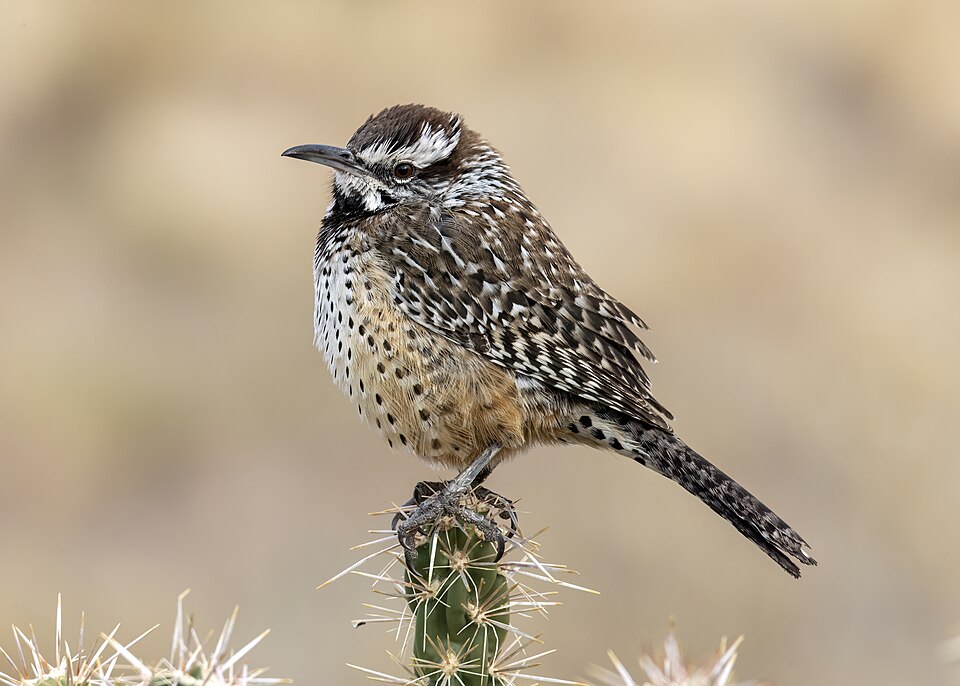
If you have spent any time in the deserts of the American Southwest, you have almost certainly heard the Cactus Wren before you saw it. This is the largest wren in the United States, a chunky, boldly marked bird with a habit of perching right out in the open atop a cholla or a saguaro arm and rattling off its dry, chugging song. Where most wrens are shy skulkers in the undergrowth, the Cactus Wren is brash, curious, and unmistakably at home in the harshest, spiniest country in North America.
It is the state bird of Arizona and a true desert specialist, building its football-shaped nests deep in the protective spines of cholla and other thorny shrubs. Cactus Wrens are non-migratory and form long-lasting pair bonds, so a backyard or wash where you find them in summer is likely the same place you will find them all winter. For desert birders, they are one of the great signature species: loud, confiding, and full of personality.
The Cactus Wren is a big, long-tailed, heavily patterned wren that often sits in the open rather than skulking. At a glance it can recall a small thrush or a sparrow, but the long slightly downcurved bill, the bold white eyebrow, and the boldly spotted underparts give it away.
| Size | The largest North American wren - noticeably bigger and bulkier than a House Wren, roughly sparrow-plus in size |
| Eyebrow | Broad, conspicuous white stripe over the eye (supercilium), one of its most reliable field marks |
| Underparts | Whitish below, heavily marked with dark spots that often concentrate into a dense cluster on the upper breast |
| Upperparts | Brown back and wings barred and streaked with white and black; rufous-brown crown |
| Tail | Long tail barred with black and white, often held cocked but also frequently lowered, unlike many smaller wrens |
| Bill | Long, sturdy, and slightly decurved - longer than the dainty bill of most wrens |
Male vs. female
Male and female Cactus Wrens look essentially alike. There is no reliable plumage difference you can use in the field - both sexes show the same white eyebrow, spotted breast, and barred tail. Males do most of the loud singing from exposed perches, so a bird belting out the full song is more likely to be a male, but this is behavior, not appearance. In the hand, breeding males average slightly larger, but you cannot sex these birds by sight under normal birding conditions.
Juveniles
Juvenile Cactus Wrens resemble adults but look softer and less crisply marked. Their breast spotting is paler and more diffuse rather than the sharp, concentrated cluster of a mature bird, and the eye is duller - adults have a reddish to reddish-brown iris, while young birds show a grayer, browner eye. Juveniles also tend to look a bit fluffier and shorter-tailed early on. By their first fall they are difficult to separate from adults in the field.
The song is the sound of the Sonoran and Chihuahuan deserts: a low, dry, mechanical series often written as chug-chug-chug-chug or char-char-char-char, speeding up slightly and running together into a rolling, gravelly churr. Birders often compare it to a car engine that will not quite turn over, or to an old machine grinding to life. It is unmusical, monotone, and carries surprisingly far across open desert.
Cactus Wrens are also vocal away from full song, giving a variety of harsh, scolding tek and buzzy rrap notes, especially when alarmed or defending territory. Pairs and family groups keep up a near-constant low chatter as they forage. Both sexes call, and the loud advertising song is delivered most persistently by males from cactus tops, fence posts, and rooftops.
The Cactus Wren is a resident of the arid Southwest, found across southern California, southern Nevada, Arizona, southern New Mexico, and parts of west and south Texas, extending south through much of Mexico into Baja California. It is tightly tied to desert and arid scrub - especially the Sonoran, Mojave, and Chihuahuan deserts - where cholla, prickly pear, mesquite, saguaro, and thorny shrubs provide both nest sites and foraging cover.
These wrens are essentially non-migratory. Pairs hold the same territory year-round and rarely wander far, so they are reliable to find in the same washes, scrubby slopes, and desert neighborhoods through all seasons. The main long-term concern for the species is local population decline where coastal sage scrub and desert habitat are lost to development, particularly in coastal southern California.
Cactus Wrens are primarily insectivores, foraging mostly on the ground and in low vegetation for beetles, ants, grasshoppers, wasps, true bugs, spiders, and other invertebrates. They are active, inquisitive foragers - flipping over leaf litter, probing into bark crevices and cactus joints, and turning over small stones and debris with that long bill to flush hidden prey.
They round out the insect diet with seeds, cactus fruit, and other plant material, and will sip nectar and take the pulp of saguaro and cactus fruits in season. Remarkably, Cactus Wrens get much of the water they need from their food, an adaptation that lets them thrive in places with little or no standing water. You may also see them snatching insects from the radiator grilles and windshields of parked cars, a habit that shows just how unbothered they are by people.
The nest is one of the most distinctive in North American birds: a bulky, football- or retort-shaped structure of dried grasses and plant fibers with a side entrance leading through a short tunnel into the nest chamber. Pairs build these almost exclusively in the protection of spiny vegetation - the dense, vicious branches of cholla cactus are a favorite, though they also use thorny shrubs, mesquite, and even yuccas. The spines deter most predators that would otherwise raid the nest.
Both members of a pair build, and a single pair often constructs multiple nests in a territory - some used for raising young and others as roosting nests where adults and fledglings shelter at night and out of the harsh sun. The female lays roughly 3 to 4 eggs (sometimes up to 5 or more), pale pinkish and speckled, and incubates them while the male helps tend the young. In the long desert breeding season pairs commonly raise two or even three broods, often reusing or refurbishing nests between attempts.
The Cactus Wren is not a classic seed-feeder bird, but if you live within its range you can absolutely encourage it to visit and even nest. The key is habitat rather than a feeder - these wrens want native desert plants, insects to hunt, and spiny cover to nest in.
- Plant native cactus and thorny shrubs - cholla, prickly pear, mesquite, and desert hackberry provide both nesting sites and foraging cover that Cactus Wrens depend on.
- Go easy on insecticides. Cactus Wrens are insect hunters; a yard with healthy beetle, ant, and spider populations is far more attractive than a sterile one.
- Skip the seed feeder and offer water instead. A low, shallow ground-level birdbath or dripper can draw them in, especially in the heat of summer.
- Leave some leaf litter and brush. These birds forage by flipping debris on the ground, so a tidy, bare yard gives them nothing to work with.
- Keep cats indoors. Ground-foraging desert birds are vulnerable to outdoor cats, and protecting them makes your yard a safer place to settle.
- Let natural desert landscaping mature. A xeriscaped yard with structure and native plants is one of the best ways to host a resident pair year-round.
- Curve-billed Thrasher: Shares the same desert habitat and a spotted breast, but is larger, longer-tailed, plainer gray-brown overall, lacks the bold white eyebrow, and has a noticeably longer, more strongly curved bill plus a startling orange eye.
- Bewick's Wren: Also shows a bold white eyebrow, but is much smaller, plain gray-brown below without the heavy spotting, and has a longer, more actively cocked and flicked tail.
- Rock Wren: A pale, finely speckled wren of rocky desert slopes; smaller, much grayer, lacks the strong eyebrow and bold breast spotting, and bobs characteristically rather than perching boldly in the open.
- Sage Thrasher: Has a streaked breast that can suggest a Cactus Wren at a glance, but is slimmer, grayer, has a short straight bill and yellow eye, and prefers open sagebrush rather than cactus.
What does a Cactus Wren sound like?
Its song is a low, dry, mechanical series of notes often written as chug-chug-chug or char-char-char that speeds up into a rolling, gravelly churr. People frequently compare it to a car engine struggling to turn over. It also gives harsh scolding tek notes when alarmed.
Where do Cactus Wrens live?
They are year-round residents of the arid Southwest - southern California, Nevada, Arizona, New Mexico, and west and south Texas, south through much of Mexico. They favor deserts and arid scrub with cholla, prickly pear, mesquite, and saguaro.
Why is the Cactus Wren Arizona's state bird?
The Cactus Wren was designated the state bird of Arizona in 1931. It is an iconic and abundant desert species, a fitting symbol of the state's Sonoran Desert landscape, and is widely recognized for its bold personality and loud, distinctive song.
How do Cactus Wrens survive in the desert without much water?
They get most of their water from their food, especially juicy insects and the moist pulp of cactus fruit. This adaptation lets them live in arid country with little or no standing water, though they will use a birdbath when one is available.
Will Cactus Wrens come to a backyard feeder?
They rarely use traditional seed feeders, since they are mainly insect eaters. To attract them, plant native cactus and thorny shrubs, provide ground-level water, avoid pesticides, and leave some leaf litter for them to forage in. Habitat matters far more than a feeder.