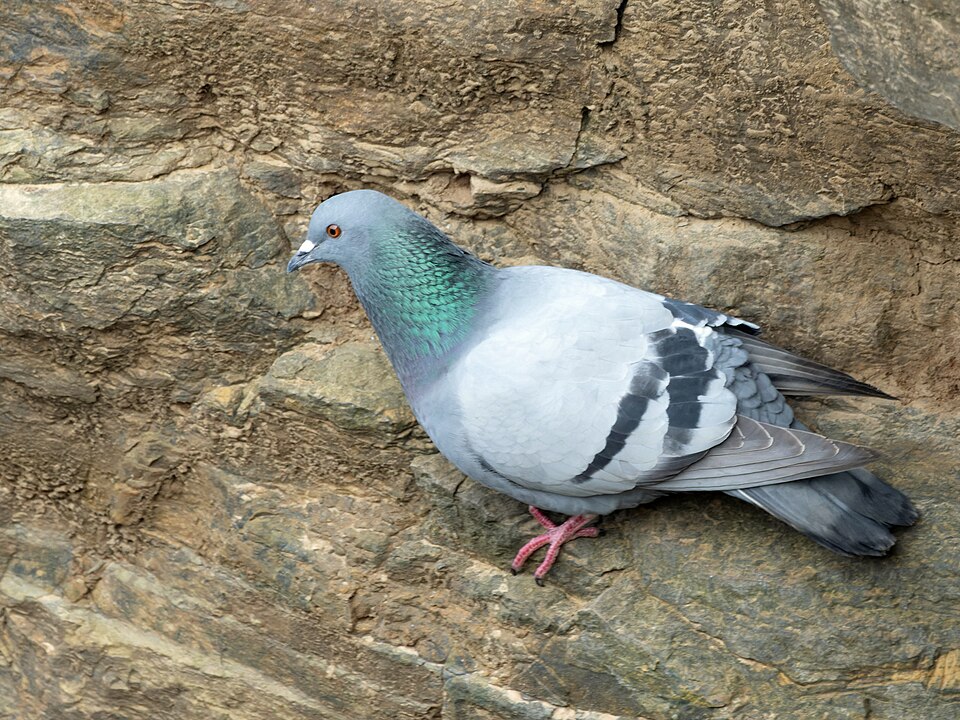
The Rock Pigeon is the bird almost everyone knows even if they have never picked up a pair of binoculars. It is the plump, strutting dove that gathers on city sidewalks, plazas, and parking lots, bobbing its head as it walks and bursting into a clatter of wings when startled. Native to the rocky coasts and cliffs of Europe, North Africa, and southwestern Asia, it was domesticated thousands of years ago and carried around the world. The pigeons we see in towns today are descendants of those escaped and released domestic birds, which is why no two flocks look quite alike.
Despite its everyday familiarity, the Rock Pigeon is a genuinely impressive animal. It is a powerful, fast flier, an extraordinary navigator (the basis of the homing pigeon), and a supremely adaptable survivor that thrives on the ledges and rooftops of human cities much as its ancestors clung to sea cliffs. For backyard birders it offers a daily, close-up lesson in plumage variation, courtship behavior, and the surprising biology hiding in a bird most people walk right past.
The Rock Pigeon is a stocky, full-chested bird with a small rounded head, short legs, and a broad tail. The classic "wild type" plumage is blue-gray overall with a paler gray back, two bold black wingbars, a white rump, and a dark band at the tip of the tail. City flocks, however, come in a riot of colors and patterns, so silhouette and behavior are often more reliable than color.
| Overall shape | Plump, broad-chested body with a small head and short legs; appears top-heavy and waddles when walking |
| Wild-type color | Blue-gray with a paler back, two black bars across each folded wing, and a glossy green-purple sheen on the neck |
| Wingbars | Two distinct black bars on the wing are the most consistent field mark on classic birds |
| Rump and tail | White or pale rump contrasts with a gray tail tipped by a broad black band |
| Bill and cere | Dark bill with a fleshy white knob (cere) at the base over the nostrils |
| Color variants | City flocks include checkered, rusty-red, all-white, all-black, and pied (patchy) birds |
Male vs. female
Males and females look essentially alike and cannot be reliably told apart in the field by plumage. On close birds the iridescent green-and-purple gloss on the neck tends to be a bit more extensive and brilliant on males, and males average slightly larger with a stouter bill, but these are subtle and overlapping. The surest clue is behavior: during courtship the male is the one puffing up his neck, fanning and dragging his tail, spinning in tight circles, and bowing and cooing at a seemingly uninterested female.
Juveniles
Young Rock Pigeons look much like adults but duller and scruffier. They lack the bright iridescent neck sheen, their plumage is more muted and brownish-gray, and the fleshy cere over the bill is grayish rather than the clean white of an adult. The eye is often duller (grayish or brown) compared with the orange-red eye of a mature bird. Because pigeons raise young inside hidden nest ledges and the chicks fledge looking nearly grown, birders rarely see the gawky downy stage that is obvious in many backyard species.
The Rock Pigeon does not sing so much as coo. The familiar sound is a soft, rolling, throaty coo-roo-coo or oor-roo-coo-too-coo, often delivered by a displaying male with his chest puffed and head bowing. It has a moaning, gurgling quality that carries surprisingly well off concrete walls and underpasses.
Just as recognizable is the bird's non-vocal sound: a sharp, slapping clatter of wings as a startled flock explodes into flight. During courtship and territorial display, males also perform a "wing-clapping" flight, snapping the wings together over the back, followed by a stiff-winged glide. These mechanical sounds are as much a part of the pigeon's repertoire as its voice.
In its truly wild form the Rock Pigeon is native to Europe, North Africa, and across to central Asia, where it nests on sea cliffs and rocky inland gorges. Through domestication and escape it now lives feral on every continent except Antarctica, and it is found across virtually all of North America from southern Canada to Central America.
Rock Pigeons are non-migratory. A flock typically spends its entire life within a small home range centered on a reliable food source and a sheltered roost, such as a bridge, grain elevator, barn, or building ledge. They are present year-round wherever they occur, and harsh winters tend to concentrate them around cities, farms, and feed lots rather than pushing them south.
Rock Pigeons are primarily seed and grain eaters. In rural areas they feed heavily on waste grain, weed seeds, and crop spillage around farms and elevators; in cities they have shifted to an opportunistic diet of bread, popcorn, discarded human food, and whatever is scattered in parks and plazas. They will also take small fruits, and occasionally snails or insects.
They feed on the ground in flocks, walking and pecking steadily, and unlike many songbirds they can drink by sucking water continuously rather than tipping the head back. Pigeons are famous for feeding their young "crop milk," a protein- and fat-rich secretion produced in the crop of both parents, which lets them raise chicks even when only seeds are available.
Rock Pigeons nest on sheltered ledges, mimicking the cliff cavities of their wild ancestors. In towns that means building ledges, window sills, bridge girders, rafters, and the recesses of overpasses and abandoned structures. The nest itself is a flimsy, often messy platform of twigs, grass, and debris that the male gathers and the female arranges.
The female usually lays two white eggs, which both parents incubate for roughly 17-19 days. Chicks (called squabs) are fed crop milk and stay in the nest for around a month before fledging. Rock Pigeons are prolific: a pair can raise several broods a year, and in mild climates or warm cities they may breed in nearly every month, which helps explain how readily they fill urban habitat.
The Rock Pigeon is not a classic feeder bird that you set out to attract, and many people actively try to discourage it because flocks can be messy and dominate seed put out for songbirds. That said, it readily comes to ground-scattered grain, and if you want to enjoy them honestly and responsibly, a little goes a long way.
- Scatter cracked corn or whole grains on the ground or a low platform, pigeons feed on the ground and ignore hanging tube feeders
- Offer a wide, shallow water source; pigeons drink heavily and can sip continuously without tipping their heads
- Expect a crowd: pigeons feed in flocks, so even a small amount of grain can draw a dozen or more birds quickly
- To keep them off songbird feeders, use small-port tube feeders or weight-sensitive feeders that exclude heavy birds
- Avoid feeding bread and processed scraps, which offer poor nutrition; cracked corn, millet, and milo are far better choices
- Discourage roosting on your home with spikes or netting if droppings become a problem, feeding and nest-site control are separate decisions
- Mourning Dove: Slimmer and pale brown with a long, pointed tail and black spots on the wing; lacks the pigeon's bold wingbars and heavy build, and gives a mournful cooing whistle
- Eurasian Collared-Dove: Pale sandy-gray and trimmer, with a distinctive thin black half-collar on the back of the neck and a squared-off tail
- Band-tailed Pigeon: A true wild forest pigeon of the West; larger, purplish-gray with a yellow bill tipped black, a white neck crescent, and a pale band across the tail tip
- White-winged Dove: Smaller and warm gray-brown with a bold white stripe along the wing edge that flashes in flight, plus a blue eye-ring
What is the difference between a pigeon and a dove?
There is no strict scientific difference, both belong to the same family (Columbidae). In everyday English, 'pigeon' tends to be used for larger, stockier species and 'dove' for smaller, slimmer ones, but the words are interchangeable. The Rock Pigeon is sometimes still called the 'Rock Dove,' its older name.
Why do pigeons bob their heads when they walk?
The head-bobbing is actually a way of stabilizing their vision. The bird thrusts its head forward, then holds it still while the body catches up, which keeps the image of the world steady long enough to spot food and danger. It only looks like constant bobbing because the walking is so quick.
Are city pigeons the same species as homing and racing pigeons?
Yes. Homing pigeons, racing pigeons, fancy show breeds, and the ordinary birds on city streets are all the same species, Columba livia. The urban flocks are descended from domestic birds that escaped or were released, which is why they show such a wide range of colors and patterns.
Where do pigeons nest in cities?
They nest on sheltered ledges that mimic their ancestral cliff homes, building sills, bridge girders, rafters, signs, and the recesses of overpasses and old structures. The nest is a loose platform of twigs, and a pair will often reuse the same spot for brood after brood.
How long do Rock Pigeons live?
In the wild and in cities most pigeons live only a few years because of predators, vehicles, and disease, though some survive considerably longer. Well-cared-for domestic and racing pigeons can live 10 to 15 years or more, showing the species' real potential lifespan.