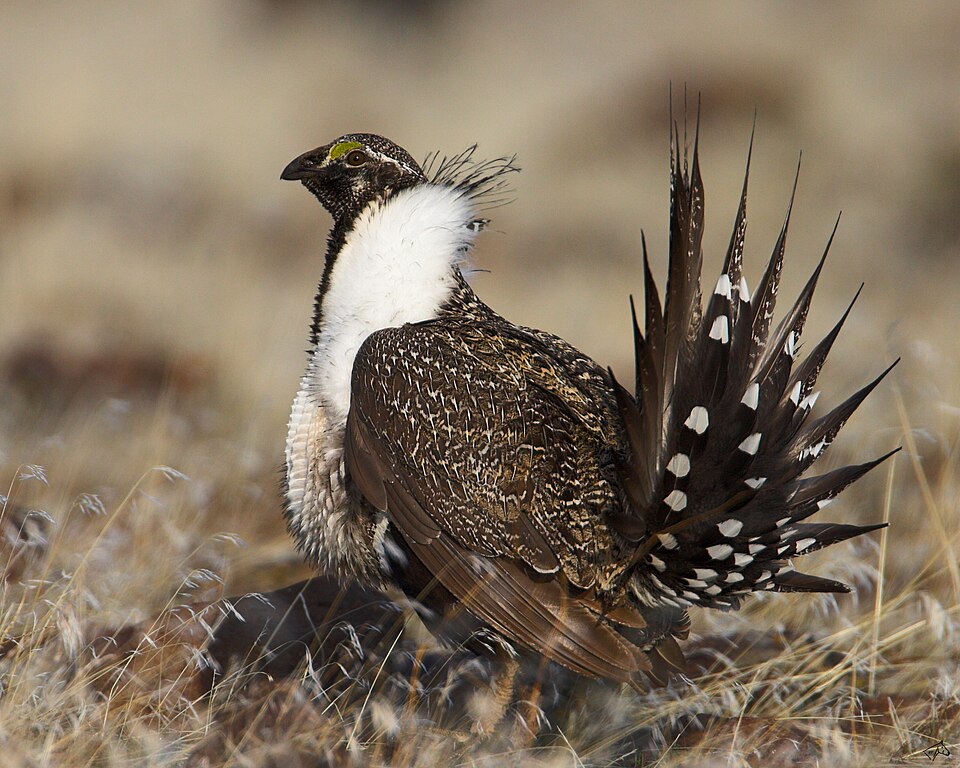
The Greater Sage-Grouse is one of North America's most charismatic and unmistakable birds, a chicken-sized to nearly turkey-sized grouse so tightly bound to sagebrush country that its fortunes rise and fall with the plant itself. Across the high, open basins of the American West, males gather before dawn each spring on traditional dancing grounds called leks, where they puff out twin yellow air sacs on their chests, fan spiky tails into a starburst, and produce a bizarre series of swishes and popping sounds. It is one of the great wildlife spectacles of the continent, and for many birders, witnessing a lek at sunrise is a bucket-list experience.
This is a bird of the wide-open sagebrush steppe, not the backyard. It depends on sagebrush for nearly everything: food in winter, cover from predators, and the structure it needs to nest and raise young. Because that habitat has shrunk and fragmented dramatically over the past century, the species has become a symbol of sagebrush conservation across eleven western states and two Canadian provinces. Where the sage still stretches to the horizon, though, the grouse endures, and an early-spring drive through the right basin can still turn up these big, ground-loving birds flushing low over the brush.
Size alone narrows this bird down fast: it is the largest grouse in North America, with males noticeably bigger and bulkier than females. Look for a heavy-bodied, long-tailed ground bird with a small head, a plump silhouette, and finely patterned grayish-brown plumage that blends perfectly into sagebrush. In flight it looks big and barrel-chested, with rapid wingbeats alternating with glides, and a dark belly patch that shows on both sexes.
| Belly patch | Both sexes show a distinctive black belly that contrasts with the mottled gray-brown body, a reliable mark in flight or on the ground. |
| Tail | Long, pointed tail feathers form a spiky fan; the male spreads them into a dramatic spiked starburst during display. |
| Male throat & chest | Displaying males show a black throat, a white ruff-like collar of stiff breast feathers, and two bare yellow-green air sacs. |
| Eye comb | Males have a fleshy yellow comb above the eye, swelling and brightening during the breeding season. |
| Overall color | Cryptic gray-brown above with fine black, white, and buff vermiculation, superb camouflage in sagebrush. |
| Filoplumes | Displaying males raise thin, hairlike feathers (filoplumes) that stick up dramatically from the back of the neck. |
Male vs. female
Males and females are easy to separate, especially in spring. The male is much larger and heavier, and in display he is unmistakable: black throat, a fluffy white chest ruff, two yellow air sacs, a yellow eye comb, and a long spiked tail held erect. The female is smaller, plainer, and more uniformly cryptic gray-brown, lacking the white chest and yellow bare parts. She has a dark throat that is less sharply defined than the male's and the same black belly patch but none of the showy ornamentation. Outside the breeding season, males still average larger and longer-tailed, but females can be subtle and are best identified by their smaller size and lack of the white breast feathering.
Juveniles
Chicks are precocial, leaving the nest within hours of hatching as small, downy, brownish balls that feed themselves under the hen's guidance. By late summer, juveniles resemble small, dull females, with looser, more mottled body feathers and shorter tails, and they often lack the crisp belly patch of adults. Young males begin showing hints of adult structure, a longer tail and the start of chest feathering, through their first fall and winter, but they typically do not display effectively or breed until their second spring.
Sage-grouse do not sing in the songbird sense; the male's display is a percussion act produced largely by his air sacs. As he struts, he draws in air, swishes his stiff breast feathers against his wings to make a scratchy swish-swish, then rapidly inflates and snaps the two yellow sacs to produce a startling, liquid double plop, often described as a hollow coo-oo-POINK or a pair of deep, bubbling pops that carry surprisingly far across open ground at dawn.
The overall effect is one of the strangest sounds in North American birding: a soft swish followed by a rubbery, popping bounce, repeated over and over by dozens of males at once. Females are mostly quiet but give low clucks and soft cackling notes, and alarmed birds of both sexes may utter a hen-like kuk-kuk-kuk when flushed.
The Greater Sage-Grouse is a year-round resident of the sagebrush steppe across the interior West, from southern Alberta and Saskatchewan south through Montana, Wyoming, Idaho, Nevada, Utah, Colorado, Oregon, and into parts of California, Washington, North and South Dakota, and northeastern corners of neighboring states. Wyoming and Montana hold some of the largest remaining populations. Its range has contracted significantly from historic levels as sagebrush has been lost to agriculture, development, energy extraction, and invasive cheatgrass-fueled wildfire.
Most birds are non-migratory, but many populations make seasonal movements between summer brood-rearing areas, often near moister meadows, and lower or more sheltered sagebrush flats in winter where snow stays shallow enough to expose the shrubs they feed on. Some populations travel considerable distances, tens of miles, between seasonal ranges, while others stay put year-round depending on local terrain and snow.
Sagebrush is the heart of the diet. In winter, adult sage-grouse feed almost entirely on the leaves of sagebrush, which they can digest thanks to specialized gut anatomy; unlike most grouse, they lack a muscular gizzard adapted for grinding hard seeds, so they cannot eat the grain and seeds that sustain other gamebirds. This makes intact sagebrush stands a non-negotiable winter requirement.
In spring and summer the menu broadens to include the leaves, buds, and flowers of forbs (broad-leaved herbaceous plants), and insects become critically important for chicks. Newly hatched young depend heavily on ants, beetles, grasshoppers, and other invertebrates for the protein they need to grow, which is why insect-rich, forb-rich habitat near brood-rearing areas is so vital to the population.
Breeding revolves around the lek. Males gather on these traditional open display grounds before dawn from roughly March into May, competing for status; a few dominant males do most of the mating while many others rarely breed at all. After mating, the female leaves entirely to nest and raise young on her own, males provide no care.
The hen scrapes a shallow nest on the ground, almost always under the protective canopy of a sagebrush shrub, and lines it with grasses, leaves, and feathers. She lays a clutch of roughly six to nine olive to greenish eggs marked with fine brown spotting and incubates them alone for about 25 to 27 days. The precocial chicks leave within a day of hatching and are led by the hen to insect-rich feeding areas, growing quickly through summer. Sage-grouse raise a single brood per year, though a hen may re-nest if her first attempt fails early.
This is not a backyard or feeder bird, and there is no way to attract one to a yard. The Greater Sage-Grouse lives only in large, intact tracts of sagebrush steppe and depends on that habitat year-round. If you want to experience one, the goal is to go to it, and to support keeping its sagebrush home intact.
- Visit a lek at dawn in spring. Many western states maintain designated public lek-viewing sites; arrive well before sunrise from late March to early May and stay in your vehicle, which doubles as a blind.
- Keep your distance and stay quiet. Disturbed males will abandon a lek, ruining the morning for the birds and everyone else. Use binoculars or a spotting scope rather than approaching.
- Never walk onto an active lek. Watch from roads or established viewing areas only, and leave before the birds disperse so you don't flush them.
- Support sagebrush conservation. The single most powerful thing for this species is protecting large, unbroken stands of sagebrush from fragmentation, fire, and invasive cheatgrass.
- Check state wildlife agency listings. Wyoming, Montana, Colorado, and others publish lek-viewing guidance and ethics each spring, a reliable way to find birds responsibly.
- Gunnison Sage-Grouse: Smaller, restricted to a tiny range in southwestern Colorado and southeastern Utah; displaying males have thicker, ponytail-like filoplumes and a different display rhythm.
- Sharp-tailed Grouse: Smaller, paler, with a short pointed tail and white belly (no black belly patch); males show purple, not yellow, neck sacs.
- Dusky Grouse: A forest-edge grouse with a much shorter, rounded dark tail and no chest ornamentation; favors conifer and aspen rather than open sagebrush.
- Ring-necked Pheasant: Introduced gamebird with a very long, thin tail and (in males) iridescent green head and white neck ring; lacks the grouse's stocky shape and black belly.
Where can I see a Greater Sage-Grouse?
Look in the sagebrush steppe of the interior West, Wyoming and Montana hold the biggest populations, with good numbers also in Idaho, Nevada, Oregon, Utah, and Colorado. The best chance is at a public lek-viewing site in spring, where males gather to display at dawn. Several state wildlife agencies publish lek locations and viewing ethics each year.
What is a lek and when is the best time to watch one?
A lek is a traditional open patch of ground where male sage-grouse gather before dawn each spring to strut and compete for mates. The peak viewing window is roughly late March through early May. Arrive well before sunrise, watch from your vehicle, stay quiet, and don't leave until the birds disperse so you don't scare them off the lek.
What is the difference between Greater and Gunnison Sage-Grouse?
They were recognized as separate species in 2000. The Gunnison Sage-Grouse is smaller, lives only in a small area of southwestern Colorado and southeastern Utah, and has a distinctly different display, including thicker, ponytail-like neck plumes and a different sequence of sac pops. The Greater Sage-Grouse is larger and far more widespread across the West.
What do those popping sounds during the display come from?
The deep, rubbery pops come from the male's two bare air sacs on his chest. As he struts, he inflates and rapidly snaps these yellow-green sacs, producing a bizarre liquid plopping sound, combined with a scratchy swish from his stiff breast feathers brushing his wings. Dozens of males doing this at once create one of birding's strangest soundscapes.
Why is the Greater Sage-Grouse declining?
The species depends entirely on large, intact sagebrush, and that habitat has been lost and fragmented by agriculture, development, energy extraction, and wildfires fueled by invasive cheatgrass. Because the birds eat sagebrush leaves through winter and need it for nesting cover, losing the sage directly threatens the population, which is why it is a flagship species for western conservation efforts.