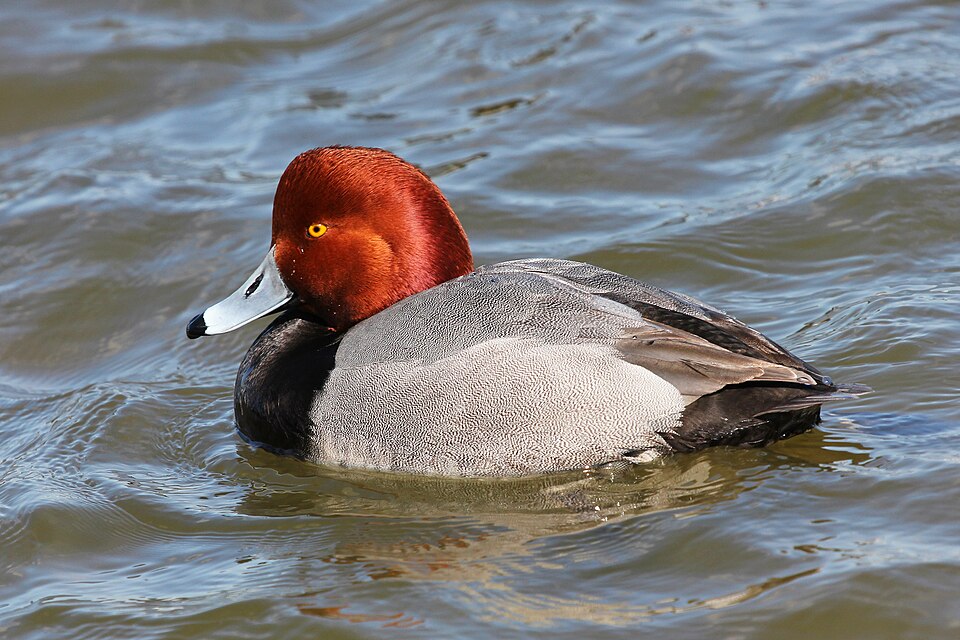
The Redhead is a medium-sized diving duck named for the drake's rich, coppery-cinnamon head, which glows like burnished metal in good light. A member of the genus Aythya (the pochards), it shares the rounded body, broad bill, and rear-set legs of its relatives, all built for diving and feeding underwater rather than dabbling at the surface. In winter, Redheads gather in enormous rafts on coastal bays and large reservoirs, sometimes thousands strong, riding the swells in tight floating flocks.
For birders, the Redhead is a rewarding bird precisely because it is so easily confused with the larger Canvasback. Learning to separate the two on head shape and bill structure is one of the classic challenges of North American waterfowl identification. Redheads breed across the prairie pothole region of the northern Great Plains and intermountain West, where the female's habit of laying eggs in other ducks' nests, a behavior called brood parasitism, makes them an unusually interesting species to study.
Look for a compact, round-bodied diving duck with a distinctly rounded, almost dome-shaped head and a fairly short, broad, blue-gray bill tipped in black. The smoothly rounded head and short neck give the Redhead a softer, more pillowy profile than the angular, long-billed Canvasback. On the water it sits lower than a Mallard, with the tail held close to the surface.
| Head | Drake: glowing coppery-red, rounded and dome-shaped, never angular |
| Bill | Pale blue-gray with a narrow white ring and a clean black tip; short and broad |
| Body (drake) | Pale gray back and flanks contrasting with a black breast and black rear |
| Eye | Drake shows a bright yellow-orange iris; female's eye is dark |
| Female | Warm brown overall with a paler face and throat, plus the same ringed, dark-tipped bill |
| In flight | Gray wing stripe (speculum) rather than white; rapid, direct flight on whistling wings |
Male vs. female
Males and females are easy to tell apart. The breeding drake is unmistakable: a coppery-red head, bright yellow eye, gray body, and black breast and stern. The female is a uniform warm grayish-brown, palest around the face, eye-ring, and throat, with a dark eye. Crucially, both sexes share the same bill pattern, that pale blue-gray bill with a faint white subterminal ring and a sharply defined black tip, which is one of the best ways to confirm a brown bird as a Redhead. In late summer the drake molts into a drab eclipse plumage that resembles the female, though he keeps the yellow eye.
Juveniles
Juvenile Redheads look much like adult females, dressed in plain warm brown with a paler face. Young males begin showing hints of their adult colors through their first fall and winter, with the head gradually warming toward red and the eye brightening from dull to yellow. By their first spring, immature drakes are largely indistinguishable from older males. The bill pattern is present, though often duller, from an early age.
The Redhead drake makes one of the strangest sounds in the duck world: a deep, catlike meow or wrah-wrah, surprisingly low and rolling for such a bird, often given during courtship as he throws his head back. It can genuinely sound like a distant cat, and once heard it is hard to forget.
Females are less vocal but give a low, rough err-err-err or soft growling quack, similar to other Aythya hens. Outside of courtship, Redheads are mostly quiet, and large winter rafts are often silent apart from the rustle of wings and water.
Redheads breed primarily in the prairie pothole region, from the Dakotas and prairie Canada west through the intermountain marshes of the Great Basin, with scattered breeding south into the western United States. These shallow, vegetated wetlands provide the dense emergent cover the females need for nesting.
In winter, the bulk of the population shifts dramatically south and to the coasts. The Laguna Madre of south Texas and the adjacent Mexican coast hold an extraordinary share of the world's Redheads, sometimes the majority of the population in a single region, feeding on seagrass beds in the shallow hypersaline lagoons. Others winter on the Chesapeake Bay, the Gulf Coast, large inland reservoirs, and the lower Colorado River. Migration is largely nocturnal, and birds funnel through the central and Pacific flyways.
Redheads are diving ducks that feed mostly by upending and diving in shallow to moderately deep water. Their diet leans heavily vegetarian compared with many of their relatives. They eat the leaves, stems, seeds, and rhizomes of aquatic plants, and on their famous wintering grounds in the Laguna Madre they specialize on the rhizomes and shoots of shoalgrass and other seagrasses, often feeding in tight aggregations over the beds.
During the breeding season and especially while females are forming eggs, they take more animal matter: aquatic insects, snails, small mollusks, and crustaceans. Ducklings feed heavily on invertebrates. Redheads frequently feed alongside other diving ducks and sometimes loaf in mixed rafts with Canvasbacks, scaup, and coots.
Redheads nest in dense emergent vegetation, typically over shallow water, weaving a bulky bowl of reeds, cattails, and bulrush lined with pale gray down. The female does the building, incubating, and brood-rearing; the drake departs once incubation is well underway.
This species is well known for brood parasitism. Females regularly lay eggs in the nests of other Redheads and, very commonly, in the nests of Canvasbacks and other ducks, leaving the host to incubate them. As a result, clutch sizes in parasitized nests can be inflated, and the species shows a flexible mix of raising its own broods and dumping eggs on neighbors. A female that does incubate her own clutch typically sits about 23 to 29 days, and the precocial ducklings leave the nest within a day of hatching.
The Redhead is not a backyard or feeder bird. It needs open water and dives for aquatic plants and invertebrates, so you will not draw it to a seed feeder or a small garden pond. The way to enjoy Redheads is to go where they are and use the right tools.
- Scan large open water in winter: coastal bays, big reservoirs, and lake edges where rafts of diving ducks gather.
- Bring a spotting scope or good binoculars; rafts often sit far offshore, and bill detail matters for ID.
- Visit prairie pothole marshes in spring and early summer for breeding pairs and the drake's catlike courtship calls.
- Look for Redheads in mixed rafts with Canvasbacks, scaup, and coots, then practice picking them out by head shape.
- If you manage a wetland, protecting dense emergent vegetation over shallow water supports nesting habitat.
- Canvasback: Larger, with a sloping forehead and long black bill that blend into a smooth wedge; back is much whiter and the drake's eye is red, not yellow.
- Greater Scaup: Dark head (glossed green) rather than red, with a blue bill and dark-and-white body; rounder head than Lesser Scaup.
- Lesser Scaup: Purple-glossed dark head with a peaked crown, blue bill, and barred gray back; smaller than a Redhead.
- Ring-necked Duck: Peaked dark head, black back, and a boldly white-ringed bill with a white wedge at the shoulder; lacks the red head.
What is the difference between a Redhead and a Canvasback?
Both drakes have red heads, but the Canvasback is larger, has a sloping forehead that runs straight into a long black bill (a wedge-shaped profile), a whitish back, and a red eye. The Redhead has a rounded, dome-shaped head, a short blue-gray bill with a black tip, a grayer back, and a yellow eye.
Why does a Redhead duck sound like a cat?
During courtship the male Redhead gives a deep, rolling meow that genuinely resembles a cat. It is a normal display call, usually delivered as he throws his head back near a female in late winter and spring.
Do Redhead ducks really lay eggs in other ducks' nests?
Yes. Redhead females are frequent brood parasites, laying eggs in the nests of other Redheads, Canvasbacks, and other ducks. Some females do this in addition to raising their own brood, and parasitized host nests can end up with very large mixed clutches.
Where can I see Redheads in winter?
Look on large open water: coastal bays, the Gulf Coast, Chesapeake Bay, and big inland reservoirs. An enormous share of the population winters in the Laguna Madre of south Texas and northeastern Mexico, feeding on seagrass beds in the shallow lagoons.
Are Redhead ducks a backyard or feeder bird?
No. Redheads are diving ducks that feed on aquatic plants and invertebrates in open water, so they will not come to seed feeders or small garden ponds. To see one, visit lakes, reservoirs, or coastal bays with binoculars or a scope.