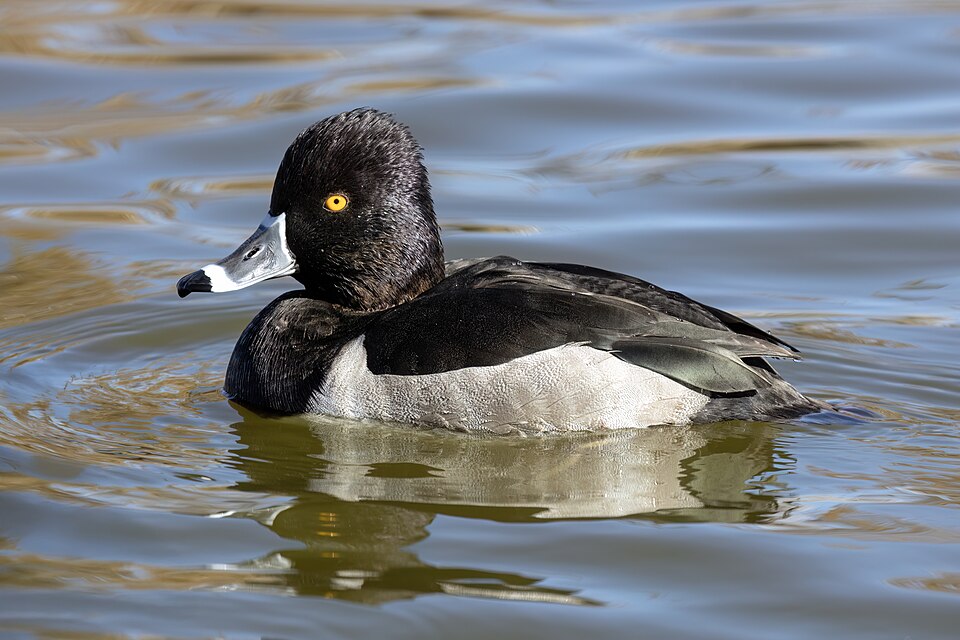
The Ring-necked Duck is one of North America's most widespread diving ducks, yet its name is one of the great misnomers in birding. The "ring" it's named for is a faint chestnut collar on the male's black neck that you'll almost never see in the field. What you will notice is the bold white ring around the bill and the duck's distinctive peaked, angular head shape. Many birders quietly wish it had been called the "ring-billed duck" instead.
This is a bird of freshwater more than salt. Unlike many of its diving-duck cousins that crowd onto coastal bays in winter, Ring-necked Ducks favor wooded ponds, beaver swamps, sewage lagoons, flooded fields, and small lakes, often in small, tight flocks. That habit of using out-of-the-way freshwater spots means a lot of birders first meet this duck on a quiet local pond rather than a famous coastal hotspot. They dive for their food, springing forward and slipping under in a single smooth motion, and they're strong, fast fliers that can launch directly off the water without the long running takeoff that scaup and other divers need.
Ring-necked Ducks are compact, medium-small diving ducks. The single best structural clue is the head: it's tall and distinctly peaked toward the back of the crown, giving the bird an angular, almost triangular profile that's very different from the smooth, rounded heads of scaup. Combine that head shape with a gray bill crossed by a crisp white ring and a white spur that points up the side of the chest, and you've nailed the ID even at a distance.
| Head shape | Tall and peaked toward the rear of the crown, giving an angular silhouette, the most reliable field mark in all plumages. |
| Bill | Gray with a bold white ring near the black tip; males also show a thin white line at the base of the bill. |
| Male body | Glossy black head, chest, and back with pale gray flanks and a vertical white spur rising in front of the wing. |
| Female body | Warm brown overall, paler face, with a white eye-ring and a faint pale line trailing back from the eye. |
| Wing stripe (in flight) | Gray (not white) stripe along the trailing edge of the wing, separates it from scaup, which show white. |
| Size | Smaller and trimmer than a Mallard; about the size of a Lesser Scaup. |
Male vs. female
Males and females look quite different. The breeding male is a striking black-and-gray bird: a glossy, faintly purple-black head, black chest and back, and clean gray flanks, with a vivid white wedge or "spur" rising up the side just ahead of the folded wing. The female is far more subdued, warm grayish-brown with a paler face, a neat white eye-ring, and a faint pale line streaking back from the eye. Both sexes share the peaked head and the white-ringed bill, so once you learn those two marks you can identify a female just as confidently as a male. In late summer, males molt into a drab "eclipse" plumage and look much more female-like, but they keep the bolder bill pattern and slightly darker tone.
Juveniles
Juveniles and first-winter birds closely resemble adult females, overall brown, with a paler face and the diagnostic peaked head. Young birds tend to be even plainer, often lacking a crisp eye-ring and showing a more uniform muddy-brown body. Young males begin acquiring darker feathering on the head and chest through their first fall and winter, so you'll sometimes see in-between birds that are mottled and patchy as they transition toward full adult plumage. The bill ring is usually visible even on young birds, making it a dependable starting point.
Ring-necked Ducks are mostly quiet birds, and you'll see far more of them than you'll ever hear. The female gives a low, growling or purring rrrr call, sometimes rendered as a soft brrt-brrt, especially when alarmed or keeping a brood together. Males are even less vocal, occasionally producing a soft, low whistle or a faint hiss during courtship displays, but nothing carrying or musical.
Because they're so quiet, sound is rarely how birders detect them. Instead, look for the silent, low-riding flocks on small ponds. Any whistling or wheezing notes you hear coming from a mixed raft are far more likely to be wigeon, teal, or other ducks sharing the water.
Ring-necked Ducks breed across the boreal forest and northern wetlands of Canada and the northern United States, favoring beaver ponds, bogs, and shallow marshes ringed by trees. Their breeding range has been expanding eastward and southward over recent decades, and the population is generally considered stable to increasing.
In fall they migrate to winter across the southern and coastal United States, Mexico, and the Caribbean, with concentrations in the Southeast, the Gulf states, the Mississippi Valley, and the West Coast. Migration brings them through nearly the entire Lower 48, so for most North American birders this is a spring and fall bird on local ponds and a winter resident farther south. They're typically among the earlier-arriving spring migrants, often showing up on still-icy ponds while other divers are still moving through.
Ring-necked Ducks are diving ducks, and they feed mostly by submerging to forage on the bottom or among submerged vegetation in shallow water, often shallower water than scaup prefer. Their diet leans heavily vegetarian, especially in fall and winter: seeds, tubers, and the leaves of pondweeds, wild celery, water lilies, and other aquatic plants make up the bulk of what they eat. Because they favor shallow ponds, they sometimes feed by tipping up like a dabbler when the water is shallow enough.
During the breeding season and while raising young, they shift toward more animal matter, aquatic insects, snails, small clams, and other invertebrates, which provides the protein females and ducklings need. They dive with a quick forward roll and stay under for several seconds at a time, popping back up in roughly the same spot.
Ring-necked Ducks nest on the ground or in floating vegetation right at the water's edge, typically well hidden among sedges, grasses, or low marsh plants on a boggy pond or fen. The female builds the nest, a bowl woven from surrounding vegetation and lined with down, often slightly elevated on a hummock or a mat of floating plants so it stays just above the water.
She lays a clutch of about 8 to 10 olive-buff eggs and incubates them alone for roughly 25 to 29 days. The male typically departs once incubation is well underway, leaving the female to raise the brood. The ducklings are precocial, covered in down and able to swim and feed themselves within a day of hatching, and they follow the female to nearby shallow water, where they dive and dabble for insects almost immediately. There is normally a single brood per year.
The Ring-necked Duck is not a backyard or feeder bird, it's a wild diving duck that needs open freshwater. You won't draw one to a seed feeder or a birdbath. But if you have access to a pond, lake, or wetland, you can absolutely make it a regular sight on your local birding patch with a little timing and habitat awareness.
- Watch freshwater, not the coast. Scan small wooded ponds, beaver swamps, flooded fields, and even sewage lagoons, these out-of-the-way spots often hold Ring-necked Ducks when busier lakes don't.
- Time it for migration. Late fall and especially early spring are peak windows across most of the U.S.; they're often one of the first divers back as ice melts.
- If you manage a pond, protect submerged aquatic plants like pondweeds and wild celery and keep some shallow, vegetated edges, that's exactly the food and cover they seek.
- Look for the head shape first. In a mixed raft of ducks, the tall peaked crown lets you pick Ring-necks out before you can even see the bill ring.
- Bring optics. They favor the far middle of ponds and ride low in the water, so a good pair of binoculars or a spotting scope turns a distant dark blob into a clean ID.
- Lesser Scaup: Rounded (not peaked) head, pale blue-gray bill with only a small black tip (no white ring), and whitish flanks rather than gray. Shows a white wing stripe in flight versus the Ring-neck's gray.
- Greater Scaup: Similar to Lesser Scaup but larger with a smoother, rounder head and prefers open and coastal water. Lacks the white bill ring and gray flanks of the Ring-necked Duck.
- Tufted Duck: A Eurasian look-alike rare in North America; male has a drooping head tuft and bright white (not gray) flanks, and lacks the white spur in front of the wing.
- Redhead: Larger with a rounded rusty-red head and a blue-gray bill tipped black; gray (not black) back, and no white spur on the side of the chest.
Why is it called a Ring-necked Duck if you can't see the ring?
The name refers to a faint chestnut band around the base of the male's black neck, which is almost impossible to see in the field and only really visible on a bird in the hand. The much more obvious white ring is on the bill, which is why many birders feel "ring-billed duck" would have been a better name. The neck ring was named by museum scientists working from specimens, not from live birds on the water.
How do I tell a Ring-necked Duck from a scaup?
Look at the head shape and bill first. Ring-necked Ducks have a tall, peaked, angular head, while scaup have a smooth, rounded head. The Ring-neck's bill has a bold white ring near the tip and the male shows gray flanks with a white spur in front of the wing; scaup have whitish flanks and a plain bluish bill with only a black nail. In flight, Ring-necked Ducks show a gray wing stripe and scaup show white.
Are Ring-necked Ducks dabblers or divers?
They're diving ducks, in the genus Aythya along with scaup, Redhead, and Canvasback. They dive underwater to feed on aquatic plants and invertebrates rather than just tipping up at the surface. That said, in very shallow water they will sometimes tip up like a dabbling duck, which can briefly confuse identification.
Where can I find Ring-necked Ducks?
Focus on freshwater. Unlike many diving ducks that winter on coastal bays, Ring-necked Ducks prefer smaller wooded ponds, beaver swamps, marshes, flooded fields, and even sewage lagoons. They breed across the boreal wetlands of Canada and the northern U.S. and winter across the southern and coastal states, Mexico, and the Caribbean, passing through most of the continent during migration.
What do Ring-necked Ducks eat?
Their diet is mostly plant material, seeds, tubers, and leaves of pondweeds, wild celery, water lilies, and other aquatic plants, especially in fall and winter. During breeding and while raising ducklings they eat more aquatic insects, snails, and small clams for protein. They get their food by diving in shallow water, usually staying under for just a few seconds at a time.