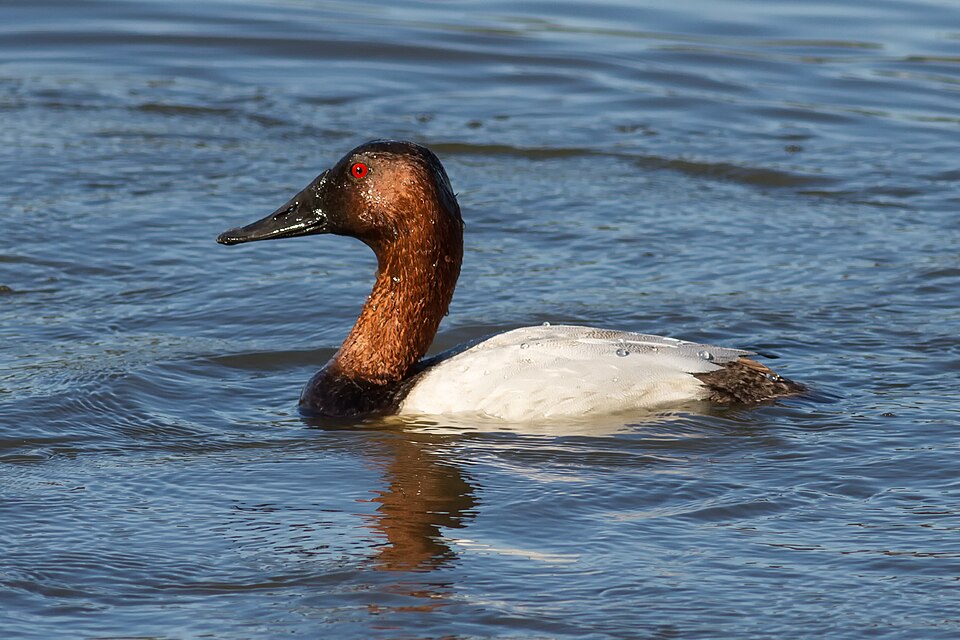
The Canvasback is the aristocrat of North America's diving ducks. Big, long, and built like a torpedo, it carries a distinctive wedge-shaped head that slopes smoothly from the tip of its long black bill all the way up to the crown, with no break or forehead bump. That single feature, more than any color, is what separates a Canvasback from every other duck on the water. Drakes wear a chestnut-red head, a black chest, and a body so pale it can look frosty white at a distance, while the species' scientific name, Aythya valisineria, nods to wild celery (Vallisneria), a favorite food.
Canvasbacks breed across the prairie pothole country and northern marshes of the western United States and Canada, then gather in huge rafts on lakes, reservoirs, and coastal bays in winter. They were once prized as the finest table duck in America, and heavy market hunting plus the draining of wetlands pushed numbers down hard in the twentieth century. Wetland protection and tighter hunting regulations have helped populations recover, though Canvasbacks remain closely tied to the health of their pothole breeding grounds and traditional wintering waters like Chesapeake Bay.
Start with the head and bill, because the Canvasback's profile is unmistakable. The long black bill and the smoothly sloping forehead form one continuous line, giving the bird a sleek, almost reptilian wedge shape. It is a large, heavy-bodied diving duck that rides fairly low and long on the water, often with the neck held a little upright.
| Head profile | Long bill and sloping forehead form a smooth, unbroken wedge, the key field mark in any plumage |
| Male body | Chestnut-red head, black breast and rear, very pale whitish-gray back and sides |
| Female body | Pale grayish-brown body with a warmer tan head and neck; same sloping profile |
| Bill | Long, all-black, and blends straight into the forehead with no notch |
| Eye | Drake has a bright red eye; female's eye is dark |
| Size & shape | Large for a diving duck, long-bodied, sits low in the water |
Male vs. female
Males and females share the telltale sloping head shape but differ sharply in color. The breeding drake has a deep chestnut-red head and neck, a glossy red eye, a black breast and stern, and a pale, almost white back and flanks that gave the bird its name (early hunters thought the back looked like canvas sailcloth). The female is far plainer: a soft grayish-brown body with a warmer tan or buff wash on the head and neck, a dark eye, and the same long sloping bill. In late summer the drake molts into a dull eclipse plumage that resembles the female, but his red eye and slightly cleaner body usually still give him away.
Juveniles
Juvenile Canvasbacks look much like adult females, overall brownish and drab, but tend to be even more uniform and muted, with a grayer cast and a dark eye. Young males begin showing hints of reddish color on the head and a paler back as they mature through their first fall and winter, and by their first spring they approach adult-male plumage. At every age the long bill and sloping forehead remain the most reliable clue to identification.
Canvasbacks are mostly quiet birds, and they are not known for any musical song. During courtship the drake gives a soft, peculiar cooing or dove-like call, sometimes described as a low ik-ik-cooo or a faint oh-h-h that he produces while throwing his head back. Away from courtship, males are largely silent.
Females are more vocal in a duck-like way, giving a low, gruff krrr or a series of harsh cuk-cuk-cuk quacks, especially when alarmed or communicating with young. On the wintering grounds, large rafts produce mostly the rush of wings and quiet background murmurs rather than loud calling.
Canvasbacks breed mainly in the prairie pothole region and boreal marshes of the north-central and western United States, the Canadian prairies, and into Alaska, favoring shallow marshes and pothole wetlands with dense emergent vegetation. They are migratory, moving south as northern waters freeze.
In winter they concentrate on large lakes, reservoirs, rivers, and coastal bays across much of the United States and into Mexico. The Chesapeake Bay, the Mississippi River system, the Gulf Coast, and the lakes and bays of the Pacific Coast all host major wintering flocks. Birders most often see them between fall and early spring, when they gather in tight rafts on open water, sometimes numbering in the thousands.
The Canvasback is primarily a vegetarian among diving ducks, and its diet shifts with the season. It is famous for feeding on the roots, tubers, and shoots of aquatic plants, especially wild celery (Vallisneria) and sago pondweed, foods that historically gave the birds from Chesapeake Bay their celebrated flavor. It dives to the bottom of lakes and bays, often in fairly deep water, and tugs up tubers and rootstocks.
When plant foods are scarce, particularly in some wintering areas, Canvasbacks also eat mollusks (such as clams), aquatic insects, and other invertebrates. During the breeding season, females and ducklings take more animal matter for protein. They forage by diving and dabbling, frequently in large social groups out on open water rather than along the shoreline.
Canvasbacks nest in marshes, building a bulky bowl of reeds, cattails, and other vegetation that is woven into standing plants over shallow water, so the nest floats or is anchored just above the waterline. The female chooses the site, builds the nest, and lines it with down. She typically lays around 7 to 12 grayish or olive eggs and incubates them on her own for roughly three to four weeks.
Like several marsh ducks, Canvasbacks are sometimes targeted by Redhead ducks, which lay their own eggs in Canvasback nests (a behavior called brood parasitism), so a Canvasback hen may end up incubating a mixed clutch. The ducklings leave the nest soon after hatching and can swim and feed themselves quickly, though the female tends them for a time before they fledge.
The Canvasback is not a backyard or feeder bird, it is a deep-diving duck of open marshes, big lakes, and coastal bays, and you won't lure one to a seed feeder or birdbath. The way to enjoy Canvasbacks is to go where they gather and to support the wetlands they depend on.
- Visit large lakes, reservoirs, and coastal bays in fall and winter, when Canvasbacks raft up on open water, bring a spotting scope, since flocks often sit far from shore.
- Scan wildlife refuges and managed wetlands in the prairie pothole region and along major flyways; many host wintering rafts.
- Look for the sloping head profile first, it lets you pick out Canvasbacks even among distant mixed flocks of diving ducks.
- Support wetland conservation and pothole protection (for example through duck and wetland conservation groups), since Canvasback numbers track the health of these habitats.
- If you own pondfront or lakefront property, protecting native aquatic plants like wild celery and pondweed helps the food sources Canvasbacks rely on.
- Redhead: Also has a red head, but with a rounded forehead and a steep, abrupt bill, plus a gray (not whitish) back and a pale blue bill with a black tip.
- Common Pochard: The Canvasback's close Eurasian relative; very similar but smaller, with a rounder head, a less extreme slope, and a darker, grayer back.
- Ring-necked Duck: Much smaller and darker with a peaked, angular head and a ringed gray bill; lacks the long sloping wedge profile.
How do you tell a Canvasback from a Redhead?
Look at the head shape and the back. A Canvasback has a long bill and a forehead that slopes smoothly into it, like a wedge, plus a very pale whitish back. A Redhead has a rounded head with a steep, distinct forehead, a shorter blue-gray bill tipped in black, and a darker gray back. Both drakes have red heads, so shape and back color are the giveaways.
Why is it called a Canvasback?
The name comes from the drake's pale, grayish-white back, which early hunters and market dealers thought resembled the off-white color and weave of canvas sailcloth. The bird's red head and black chest contrast sharply with that 'canvas' back.
Are Canvasbacks rare or endangered?
No. Canvasbacks are listed as Least Concern and are locally common. Their numbers dropped badly in the twentieth century from overhunting and wetland loss, but wetland protection and regulated hunting have allowed populations to recover, though they still depend heavily on healthy marshes and traditional wintering waters.
What do Canvasbacks eat?
They are mostly plant eaters, diving to pull up the roots, tubers, and shoots of aquatic plants like wild celery and pondweed. When those are scarce, especially in winter, they also eat clams and other mollusks, aquatic insects, and invertebrates.
Where can I see a Canvasback?
Look on large lakes, reservoirs, rivers, and coastal bays during fall and winter, where Canvasbacks gather in big rafts on open water. Wildlife refuges along major flyways and famous wintering areas like Chesapeake Bay are reliable spots. A spotting scope helps, since the flocks often sit far offshore.