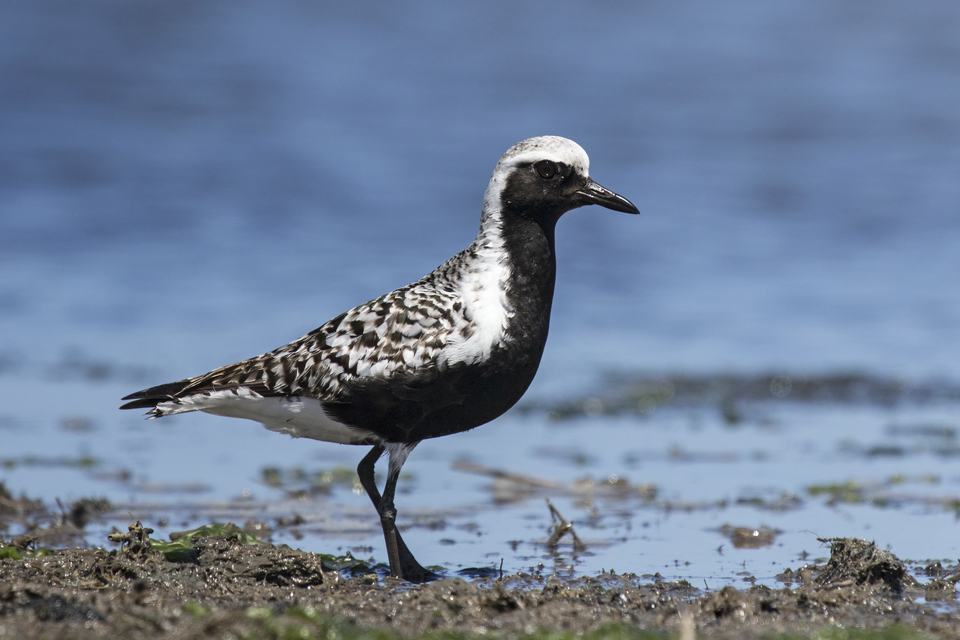
The Black-bellied Plover is the largest and chunkiest of North America's plovers, a stocky, big-headed shorebird that patrols open beaches, tidal flats, and flooded fields with a stop-run-stop gait that is the hallmark of the whole plover family. In its full breeding dress it is one of the most dramatic shorebirds on the continent: a coal-black face and belly set against a frosty silver-and-white back. For most of the year, though, North American birders see it in its plainer gray non-breeding plumage, when it can look almost featureless at a distance. Despite that drabness, it is rarely hard to pick out, because it is bigger, paler, and more upright than the small plovers and sandpipers around it.
This is a true globe-trotter. It breeds on the high Arctic tundra of North America and Eurasia and winters on coastlines across six continents, making it one of the most widespread shorebirds in the world. In Europe and much of the Old World it goes by the name Grey Plover. Wherever it occurs, it tends to be the alert sentinel of the flock, often the first bird to throw its head up and give its plaintive whistle when a falcon or a person comes too close. That wariness, combined with its mournful three-note call, gives it an unmistakable presence on a windswept shore.
Look for a large, round-headed, short-billed plover that stands taller and more hunched than the sandpipers around it. The stout black bill is noticeably heavier than that of a Killdeer or a small plover, and the bird has a faintly hunch-shouldered, big-eyed look. The single most reliable mark works in every plumage and every season: a flash of black in the "wingpit" (the axillaries) when the bird raises its wings or flies.
| Size & shape | Large, stocky plover with a big rounded head, short thick neck, and a stout black bill clearly heavier than a small plover's. |
| Black axillaries | Diagnostic black armpit patches show in flight or when the wings are raised, visible in every plumage and the best single field mark. |
| Flight pattern | Bold white wing stripe, white rump and barred tail, and the black wingpits, a distinctive package overhead. |
| Breeding plumage | Jet-black face, throat, and belly bordered by white; silvery-spangled black-and-white upperparts; white undertail. |
| Non-breeding plumage | Plain pale brownish-gray above and on the breast, whitish belly, dingy face with a pale eyebrow, overall washed-out and gray. |
| Legs & posture | Dark gray legs; stands upright and runs in short bursts, then freezes, the classic plover stop-and-go. |
Male vs. female
In breeding plumage males and females look broadly similar, but males tend to be cleaner and more contrasting, a deeper, more solid black on the face and belly and a brighter, more sharply spangled silver-and-black back. Females usually show a slightly browner or more mottled wash, with some white flecking intruding into the black underparts and a less crisp border. The differences are subtle and overlap, so a lone bird often cannot be reliably sexed in the field. Outside the breeding season the sexes are effectively identical.
Juveniles
Juveniles and first-winter birds are warmer and more patterned than plain non-breeding adults. The upperparts are neatly spangled with small buffy-yellow or whitish spots on a darker ground, giving a scaly, gold-flecked look, and the breast is finely streaked rather than clean gray. This golden spangling can briefly suggest one of the golden-plovers, but the larger size, heavier bill, and, in flight, the black wingpits and white rump quickly settle the matter. By their first spring, young birds molt toward the adult pattern.
The signature sound is a clear, slurred, three-note whistle, often written pee-oo-ee or klee-oo-ee, with the middle note dropping and the last note rising again. It carries a distinctly mournful, plaintive quality that travels well over wind and surf, and it is one of the most evocative sounds of an open shoreline. Birders frequently hear this call before they spot the bird, as a flock lifts off a mudflat or a single sentinel announces an approaching predator.
On the Arctic breeding grounds the male adds a rolling, more musical song during display flights, but this is rarely heard away from the tundra. For most observers, the year-round contact whistle is the only vocalization they will encounter, and learning it is a fast way to detect the species at a distance.
Black-bellied Plovers breed across the high Arctic, in North America from Alaska eastward across the Canadian Arctic islands and coast, and through Arctic Eurasia. They are long-distance migrants that spread out to coastlines around the world for the non-breeding season, reaching as far south as southern South America, Africa, southern Asia, and Australia.
In North America they are common migrants and winter residents along both the Atlantic and Pacific coasts and the Gulf of Mexico, with smaller numbers passing through the interior at lakeshores, flooded fields, and large mudflats. Spring migration peaks in May, and southbound adults move through from July into fall, followed by juveniles. Many non-breeders in their first summer linger on wintering beaches year-round rather than making the long trip back to the tundra, so it is possible to see them on a coast in any month.
This plover is a visual hunter of invertebrates. On tidal flats and beaches it feeds with the classic plover technique: a quick run, an abrupt stop, a pause to watch and listen, then a sudden forward stab to seize prey at or just below the surface. Marine worms (especially polychaetes) are a staple, along with small crustaceans, mollusks, and other invertebrates pulled from the mud and sand as the tide drops.
Inland and on the breeding grounds, the diet shifts toward insects, insect larvae, and other terrestrial invertebrates, and birds will also take small bivalves and worms in flooded fields and lakeshore margins. Black-bellied Plovers often feed well-spaced from one another, defending small feeding patches, and they frequently forage by sight at night as well as by day, taking advantage of low tides whenever they occur.
Nesting takes place on dry, open Arctic tundra, often on slightly raised ground or gravelly ridges with good visibility. The nest is a simple shallow scrape in the ground, sometimes lined with bits of lichen, moss, and small pebbles. Both members of the pair help defend the territory, and the species is well known for vigorous distraction displays and dive-bombing intruders that approach the nest or chicks.
The clutch is typically four eggs, buff to olive and heavily blotched with dark markings that camouflage them against the tundra. Both parents share incubation over roughly three to four weeks. The downy chicks leave the scrape soon after hatching and feed themselves, guarded by the adults until they fledge. Pairs raise a single brood per short Arctic summer before beginning their long southward migration.
This is not a backyard or feeder bird, so you won't draw one in with seed or suet. It's a coastal and wetland specialist, and the way to "attract" it is to go where it is, but a few habits will dramatically improve your odds of finding and watching one well.
- Bird the tide, not the clock. Aim for a falling or low tide on a wide mudflat or beach, when fresh feeding ground is exposed and plovers spread out to forage.
- Scan open beaches, tidal flats, and flooded agricultural fields, anywhere with bare wet ground and a clear sightline is prime habitat.
- Learn the mournful three-note whistle. You will often hear a bird or flock before you see it, especially when something flushes them.
- Watch for the black wingpits as birds raise their wings or fly, it confirms the ID instantly even on a drab winter bird.
- Bring a spotting scope and approach slowly; these are wary birds that flush early, so distance and patience pay off.
- Check coastal flocks of dowitchers, dunlin, and small plovers, Black-bellieds often stand among them as the largest, palest, most upright bird in the group.
- American Golden-Plover: Slimmer and smaller with a more delicate bill; warmer gold-spangled back; lacks the black wingpits and shows dusky (not white) underwings and a less prominent wing stripe in flight.
- Pacific Golden-Plover: Slender, longer-legged, and brighter gold above; like the American it lacks black axillaries and the bold white rump, and shows white extending farther down the flanks in breeding plumage.
- Killdeer: Much smaller and slimmer with two black breast bands, a bright rufous rump, and a long tail; an inland and lawn bird rather than a flat-patrolling beach specialist.
- Red Knot: A plump shorebird that shares mudflats, but it has a longer straight bill, probes rather than runs-and-stops, and shows pale (not black) wingpits and a finely barred gray rump.
Why is it called Black-bellied Plover if the ones I see are gray?
The black belly only appears in full breeding plumage during the nesting season on the Arctic tundra. Most birders see these plovers in fall, winter, and early spring along the coast, when they wear a plain gray non-breeding plumage with a whitish belly, so the name can be confusing outside of summer.
What's the difference between a Black-bellied Plover and a Grey Plover?
They are the same bird (Pluvialis squatarola). 'Black-bellied Plover' is the North American name and 'Grey Plover' is the name used in Britain and much of the Old World, reflecting its plainer non-breeding look there.
How can I tell it apart from a golden-plover?
The fastest check is the wings: Black-bellied Plover shows diagnostic black armpit patches (axillaries) and a bold white rump and wing stripe in flight, while both golden-plovers have plain dusky underwings, no black wingpits, and warmer gold tones on the back. The Black-bellied is also larger with a heavier bill.
Will Black-bellied Plovers come to my backyard or feeders?
No. They are coastal and wetland shorebirds that feed on worms, crustaceans, and insects on open mud, sand, and flooded ground. To see one, visit beaches, tidal flats, or flooded fields at low tide rather than waiting at a feeder.
What does a Black-bellied Plover sound like?
Listen for a clear, mournful, slurred three-note whistle, often rendered pee-oo-ee, with the middle note dropping and the last rising. The plaintive call carries well over wind and surf and is frequently heard before the bird is seen.