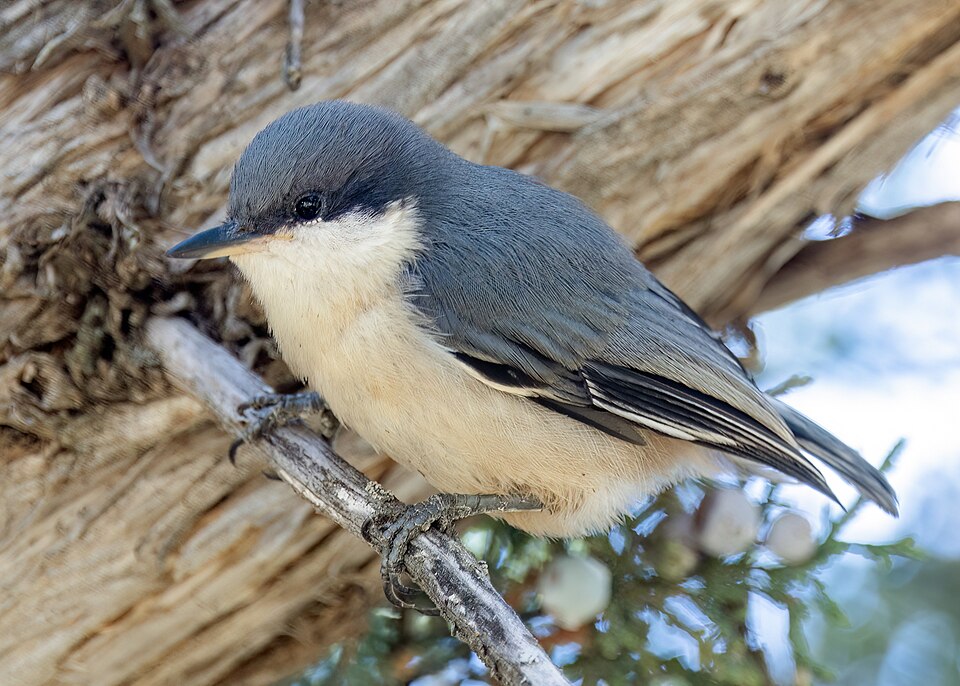
The Pygmy Nuthatch is one of the smallest and most social birds of western North America's pine forests. Barely larger than a kinglet, it spends its days clambering over the trunks, cones, and outer twigs of ponderosa, Jeffrey, and other long-needled pines, often hanging upside down as it probes for insects. Where you find one, you almost always find a flock: this is a bird that lives, forages, and even sleeps in company, and its constant, high-pitched chatter is usually the first thing that gives away a foraging party overhead.
What makes the Pygmy Nuthatch genuinely remarkable goes beyond its size. It is a cooperative breeder, meaning extra adults (often a pair's grown sons from a previous year) help feed and defend the nest. On freezing winter nights, dozens of these tiny birds will pile into a single tree cavity and huddle together, lowering their body temperature to save energy, a survival trick that lets such a small bird endure cold mountain winters. For birders in the West, it is a cheerful, approachable signature species of the pine belt.
This is a compact, almost neckless little bird with the classic nuthatch shape: a large head, short tail, and a sturdy, slightly upturned bill that looks oversized for its body. It moves in short, jerky hops over bark and clusters of pine needles, and frequently feeds while hanging head-downward, a posture that instantly marks it as a nuthatch rather than a warbler or chickadee.
| Crown & nape | Gray-brown cap that extends down to just below the eye, with a paler, slightly grayer back of the neck |
| Eye line | A dark line through the eye separates the cap from the white cheek and throat |
| Underparts | Creamy white to buff below, often with a faint cinnamon wash on the belly |
| Back & wings | Plain blue-gray above, lacking strong patterning |
| Bill | Thin, sharp, slightly upturned, proportionally long for such a tiny bird |
| Size & shape | Tiny, big-headed, and short-tailed; smaller than a chickadee, with a stubbier tail |
Male vs. female
Males and females look essentially alike and cannot be reliably told apart in the field. Both sexes show the same gray-brown cap, dark eye line, white cheeks, and buffy underparts. On close inspection some observers feel the male's cap averages slightly darker or more contrasting, but this is subtle, variable, and not a dependable field mark. For practical backyard and field identification, treat the sexes as identical.
Juveniles
Juvenile Pygmy Nuthatches resemble adults but look a little softer and duller overall, with a browner, less crisply defined cap and slightly fluffier, paler underparts. Freshly fledged young often follow adults closely, begging with fluttering wings and high calls, and because the species breeds cooperatively you may see several adults attending and feeding a single batch of youngsters. By late summer the young are largely indistinguishable from adults.
Pygmy Nuthatches are vocal almost nonstop, and their voice is one of the best ways to locate them. The most common sound is a high, piping pip-pip-pip or wee-bee, wee-bee, given rapidly and repeated as flock members keep in contact. When a feeding party is active, the combined effect is a continuous, squeaky twittering drifting down from the treetops.
They also give an excited, rolling chatter and a softer tit-tit-tit. Compared with the nasal, tin-horn yank-yank of the White-breasted Nuthatch or the higher, faster horn of the Red-breasted, the Pygmy's voice is thinner, squeakier, and far more conversational, often described as sounding like a flock of tiny squeak toys.
The Pygmy Nuthatch is a year-round resident of yellow-pine forests in western North America. Its range stretches from the interior of British Columbia south through the mountains of the western United States, including the Sierra Nevada, the Rockies, the Cascades and coastal ranges, and into the highlands of Mexico. It is closely tied to long-needled pines, especially ponderosa pine, and its distribution tends to mirror that of those forests.
This is a non-migratory species. Birds stay on or near their breeding territories all year, though flocks may wander short distances or drop to slightly lower elevations in harsh winters. Because it does not migrate, finding one is largely a matter of being in the right habitat, the open, mature pine woodland it depends on, rather than catching it during a particular season.
Pygmy Nuthatches eat a mix of insects and seeds, with the balance shifting through the year. In the warmer months they feed heavily on insects and spiders, gleaning beetles, caterpillars, ants, true bugs, and other small prey from pine needles, twigs, bark crevices, and cones. They forage acrobatically out on the slender outer branches and needle clusters, often higher and farther out than other nuthatches, and they regularly hang upside down to reach hidden prey.
In fall and winter pine seeds become an important food. Like other nuthatches, they wedge seeds into bark crevices and hammer them open with the bill, and they will cache surplus seeds for later. They forage almost entirely in flocks and frequently join mixed feeding parties with chickadees, kinglets, and other small songbirds moving through the canopy.
Pygmy Nuthatches are cavity nesters. A pair (often with one or more helper birds) excavates or enlarges a hole in a dead or dying pine, snag, or fence post, or uses an existing natural cavity, old woodpecker hole, or nest box. The cavity is lined with soft material such as plant down, fur, feathers, and shredded bark, and the birds sometimes plug bark crevices around the entrance to insulate it.
The female lays a clutch of roughly 5 to 9 white eggs marked with reddish spots and incubates them while she is fed by her mate and any helpers. After hatching, all the attending adults pitch in to feed the nestlings, one of the clearest examples of cooperative breeding among North American songbirds. Typically a single brood is raised each year. Outside the breeding season, the same cavity-using instinct serves another purpose: large groups roost together in tree holes to share warmth on cold nights.
If you live in or near western pine country, you can absolutely draw Pygmy Nuthatches to your yard. They visit feeders readily, especially for high-energy foods, and they take to nest boxes. The key is habitat: yards near mature ponderosa or other yellow pines, with dead limbs or snags left standing, are far more likely to host them than treeless suburban lots.
- Offer black-oil sunflower seeds and suet, their favorite feeder foods, especially in fall and winter.
- Put up a small nest box with an entrance hole around 1.25 inches, mounted on a pine trunk or post; they will also use it for winter roosting.
- Leave dead limbs and snags standing where safe, since they nest and roost in natural and excavated cavities.
- Plant or preserve native pines, particularly ponderosa, the heart of this bird's habitat.
- Provide peanut bits and peanut butter blends at a hopper or platform feeder for extra protein and fat.
- Add a water source such as a shallow birdbath, which busy flocks use for drinking and bathing.
- Red-breasted Nuthatch: Has a bold black-and-white striped face with a strong white eyebrow and rusty underparts; the Pygmy has a plain gray-brown cap, dark eye line, and buffy-white belly.
- White-breasted Nuthatch: Much larger, with a clean white face and bright white underparts; gives a nasal yank-yank rather than the Pygmy's high squeaky twitter.
- Brown-headed Nuthatch: Nearly identical in size and habits but a southeastern pine specialist; ranges do not overlap, so location alone usually separates them.
- Mountain Chickadee: Shares western pine forests but has a black cap and bib with a white eyebrow, a longer tail, and a buzzy chick-a-dee call; it does not creep head-down on trunks.
How is a Pygmy Nuthatch different from other nuthatches?
It is the smallest of the common North American nuthatches and the most tied to long-needled pines. It has a plain gray-brown cap with a dark eye line and buffy underparts, rather than the rusty belly and striped face of the Red-breasted or the clean white face of the larger White-breasted Nuthatch. It is also far more social, traveling in noisy flocks year-round.
Where can I see a Pygmy Nuthatch?
Look in open, mature pine forests across the western United States, southwestern Canada, and the mountains of Mexico, especially anywhere ponderosa pine grows. They are non-migratory residents, so the right habitat will hold them year-round. Scan and listen high in the pines, where their constant squeaky chatter usually gives them away.
Do Pygmy Nuthatches come to bird feeders?
Yes. In or near pine country they readily visit feeders for black-oil sunflower seeds, suet, and peanuts, particularly in fall and winter. Yards with nearby mature pines have the best odds, since the birds rarely stray far from that habitat.
Why do Pygmy Nuthatches gather in large groups?
They are highly social and benefit from flocking in several ways. Foraging together helps them find food and detect predators, they breed cooperatively with extra adults helping at the nest, and on cold nights dozens may roost huddled in a single tree cavity, lowering their body temperature to conserve heat.
What does a Pygmy Nuthatch sound like?
Its voice is a high, thin, piping series often written as pip-pip-pip or wee-bee, wee-bee, repeated rapidly. An active flock produces a steady squeaky twittering from the treetops, much higher and more conversational than the nasal yank of a White-breasted Nuthatch.
Will Pygmy Nuthatches use a nest box?
They will. A small box with an entrance hole around 1.25 inches, mounted on a pine trunk or post in suitable habitat, can attract a nesting pair, and the birds may also use it as a communal roosting spot on cold winter nights.